
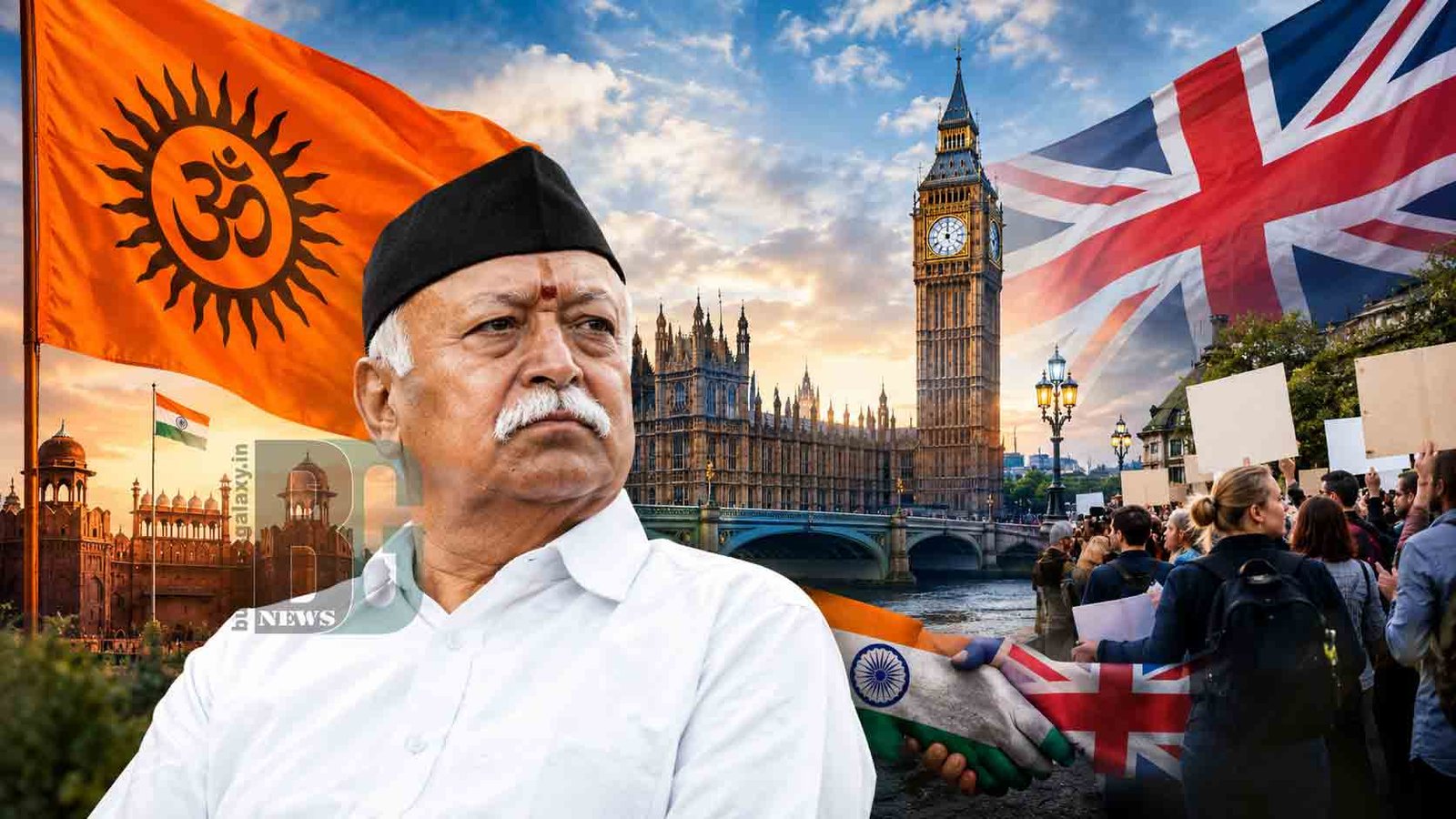
LONDON: Rashtriya Swayamsevak Sangh (RSS) chief Mohan Bhagwat’s recent international outreach has triggered protests and political debate, particularly in the United Kingdom, following similar demonstrations during his visit to the United States.
Bhagwat’s overseas tour was organised as part of the RSS’s centenary year activities and included engagements with members of the Indian diaspora and community organisations.
Protests in London
- During Bhagwat’s UK visit, several civil society and community organisations opposed his programmes in London.
- Reports said around 20 organisations raised objections to the visit and urged authorities and institutions to distance themselves from RSS related events. Groups including Hindus for Human Rights, the UK-Indian Muslim Council and the South Asia Solidarity Group were among those expressing opposition.
- Critics have raised concerns about the RSS’s ideology and its views on Indian society, minorities and the concept of Hindutva. Some opponents have also accused the organisation of contributing to social divisions in India.
- These are the views and allegations expressed by the protesting groups and should not be treated as established facts without independent evidence.
Controversy Over London Gurdwara Visit
- Another major point of debate was Bhagwat’s visit to the Khalsa Jatha British Isles Gurdwara in central London on September 6.
- The visit generated criticism among sections of the Sikh community because of the RSS’s ideological and historical relationship with Sikh institutions and debates surrounding its views on Indian identity.
- However, Sikh businessman Peter Virdee and Rajya Sabha MP Vikramjeet Singh Sahney defended their participation in the visit.
- They said a gurdwara is open to people from different backgrounds and that welcoming Bhagwat should not automatically be interpreted as supporting the RSS or its ideology.
- The disagreement therefore reflects two different views: supporters describe the meeting as an opportunity for dialogue and community engagement, while critics say providing a platform to Bhagwat gives legitimacy to an organisation they strongly oppose.
RSS Responds to the Opposition
- The RSS has rejected the idea that the international outreach is intended to create division.
- RSS spokesperson Sunil Ambekar said democratic societies naturally have different viewpoints and that the organisation is open to dialogue with those who disagree with it.
- The RSS has described Bhagwat’s overseas programme as an effort to promote social harmony, peace, unity and the philosophy of “Vasudhaiva Kutumbakam”, or “the world is one family.”
- The organisation has also said that its doors remain open for discussions with critics.
Why Is Bhagwat’s Visit Controversial?
- The controversy is largely connected to the wider debate surrounding the RSS and its ideology.
- Supporters of the organisation describe the RSS as a cultural and social organisation working on community service, national unity and social harmony.
- Critics, however, argue that the organisation’s Hindutva ideology has implications for India’s religious minorities and accuse it of contributing to majoritarian politics.
- These disagreements have existed for decades and have become particularly visible during Bhagwat’s international outreach, where supporters and opponents have sought to present different views of the RSS to the Indian diaspora.
From the US to the UK
- Bhagwat’s New York programme on August 29 also attracted protests outside the venue.
- The subsequent demonstrations in London have therefore added to a wider debate over the RSS’s international outreach and how its message is received among Indian origin communities abroad.
- At the same time, Bhagwat has also received support from sections of the Indian diaspora and community leaders during his overseas engagements. Reports from London indicate that the response has not been uniform.
A Debate Over Dialogue and Representation
- The controversy has now developed into a broader discussion about whether organisations with strongly contested political or ideological reputations should be given platforms at community and religious institutions.
- Supporters argue that dialogue requires engaging with people who hold different views. Opponents argue that engagement can also be seen as legitimising an ideology they believe has harmed minority communities.
- For now, the RSS says it is willing to engage with critics, while organisations opposing Bhagwat’s visit continue to voice their concerns.
- The developments highlight the continuing debate surrounding the RSS, Hindutva, minority rights and the organisation’s growing engagement with Indian communities outside India.