

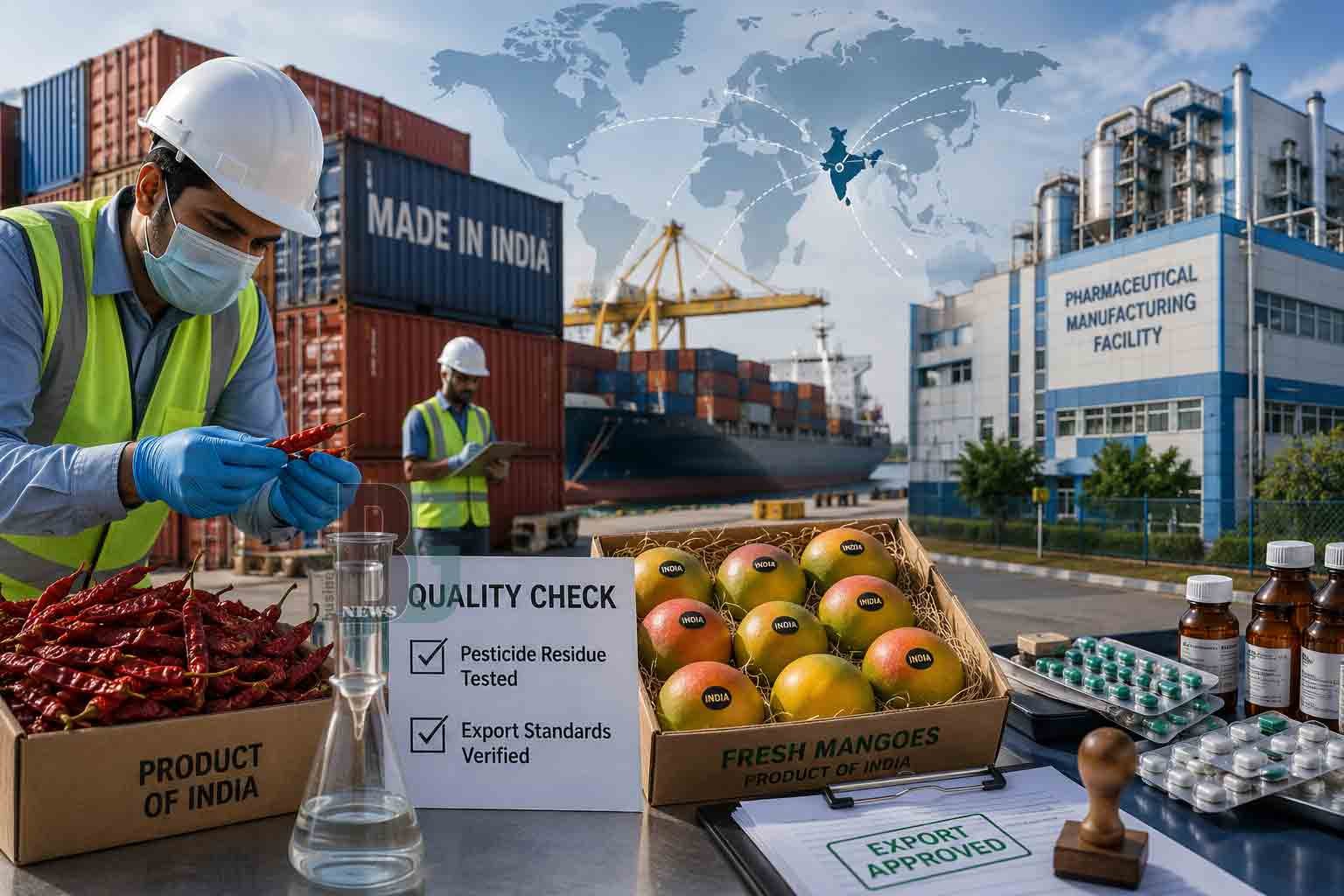
A series of recent developments involving Indian export consignments has reignited debate over the country’s quality control systems and preparedness to meet increasingly stringent global standards.
China has temporarily suspended three Indian chilli exporters after detecting excessive levels of methamidophos, a pesticide residue, in chilli consignments shipped from India. The move has drawn attention to the importance of maintaining strict compliance with international food safety regulations.
The development follows another setback for Indian agricultural exports, with Japan suspending imports of fresh Indian mangoes after identifying deficiencies in pest control and treatment procedures at approved export facilities. The decision affected several popular Indian mango varieties during the peak export season and highlighted the growing emphasis placed by importing countries on phytosanitary compliance and process integrity.
Meanwhile, in the pharmaceutical sector, the US Food and Drug Administration (FDA) has issued an import alert affecting products manufactured at a Dabur India facility in Dadra and Nagar Haveli. The action followed inspections that flagged concerns related to manufacturing practices, data integrity, and maintenance standards. Dabur has stated that it is cooperating with the regulator and implementing corrective measures.
While these incidents involve different industries and regulatory frameworks, they collectively underscore a broader challenge facing Indian exporters: sustaining international confidence through consistent adherence to quality benchmarks.
India has set ambitious targets to expand its presence in global markets, positioning itself as a reliable alternative in international supply chains. However, industry experts argue that competitive pricing alone may not be sufficient to secure long-term growth. Increasingly, global buyers are prioritising factors such as traceability, regulatory compliance, product safety, and process transparency.
Export setbacks can carry consequences beyond individual businesses. A rejected shipment may lead to enhanced scrutiny of future consignments, increased compliance costs, and reputational damage for entire sectors. In highly competitive markets, even isolated lapses can influence buyer perceptions and market access.
At the same time, analysts caution against viewing these incidents as evidence of a widespread systemic failure. Many Indian exporters continue to meet rigorous international standards and successfully supply products to demanding markets around the world. Nevertheless, the recent cases highlight the need for stronger monitoring mechanisms, better farmer and manufacturer awareness, and continuous investment in quality assurance systems.
As India seeks to strengthen its position as a global export powerhouse, experts say the next phase of growth will depend not only on production capacity and cost competitiveness but also on the ability to deliver products that consistently meet international expectations.
In an increasingly interconnected marketplace, credibility and compliance may prove to be among India’s most valuable export assets.