
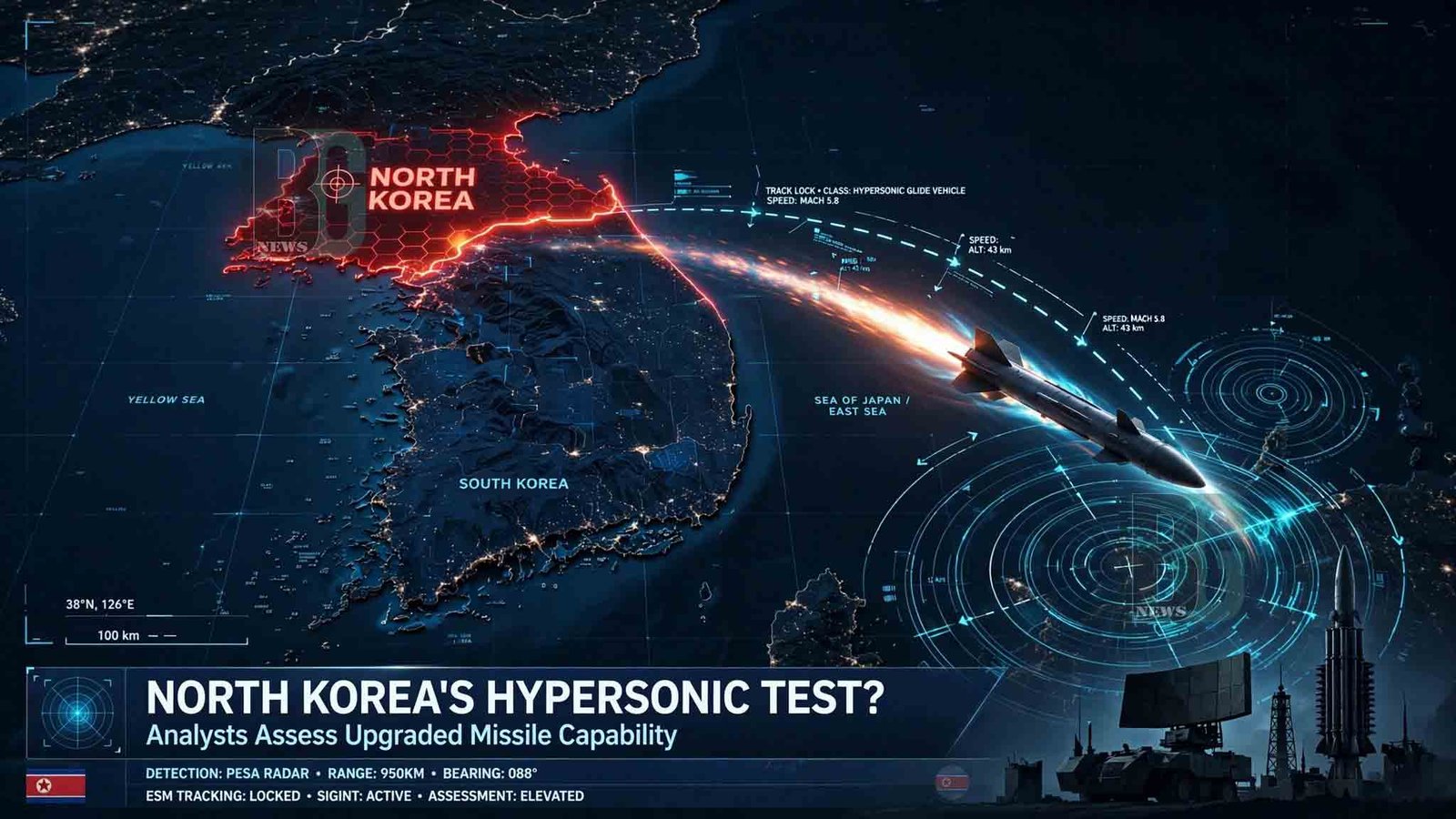
North Korea appears to have tested an upgraded hypersonic weapon that could be more difficult for existing missile defence systems to track and intercept, according to analysts cited by AFP.
South Korea and Japan said North Korea launched two short range ballistic missiles from its east coast on September 20. The missiles travelled approximately 450 kilometres and more than 600 kilometres respectively before falling into waters in the East Sea.
North Korea later confirmed that its missile bureau had successfully tested a “New type of weapon” describing the test as a demonstration of advanced defence technology. However, Pyongyang did not officially identify the weapon as hypersonic.
Images released by North Korean state media showed leader Kim Jong Un observing the test. A screen displayed what appeared to be a flight trajectory labelled Hwasongpho-11Ma-1, leading analysts to assess that the system could be an upgraded version of North Korea’s previously demonstrated hypersonic short-range ballistic missile.
Analysts cited by AFP said the missile could have a range of around 450 to 600 kilometres, potentially putting key military facilities across the Korean Peninsula within its reach.
One important feature of hypersonic glide technology is its ability to manoeuvre during the later stages of flight. Analysts said such manoeuvring, combined with high speed, could make the weapon more difficult to track and intercept than a conventional ballistic missile.
However, analysts also cautioned that a single successful test does not establish that the system has reached full operational capability. Questions remain about the missile’s actual performance, including the consistency of its claimed hypersonic characteristics.
North Korea’s state media reported that Kim Jong Un viewed the weapons development as an important advance in modernising the country’s military. He also warned that the weapon would increase the pressure on its adversaries.
The latest test comes amid continuing tensions on the Korean Peninsula and efforts by South Korea and the United States to maintain or revive diplomatic engagement with Pyongyang.
The development also comes as North Korea continues to strengthen its military and strategic relationship with Russia, while maintaining its nuclear and missile programmes.
For now, the key assessment from outside analysts is that North Korea may have demonstrated an upgraded manoeuvrable missile capability, but the extent of its operational effectiveness remains to be independently established.