
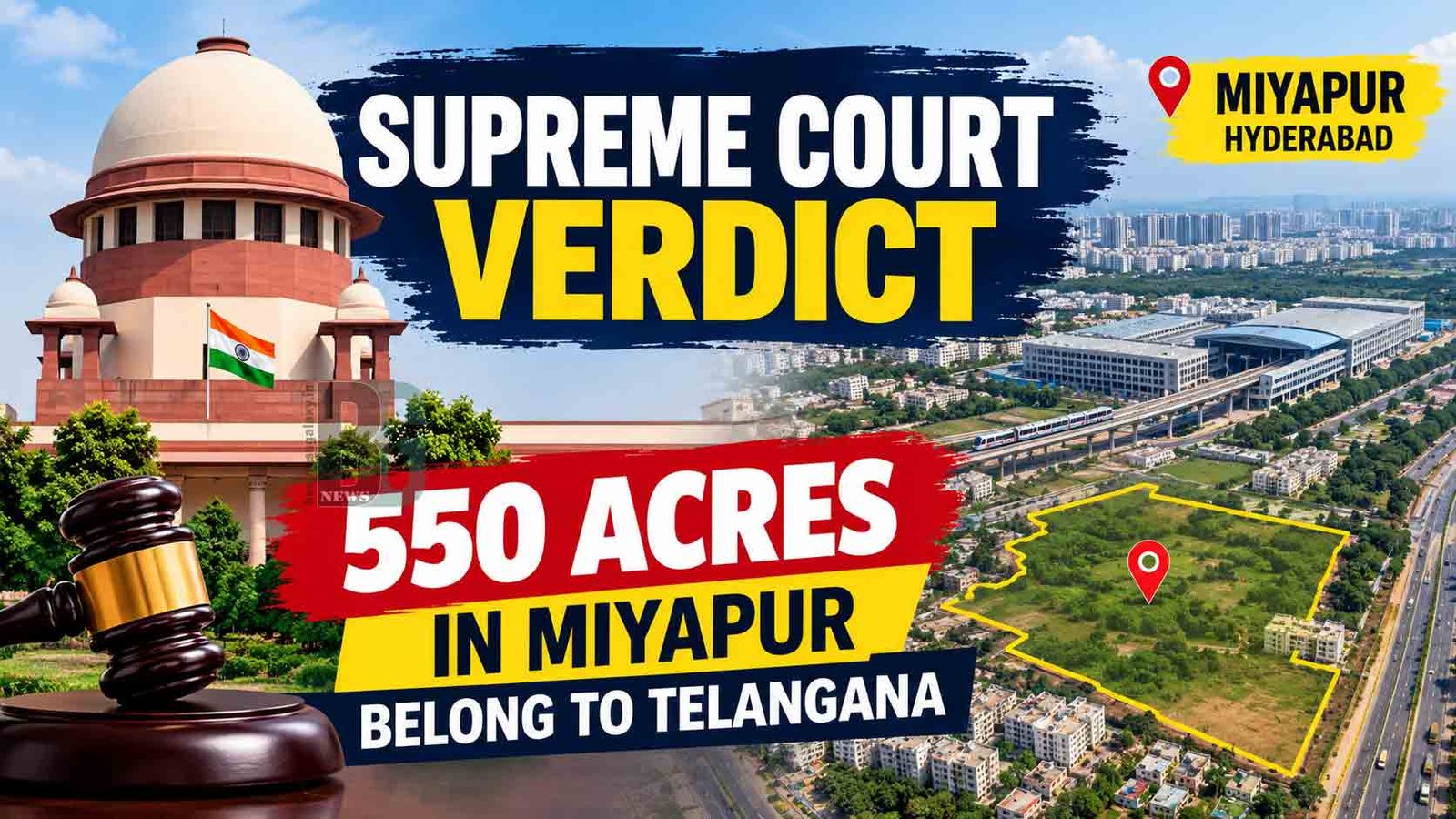
Hyderabad: The Supreme Court of India has upheld the Telangana government’s ownership of approximately 550.39 acres of disputed land in Miyapur, Hyderabad, dismissing a batch of appeals filed by private individuals and housing societies claiming ownership of the property.
The judgment, delivered on October 29, 2026, brings a major development in a long running legal dispute that continued for more than 23 years. The disputed land is located in Survey Nos. 100 and 101 of Miyapur village in Serilingampally Mandal, Ranga Reddy district.
A Supreme Court bench comprising Justice M.M. Sundresh and Justice Satish Chandra Sharma dismissed the appeals and upheld the earlier judgment of the undivided Andhra Pradesh High Court dated April 16, 2003, which had recognised the state government’s ownership of the land.
550 Acres Classified as Government Land
According to historical land records, the disputed property was classified as ‘Sarkari Poramboke’, meaning government land, following a survey conducted in 1912.
The disputed area comprises:
- Survey No. 100: 277 acres and 5 guntas.
- Survey No. 101: 273 acres and 34 guntas.
- Total: 550 acres and 39 guntas.
The land is located in a prime area of Miyapur, adjoining National Highway 65. The Hyderabad Metro Rail depot is also situated within the larger disputed land parcel.
Dispute Involving Historical Jagir Rights
- The private claimants relied on historical grants, inheritance claims, revenue records and other documents to establish their ownership.
- One of the central issues concerned the historical Paigah estates and a grant associated with Rafi-un-nisa Begum during the Nizam’s rule.
- However, the Supreme Court explained that a Jagir grant primarily concerned rights over land revenue and did not automatically establish ownership of the property.
- The court also considered the Andhra Pradesh (Telangana Area) (Abolition of Jagirs) Regulation, which came into effect on August 15, 1949. Under the regulation, the Jagir lands vested in the state, and the former Jagirdars entitlement was limited to the applicable commutation compensation.
Supreme Court Questions Revenue Entries
- A significant part of the judgment concerned revenue records from the early 1950s.
- The court examined entries in the Pahanies for 1950-51, 1951-52 and 1952-53, in which the name of Raheemunissa Begum appeared in the Pattadar column.
- However, the court found that these entries lacked supporting transfer or mutation proceedings and were not reflected in other corresponding official records.
- The bench upheld the findings that the entries were unauthorised and bogus, resulting from fraud and collusion with revenue officials.
- The court also rejected claims based on alleged historical purchases, inheritance documents and adverse possession, finding that the appellants had failed to establish valid ownership.
Earlier Court Decisions
- The dispute had already been examined by the Special Court constituted under the Andhra Pradesh Land Grabbing (Prohibition) Act, 1982.
- In 1997, the Special Court ruled in favour of the government in the relevant proceedings. The then Andhra Pradesh High Court subsequently upheld the government’s ownership in its common judgment dated April 16, 2003.
- The private claimants challenged the High Court’s decision before the Supreme Court. The appeals remained pending for more than two decades.
- With the Supreme Court dismissing the appeals, the earlier findings recognising the state’s ownership have been upheld.
Land Value and Government Implications
- The disputed land is considered a highly valuable public asset because of its location in the rapidly developing Miyapur area.
- Media reports have placed its estimated value at around ₹25,000 crore, although other reports have cited higher estimates. The exact market valuation has not been independently established in the judgment.
- The ruling strengthens the state’s legal position over the disputed property and is significant for the protection of government land and public assets.
- The judgment also brings renewed attention to the need for accurate revenue records, proper land administration and protection of public property from unauthorised claims.
- The Supreme Court dismissed the connected appeals and applications for intervention and impleadment without awarding costs.
Source: Supreme Court judgment dated October 29, 2026; Law Trend; Deccan Chronicle; The Times of India.