

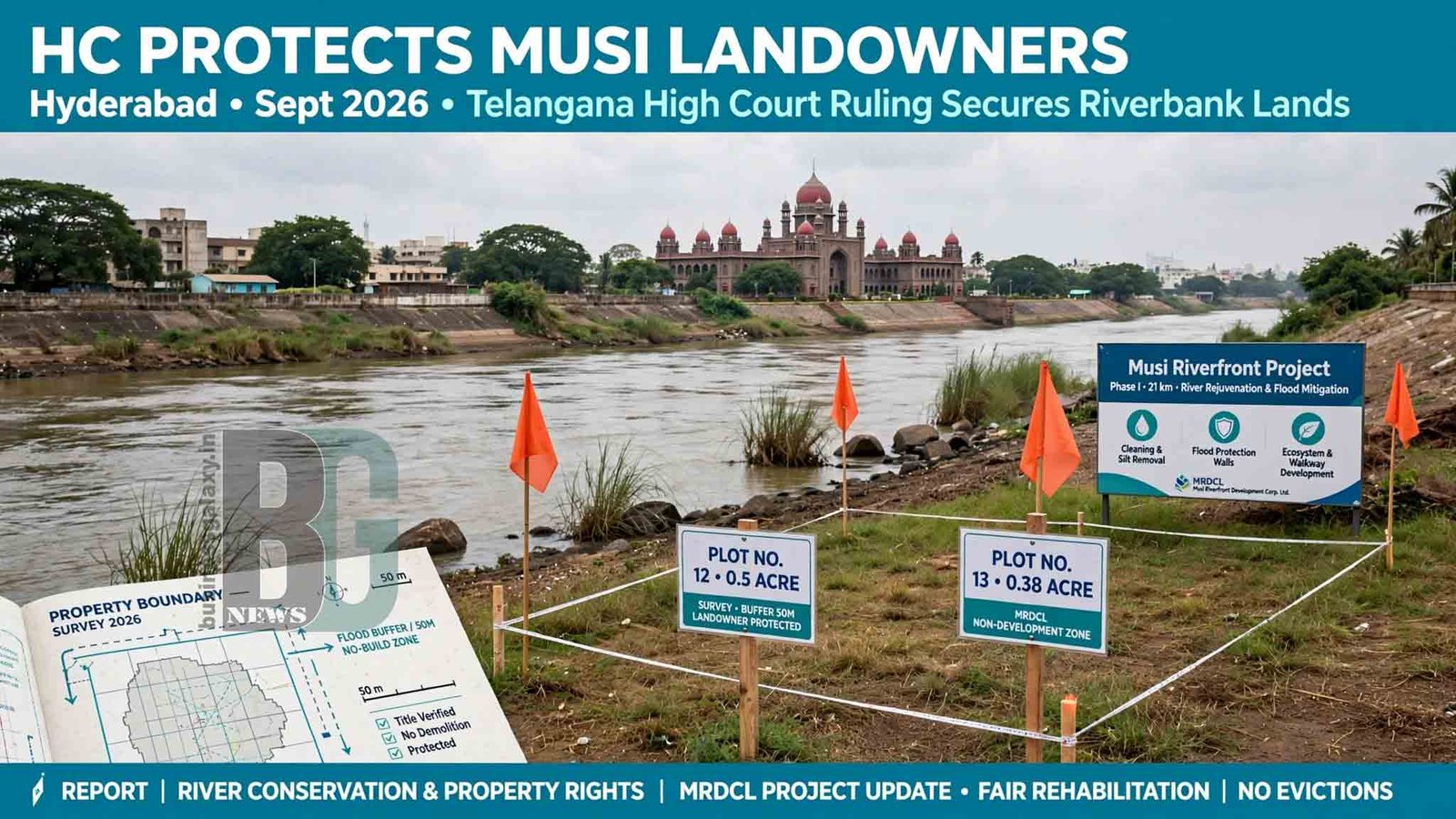
The Telangana High Court has granted interim relief to a group of landowners affected by the proposed Musi Riverfront Development Project. The court directed government authorities not to evict or remove the petitioners from their land until the next hearing.
Justice K. Sarath passed the order after hearing a petition filed by I. Prabhakar Reddy, Atibhumi Holdings Private Limited, Sahasra Infra Private Limited and S.C. Mohan Reddy.
What is the dispute?
- The petitioners claim ownership of around 9 acres and 8¾ guntas of land in Dargah Khaleej Khan village, Gandipet Mandal, Ranga Reddy district.
- They approached the High Court challenging the government’s steps to acquire their land for the Musi Riverfront Development Project.
- The petitioners also challenged G.O.Rt. No. 921, issued on December 16, 2025, which relates to an exemption given to the Musi Riverfront Development Project under the land acquisition law.
Court seeks government response
- The High Court has directed the Telangana government, Ranga Reddy District Collector, revenue authorities and Musi Riverfront Development Corporation Limited to respond to the petition.
- The authorities have been given two weeks to file their responses.
- Until the next hearing, the authorities have been directed not to dispossess the petitioners from the disputed land.
What does this mean?
- The court’s order is temporary and does not mean that the land acquisition has been cancelled.
- In simple terms, the affected landowners can continue to remain on their properties for now. The government cannot remove them from the disputed land until the matter is considered further by the court.
- The final decision on the legality of the land acquisition will be taken later.
Musi Riverfront Project
- The Telangana government is planning a major redevelopment of the Musi River and its surrounding areas. The project aims to improve the river corridor, infrastructure, public spaces, greenery and connectivity.
- However, land acquisition has become an important issue, with some property owners challenging the government’s actions in court.