
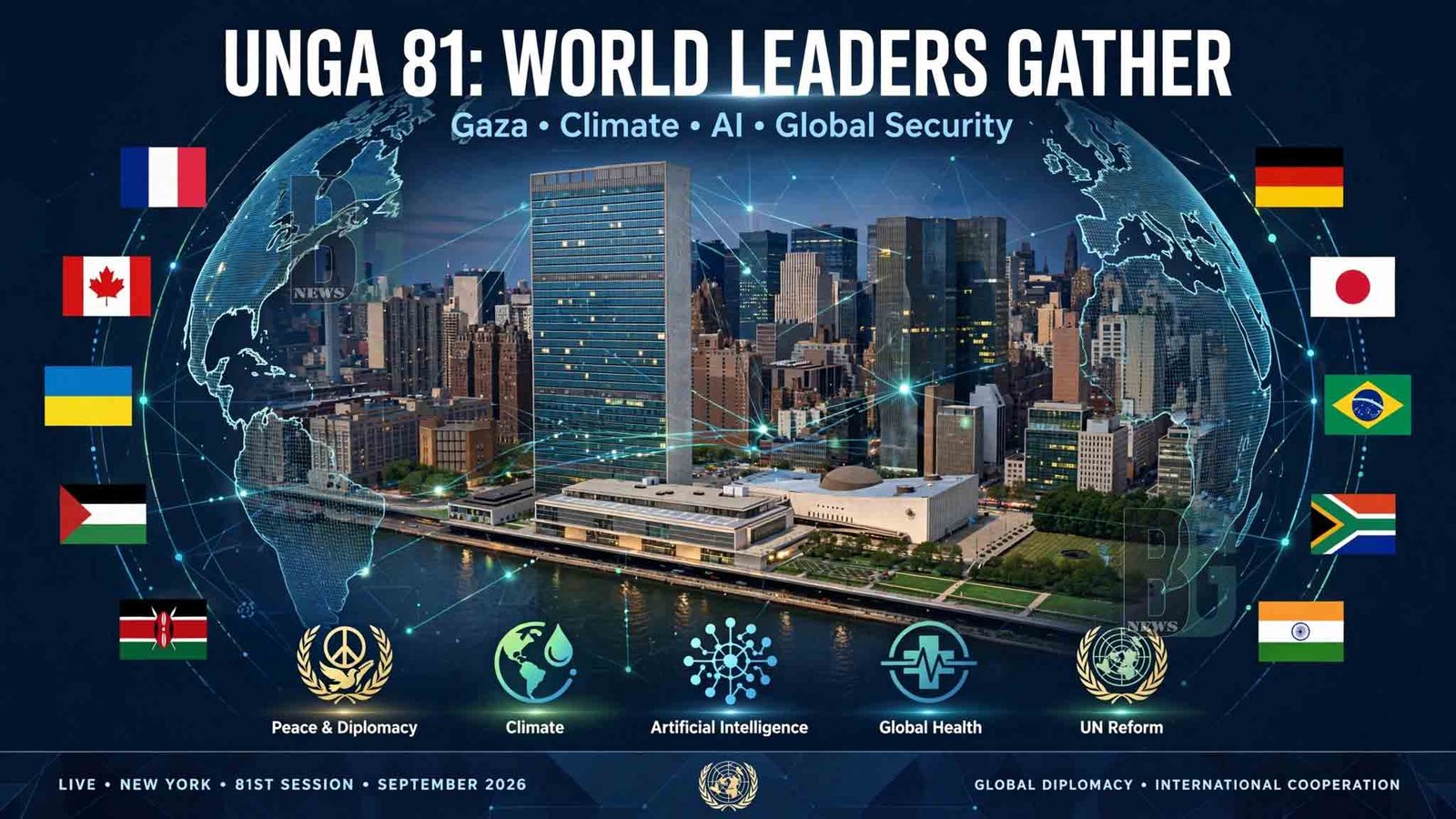
World leaders and senior government representatives have gathered at United Nations Headquarters in New York for the 81st session of the UN General Assembly, with conflicts, humanitarian crises, climate change, artificial intelligence, development and the future of multilateral cooperation among the major issues under discussion.
The General Debate began on September 22 and will continue through September 26, with an additional sitting on September 28. The UN says nearly 130 heads of state and government are expected to attend in person, while all 193 UN Member States are represented in the General Assembly.
The central theme of this year’s session is “Restoring trust, managing transformation: A United Nations that delivers for all.” The theme reflects the UN’s focus on strengthening international cooperation while addressing rapidly changing global challenges.
Gaza and the Middle East
The war in Gaza and the wider Israeli-Palestinian conflict remain among the most prominent diplomatic issues during the high-level week.
Governments are expected to discuss humanitarian assistance, civilian protection, the future governance and security of Gaza, Palestinian statehood and the prospects for a two-state solution.
The issue has already featured prominently in leaders’ statements. Saudi Foreign Minister Prince Faisal bin Farhan, for example, has called for implementation of the U.S. Gaza peace plan and stressed concerns over settlement expansion and settler violence in the West Bank.
Wars and International Security
The Ukraine war, conflicts in the Middle East and other regional crises are also expected to feature prominently in discussions.
The General Assembly provides a platform for countries to present their positions, while separate diplomatic meetings on the sidelines allow leaders to discuss possible areas of cooperation, humanitarian assistance and peace efforts.
The question of how the international system can respond more effectively to conflicts is also connected to wider discussions about the future of multilateralism and UN reform.
Climate Change and Sea-Level Rise
Climate action is another major priority during the 2026 High-Level Week.
A high-level meeting on climate action and the just transition is focusing on accelerating the transition to cleaner energy, strengthening energy security and addressing climate impacts.
A separate high-level meeting on September 24 will address the growing threat posed by sea-level rise, with particular attention to vulnerable coastal areas and small island developing states. The meeting is intended to encourage practical and adequately financed international action.
Artificial Intelligence and Emerging Technology
Artificial intelligence has emerged as another important issue at this year’s General Assembly.
Governments and international organisations are discussing how AI should be governed, how to manage emerging risks and how developing countries can gain access to the benefits of new technologies.
The broader discussion comes amid growing international debate over the rapid development of increasingly powerful AI systems and the need for greater international coordination.
Sustainable Development and Development Financing
The UN is also placing renewed emphasis on the Sustainable Development Goals (SDGs), poverty reduction, inequality, development financing and economic resilience.
The session includes discussions on the right to development and efforts to accelerate progress toward sustainable development. A high-level meeting on September 23 is marking the 40th anniversary of the UN Declaration on the Right to Development.
Global Health and Pandemic Preparedness
Global health will receive dedicated attention on September 25, when the UN will hold a high-level meeting on pandemic prevention, preparedness and response.
The meeting is intended to mobilise political support for stronger national, regional and international preparedness and is scheduled to conclude with an action-oriented political declaration agreed through intergovernmental negotiations.
UN Reform and Restoring Trust
Another major theme is the future effectiveness of the United Nations itself.
Countries are discussing how international institutions can become more effective, inclusive and responsive at a time of growing geopolitical tensions.
The EU, for example, has highlighted its support for an effective, inclusive and rules-based multilateral system based on the UN Charter and international law. A separate “Partners for Multilateralism” summit involving countries including India, Canada, Australia, Brazil, Barbados and Kenya was also held on the margins of the General Assembly.
What to Watch During the High-Level Week
The most important developments to monitor include:
- Gaza: humanitarian access, peace arrangements, governance and the two-state solution.
- Ukraine and other conflicts: diplomatic initiatives, international-law discussions and humanitarian measures.
- Climate: commitments on climate action, energy transition, climate finance and sea-level rise.
- AI: international cooperation and governance of emerging technologies.
- Global health: the September 25 pandemic preparedness declaration.
- Development: financing for the SDGs and support for developing countries.
- UN reform: proposals aimed at strengthening multilateral cooperation and institutional effectiveness.
The UN has scheduled several high-level meetings during the week, including those on climate action, sea-level rise, pandemic preparedness and development.
While individual governments are expected to announce positions, initiatives and agreements during the week, not every statement represents an agreed UN position. Formal resolutions, declarations and agreements adopted through the appropriate UN processes will determine which proposals become collective outcomes.
The 81st General Assembly therefore provides a major diplomatic forum for countries to present their priorities, negotiate with other governments and seek common ground on issues ranging from war and humanitarian crises to climate change, technology, health and sustainable development.