

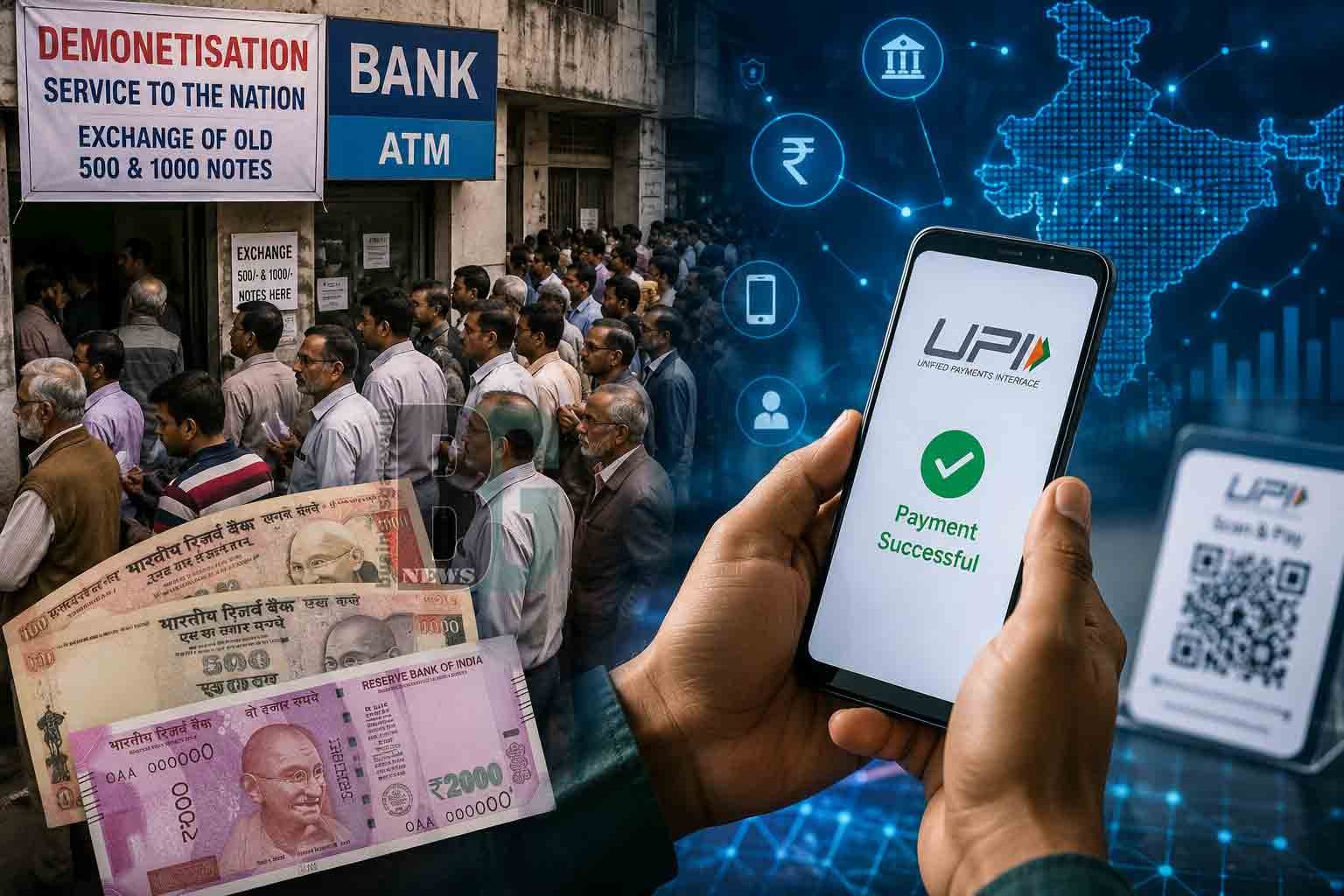
Nearly eight years after the Indian government announced the demonetisation of ₹500 and ₹1,000 currency notes, the policy remains one of the most debated economic decisions in the country’s history.
On November 8, 2016, the government declared that the two high value currency notes would cease to be legal tender, citing objectives such as tackling black money, counterfeit currency, corruption and terror financing. The move affected nearly 86% of the currency in circulation at the time and triggered long queues outside banks and ATMs across the country.
Short Term Economic Disruption
In the weeks and months following the announcement, millions of Indians faced cash shortages as old notes were exchanged for newly printed currency. Small businesses, traders, farmers and daily wage workers were among those most affected, particularly in sectors that relied heavily on cash transactions.
The Reserve Bank of India (RBI) also incurred significant costs in printing replacement currency. Printing expenses rose sharply as new notes, including the ₹2,000 denomination, were introduced to restore liquidity in the financial system.
Critics argue that the economic disruption and financial costs placed a heavy burden on ordinary citizens, while supporters maintain that the temporary inconvenience was necessary to achieve broader economic reforms.
The Black Money Question
One of the key goals of demonetisation was to curb black money. However, the issue remains a subject of debate.
Critics point to RBI data showing that most of the demonetised currency eventually returned to the banking system. They argue that this suggests a large portion of unaccounted cash was either deposited or converted, raising questions about the policy’s effectiveness in eliminating black wealth.
Supporters counter that the return of currency created a valuable audit trail, enabling authorities to identify suspicious transactions, improve tax compliance and bring more economic activity into the formal financial system.
Economists note that black wealth is often stored in assets such as real estate, gold and overseas investments rather than cash alone, making the issue difficult to measure solely through currency data.
Counterfeit Currency Remains a Challenge
Reducing fake currency was another major objective of the policy. While redesigned banknotes initially disrupted counterfeit networks, fake notes continue to be detected by banks and law enforcement agencies.
Recent RBI reports indicate that counterfeit currency remains present in the system, particularly among ₹500 notes. However, experts caution that counterfeit currency is a challenge faced by many countries and that periodic upgrades to currency security features are necessary regardless of demonetisation.
Digital Payments: A Lasting Impact
Perhaps the most visible change since 2016 has been the rapid growth of digital payments.
The widespread adoption of UPI, mobile wallets and online banking has transformed the way millions of Indians make transactions. Today, India processes billions of digital transactions every month, making it one of the world’s leading digital payment markets.
Many analysts believe demonetisation accelerated this transition by encouraging consumers and businesses to adopt electronic payment methods. However, they also note that technological innovation, affordable internet access and government backed digital initiatives played a major role in the expansion.
Cash Still Remains King
Despite the rise of digital payments, cash continues to play an important role in India’s economy.
Currency in circulation has grown significantly since 2016, indicating that both cash and digital payments are widely used. Analysts say this reflects India’s diverse economy, where digital transactions are growing rapidly while cash remains essential for many households and small businesses.
The ₹2,000 note introduced after demonetisation has largely been withdrawn from circulation, adding another chapter to the country’s evolving currency management strategy.
What About Plastic Notes or a Cashless India?
Questions about the future of India’s currency system continue to emerge.
Over the years, discussions have taken place regarding the possible introduction of polymer (plastic) banknotes, which are used in countries such as Australia, Canada and the United Kingdom because of their durability and enhanced security features. However, no nationwide rollout of plastic currency has been announced.
Similarly, while the RBI has launched pilot projects for the Digital Rupee (e₹) and digital payments continue to grow rapidly, there is currently no official plan to eliminate physical cash or move India to a fully cashless economy.
Experts believe India’s financial future is more likely to involve a combination of cash, digital payments and central bank digital currency rather than a complete replacement of traditional banknotes.
What Analysts Say
Most economists and policy analysts describe demonetisation as a policy with mixed outcomes.
Many acknowledge that it accelerated digital payment adoption, improved financial transparency and generated valuable data for tax authorities. At the same time, questions remain about its effectiveness in eliminating black money and delivering long term reductions in counterfeit currency.
Nearly a decade later, there is still no clear consensus on whether the benefits ultimately outweighed the costs. While supporters view demonetisation as a transformative reform that helped modernise India’s financial system, critics continue to see it as a costly experiment with limited success against its primary targets.
What remains undisputed is that demonetisation changed the way India thinks about money, payments and financial accountability, leaving a lasting mark on the country’s economic landscape.