
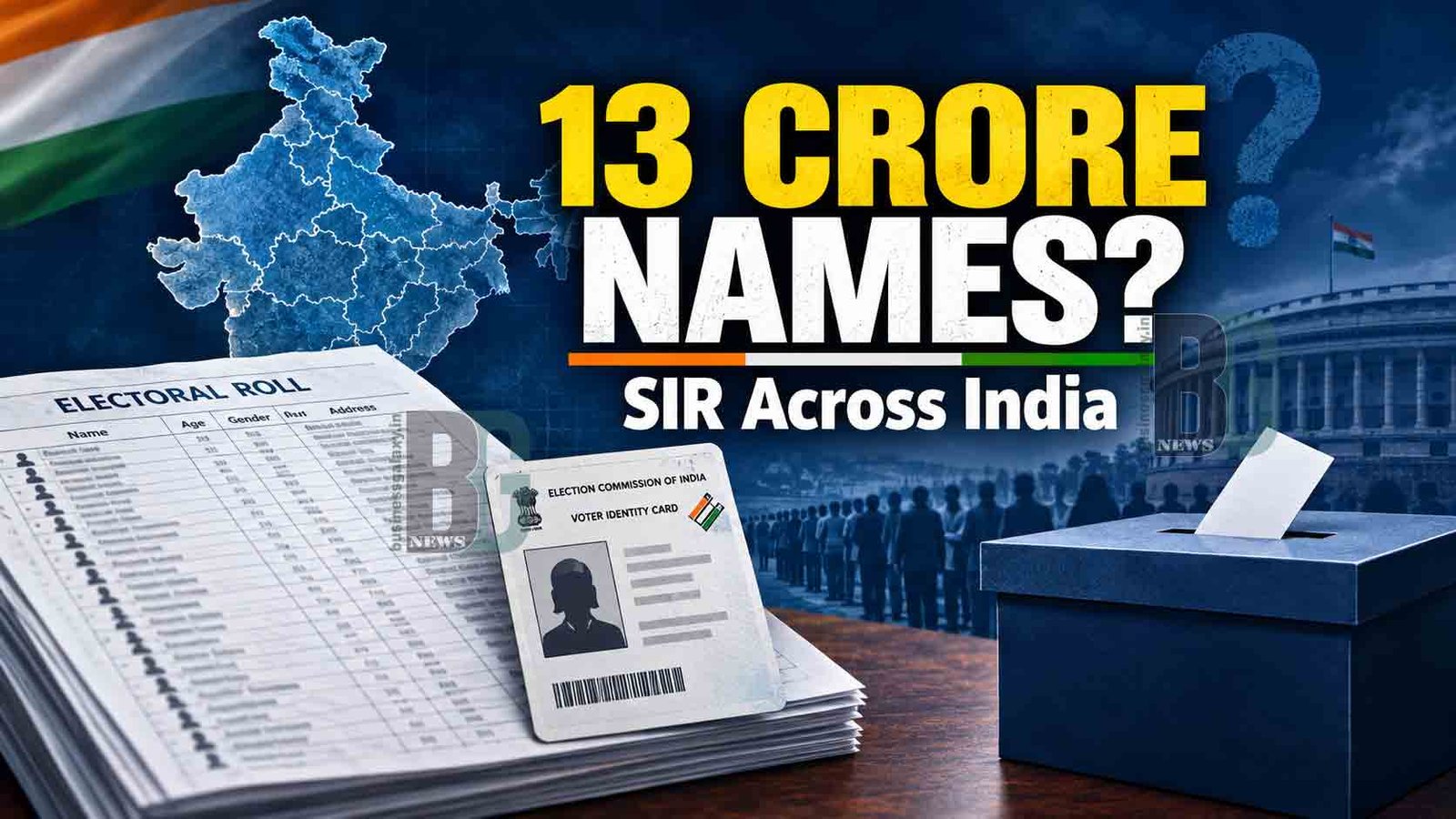
India’s electoral system is facing growing public scrutiny over the large scale removal of names from draft electoral rolls, complaints from citizens who say they risk losing their right to vote and questions about the transparency of the Election Commission of India’s (ECI) digital systems.
At the centre of the controversy is the Special Intensive Revision (SIR) of electoral rolls, an exercise intended to verify voter records and remove entries that are ineligible, duplicate, deceased or no longer valid at a particular address.
According to published reports, approximately 13 crore names were removed from draft electoral rolls across 30 states and Union Territories during the nationwide exercise. The Election Commission says the deletions include deceased voters, people who have shifted residence, duplicate entries and people who could not be traced.
However, the scale of the deletions has raised a serious question: How can the country ensure that an exercise intended to clean electoral rolls does not leave eligible Indian citizens unable to vote?
The controversy is no longer limited to political parties. It concerns ordinary citizens, first time voters, families whose members have previously voted and people who may now have to prove their eligibility to remain on the electoral roll.
Why Are Citizens Questioning Mass Voter Deletions?
- For many citizens, the central concern is straightforward: if a person has voted in previous elections, why should that person suddenly face the risk of exclusion from the electoral roll?
- Previous participation in elections does not automatically establish that every current entry is correct. Electoral rolls must be updated, and genuine duplicate or ineligible entries can be removed.
- But the opposite is equally important. A name should not be removed merely because a verification process cannot immediately establish a person’s details, address or supporting documents.
- A citizen who is alive, eligible and ordinarily resident at the relevant address must have a fair opportunity to establish eligibility, receive notice where required, present documents and challenge an adverse decision.
- For people who lack conventional address documents, have moved between locations, or face difficulties navigating official procedures, the process can become especially challenging.
- The issue is therefore not whether voter verification should take place. It is whether the process is transparent, accurate, fair and accessible to every eligible citizen.
- A voter should not have to discover on election day that their name is missing and that they cannot cast a ballot.
Approximately 13 Crore Names Removed: What Does This Figure Mean?
- The figure of approximately 13 crore refers to names removed from draft electoral rolls during the nationwide revision, according to media reports. It should not automatically be interpreted as 13 crore eligible voters being unlawfully disenfranchised.
- The Election Commission maintains that the revision is intended to improve the accuracy of electoral rolls. Its stated categories include deceased people, duplicate entries, people who have shifted and individuals who could not be traced.
- The important question is how these categories were verified and whether eligible people were mistakenly included among the deletions.
To establish the accuracy of the exercise, citizens and the public need clear, state wise information showing:
- The number of names removed and the reasons for removal.
- The number of people who challenged their deletion.
- The number of deleted names subsequently restored.
- The number of appeals pending and the time taken to decide them.
- The safeguards used to prevent eligible voters from being wrongly excluded.
Without accessible and comparable information, it becomes difficult for citizens to assess the accuracy of the revision or for independent observers to determine the extent of any wrongful exclusions.
ECINet Controversy: Why Is Election Software Under Scrutiny?
- The controversy has deepened following a technical audit by Charchagram, a civic tech initiative, which examined publicly served code associated with the ECI’s ECINet platform.
- A report published by Hindustan Times on October 20 said the audit identified a state specific restriction in the code that could prevent Electoral Registration Officers (EROs) and Assistant Electoral Registration Officers (AEROs) in West Bengal from accessing certain enumeration form details and notice and hearing tools.
- The audit could not establish whether the restriction was activated or whether it prevented officers from carrying out their duties. It also did not prove that voter records were unlawfully changed.
- Nevertheless, the finding raises a serious administrative question: why did the publicly served code contain a restriction specifically affecting election officials in West Bengal, and what was its purpose?
- The concern matters because EROs and AEROs have responsibilities under election law. They must be able to examine records, verify documents and perform the duties assigned to them through the applicable legal framework.
- If authorised officers cannot access the information required for their work, it could affect the handling of voter claims and objections. Whether that happened in this case requires a clear technical and administrative explanation.
- The controversy also raises questions about who authorised the restriction, what safeguards governed its implementation and whether the Election Commission has independently examined the feature.
Tribunal Judges Reported Problems in West Bengal Appeals
- Concerns about digital systems have also emerged in the process for people challenging their deletion from West Bengal’s electoral rolls.
- According to The Indian Express, judges serving on special tribunals established to hear appeals by deleted voters reported difficulties with the portal provided for their work.
- The reported problems included difficulties serving notices, conducting hearings, uploading additional documents, downloading orders and restoring voters to the electoral rolls.
- These complaints are significant because an appeal process must offer a practical remedy, not merely a formal opportunity to challenge deletion.
- If an eligible voter is removed from the electoral roll, the system should allow the case to be examined promptly. If a tribunal or authorised officer decides that the person should be restored, the necessary administrative and technical steps should follow without avoidable delay.
- The reported portal problems do not establish that every deletion was wrongful. They do, however, raise questions about whether the mechanisms intended to protect affected voters were functioning effectively.
- The Election Commission needs to clarify which problems were identified, what corrective measures have been taken and whether any eligible voters remain excluded because of administrative or technical obstacles.
Questions About the Election Commission’s Internal Decision Making
- The controversy has expanded following media reports about disagreements within the Election Commission itself.
- The Indian Express reported that Election Commissioners Sukhbir Singh Sandhu and Vivek Joshi had recorded objections to several decisions relating to electoral roll procedures and the centralisation of control over election software.
- The Commission responded to earlier reporting by describing internal observations as part of its decision making process and stating that its digital platforms operate under security protocols designed to prevent unauthorised tampering.
- It has also maintained that EROs and District Election Officers exercise their statutory powers regarding voter registration and deletion.
- These explanations are relevant. However, the public interest requires clarity on the specific questions raised by the reported objections, particularly where they concern statutory responsibilities, changes to forms, software access and the handling of appeals.
- Internal disagreement does not itself prove wrongdoing. But when senior officials raise concerns about systems affecting citizens’ voting rights, a transparent explanation can help establish whether those concerns were examined and resolved.
- The responsibility of the Election Commission is not only to conduct elections but also to maintain public confidence that electoral procedures are impartial, lawful and open to scrutiny.
Questions for Chief Election Commissioner Gyanesh Kumar and the ECI
The scale of voter deletions and the ECINet controversy have placed the Election Commission’s accountability under greater public scrutiny.
The following questions deserve clear answers from the Commission:
- Why were so many names removed?
The ECI should provide clear state wise figures explaining how many entries were removed under each category and how those decisions were verified. - How many eligible voters may have been wrongly excluded?
The Commission should publish information about complaints, appeals, restorations and cases in which deletion decisions were overturned. - What caused the reported ECINet access restriction in West Bengal?
The Commission should clarify who authorised the feature, whether it was operational and whether it affected EROs or AEROs in practice. - Were all statutory officers given the access needed to perform their duties?
The ECI should explain how access permissions are decided, who can change them and what safeguards prevent technical administrators from improperly interfering with the responsibilities of authorised election officials. - Have problems reported by tribunal judges been resolved?
The public deserves information on whether the reported difficulties with notices, hearings, documents and restoration of voters have been corrected. - What happens to eligible voters whose names remain missing?
The Commission should make the process for checking status, submitting claims, challenging deletion and securing restoration clear and accessible. - Will an independent review examine the entire process?
A transparent technical and administrative review could help establish whether the systems and procedures complied with applicable law and whether corrective action is necessary.
These are questions of public accountability. Asking them does not amount to an allegation that the Chief Election Commissioner or any other individual has committed an offence.
What Is the Ruling Government’s Responsibility?
- The Bharatiya Janata Party and the government it leads have faced allegations from opposition parties that the revision could disproportionately affect certain communities and voters who may oppose the ruling party.
- The BJP and the Election Commission have denied allegations of political bias and defended the need to maintain accurate electoral rolls.
- At present, the existence of large scale deletions and reported administrative difficulties does not, by itself, establish that the exercise was designed to benefit a particular political party.
- Nevertheless, questions about electoral fairness cannot be dismissed merely because they are raised by political opponents.
- The government has a responsibility to protect citizens constitutional rights, explain the legal and administrative framework governing electoral registration, and ensure that eligible citizens are not deprived of their right to participate in elections through arbitrary or unlawful action.
- The Election Commission, which is constitutionally responsible for supervising elections, must independently demonstrate that its decisions and systems comply with the law.
- The public interest requires evidence, transparent procedures and accountability not unverified allegations or blanket assurances.
Protests Across India: Why Are People Demanding Answers?
- The voter roll revision has triggered protests and political criticism in several parts of the country.
- On October 24, demonstrators formed a human chain at Hyderabad’s Tank Bund under the slogan “Vote Bachao, Desh Bachao” (Save Votes, Save the Country). Protesters called for the restoration of deleted voters, opposed the SIR process and demanded accountability from the Election Commission.
- The protests reflect a wider concern: citizens want assurance that electoral roll revision will not prevent eligible people from voting.
- For many protesters, the issue is not simply the number of names removed. It is whether the process provides sufficient transparency, whether citizens can challenge decisions effectively and whether institutions respond when credible concerns are raised.
- The right to question public authorities is an essential part of democratic accountability. Peaceful protests, legal challenges, public interest reporting and requests for official information can all contribute to scrutiny of the electoral process.
- However, claims about deliberate manipulation must still be supported by evidence. The purpose of investigation should be to establish what happened, who was affected and whether the law was followed.
What Must Happen Now?
- The Election Commission has announced measures intended to help enrol eligible voters who may have been left out of revised rolls, including a special enrolment drive in states and Union Territories where the revision has been completed.
- That is an important step, but the public also needs clear information about its implementation and results.
- The Commission should publish accessible state wise data on deleted and restored voters, pending appeals and the reasons for adverse decisions. It should explain the technical findings relating to ECINet, address documented problems in the appeal process and provide an effective route for eligible voters to correct their records.
- The government and political parties should also avoid presenting unverified allegations as established facts. Any claim of deliberate interference with electoral rolls must be examined through evidence and appropriate legal processes.
- Most importantly, an eligible citizen who has been wrongly excluded must have a fair, timely and effective opportunity to seek restoration before an election.
Conclusion: The Right to Vote Must Be Protected by Transparency
- India’s electoral rolls must be accurate. Removing genuinely ineligible entries is a legitimate part of maintaining an effective election system.
- But accuracy cannot be measured only by the number of names removed. It must also be measured by whether eligible citizens remain on the rolls, whether errors can be corrected and whether every decision can withstand scrutiny.
- When approximately 13 crore names are removed from draft electoral rolls, when citizens report difficulties restoring their registration and when technical audits and tribunal judges raise questions about the systems used to manage appeals, clear answers become essential.
- The central issue is not whether election authorities should be questioned. It is whether the authorities can demonstrate that their procedures protect every eligible voter’s rights.
No eligible citizen should lose the opportunity to vote because of an unexplained administrative decision, an inaccessible digital system or a process that fails to provide an effective remedy.
- The Election Commission should answer the questions raised, explain what has been verified and make the necessary information publicly accessible. The government, political parties and civil society should support a process in which allegations are investigated fairly and the rights of eligible voters are protected.
- Democracy depends not only on conducting elections, but also on ensuring that every eligible citizen has a fair opportunity to participate.
Business Galaxy | India Political and Constitutional Affairs
Editorial note: This report draws on published reporting by Reuters, The Indian Express and Hindustan Times, as well as public statements attributed to the Election Commission and political parties. The approximately 13 crore figure refers to removals from draft electoral rolls, not a verified count of eligible voters unlawfully disenfranchised. The ECINet audit identified a restriction in publicly served code but did not establish that it was activated or used to manipulate voter records. Allegations of political intent remain contested and have not been established by the findings described above.