
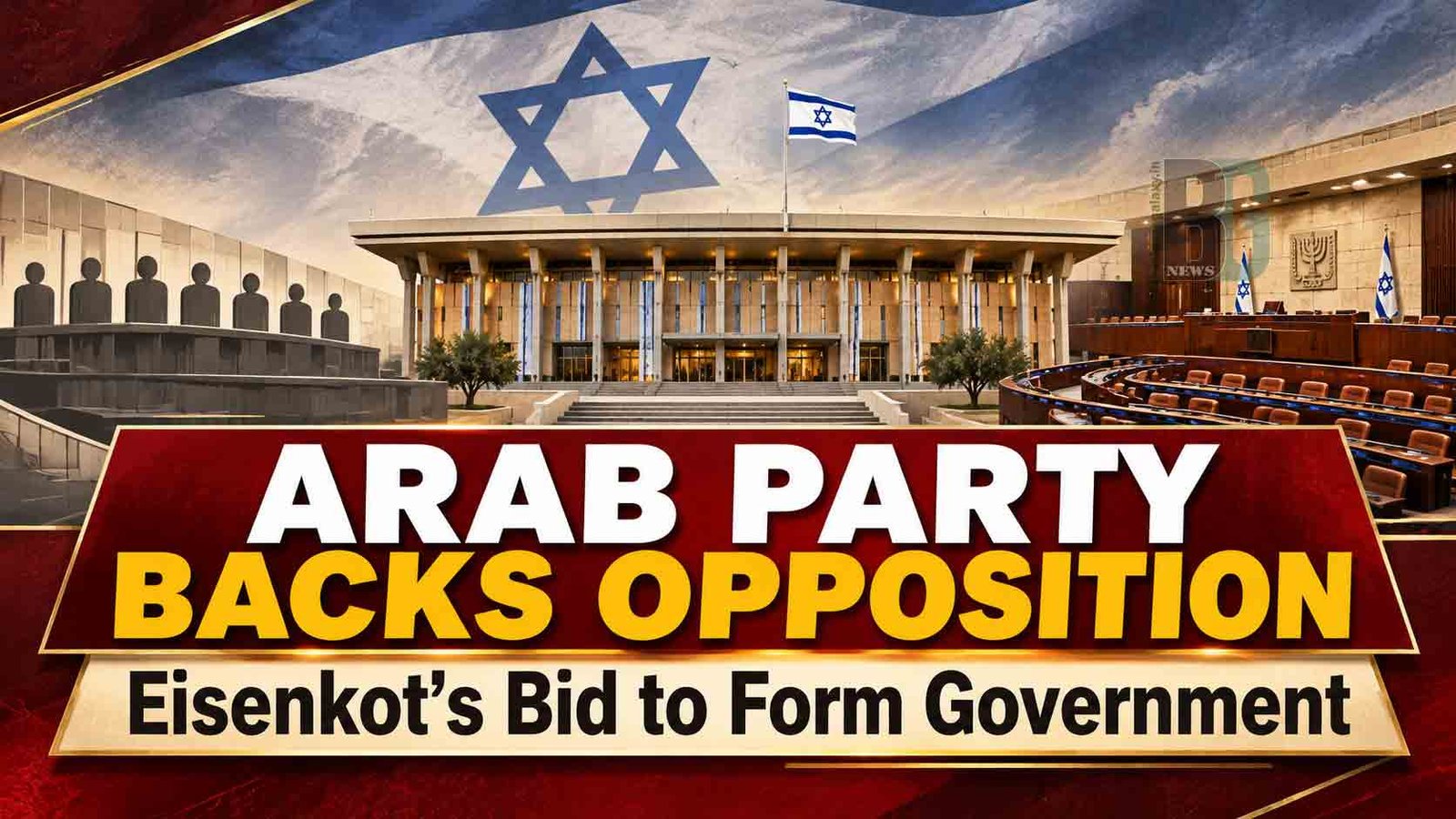
Jerusalem: Israel’s Arab-led Ra’am party has announced that it will recommend opposition leader Gadi Eisenkot to form the next government, following the country’s parliamentary elections held on October 27, 2026.
The decision could strengthen Eisenkot’s position as political parties begin consultations with Israeli President Isaac Herzog over the formation of a new government.
Ra’am’s eight incoming lawmakers are expected to support Eisenkot, bringing his total recommendations to 56, compared with 53 for outgoing Prime Minister Benjamin Netanyahu’s bloc.
Election Results Leave Israel Without a Clear Majority
The election resulted in a divided 120 member Knesset (Israeli Parliament).
The reported seat distribution is:
- Netanyahu’s bloc: 53 seats.
- Opposition alliance led by Eisenkot: 48 seats.
- Arab-led parties: 19 seats, including Ra’am’s 8 and the Joint List’s 11.
A minimum of 61 seats is required for a parliamentary majority. Neither major bloc secured enough seats independently.
Who Is Gadi Eisenkot?
- Gadi Eisenkot is a former Chief of Staff of the Israel Defense Forces (IDF) and leader of the Yashar party. He emerged as the opposition’s candidate to replace Netanyahu following the election.
- Several opposition leaders, including former Prime Minister Naftali Bennett, Avigdor Lieberman and Yair Golan, have also announced their support for Eisenkot.
What Happens Next?
- Israeli President Isaac Herzog is consulting political parties to determine which lawmaker should receive the mandate to form a government.
- Eisenkot’s recommendations could give him an initial advantage. However, this does not automatically make him prime minister.
- He will still need to negotiate with other parties and secure sufficient parliamentary support to establish a functioning government.
- The political situation remains uncertain, particularly because some opposition leaders have expressed reservations about relying on Arab-led parties for a minority government.
Why This Development Matters
- Ra’am’s decision is significant because Arab-led parties could play an important role in determining Israel’s next government.
- However, disagreements among opposition parties over cooperation with Arab lawmakers could complicate coalition negotiations.
- The coming days will be important in determining whether Eisenkot can build a parliamentary majority or whether Israel faces further political uncertainty.