
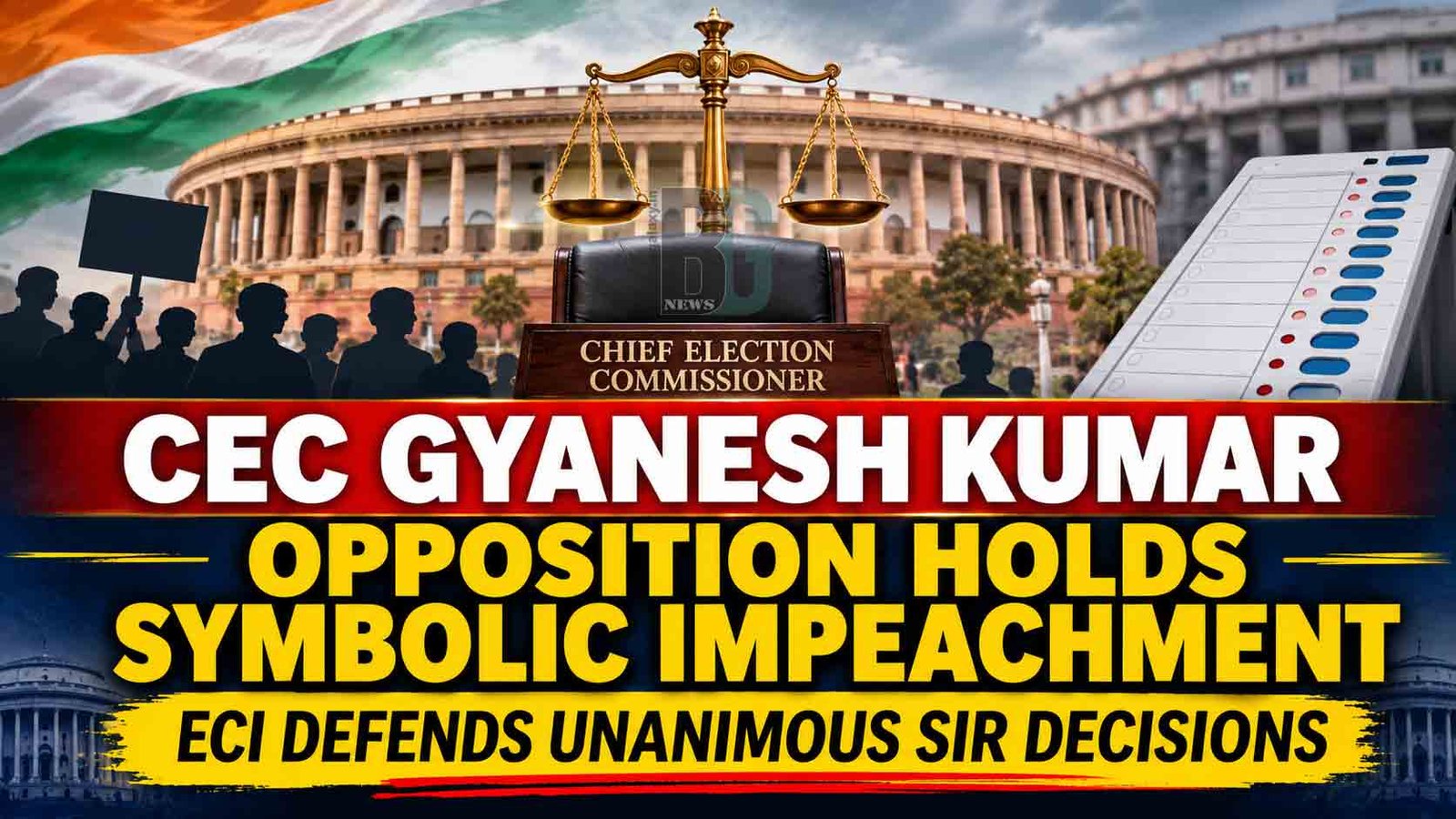
Opposition INDIA bloc leaders on Saturday organised a symbolic ‘public impeachment’ proceeding against Chief Election Commissioner (CEC) Gyanesh Kumar in New Delhi, accusing him of undermining the fairness and independence of India’s electoral process.
The opposition leaders unanimously passed a resolution demanding Kumar’s removal and calling for legal action over alleged irregularities in the Special Intensive Revision (SIR) of electoral rolls.
The development comes amid an ongoing legal dispute in the Supreme Court over the Election Commission of India’s decision making process and allegations that important SIR related decisions were taken without the agreement of the other two Election Commissioners.
INDIA Bloc Passes Resolution After Three Hour Proceeding
- The symbolic proceeding was organised at the residence of Congress president Mallikarjun Kharge at 10, Rajaji Marg, New Delhi. Former Lok Sabha Speaker Meira Kumar presided over the meeting.
- The resolution was moved by Mallikarjun Kharge, seconded by Samajwadi Party MP Harendra Malik and supported by Leader of Opposition Rahul Gandhi.
- Representatives of at least 18 political parties, opposition MPs, civil society members and individuals who claimed that their names had been wrongly deleted from electoral rolls participated.
- After approximately three hours of speeches, the resolution seeking the CEC’s removal was passed unanimously through a show of hands.
Six Allegations Against Chief Election Commissioner
The INDIA bloc’s resolution listed six major allegations against Gyanesh Kumar:
- Electoral manipulation: Alleged involvement in actions that the opposition claims undermined free and fair elections.
- SIR related voter deletions: Opposition leaders alleged that the Special Intensive Revision exercise resulted in the intentional deletion of approximately 13.2 crore voters.
- Form 6 changes: Alleged changes to voter registration procedures without adequate parliamentary oversight, potentially affecting the enrolment of first-time voters.
- Centralisation of electoral rolls: Alleged centralisation of control through ERONET/ECINET software, affecting the functioning of local Electoral Registration Officers.
- Exclusion of Election Commissioners: Alleged exclusion of the other two Election Commissioners from important decisions, despite reportedly recorded objections.
- Questions over independence: Alleged failure to maintain the constitutional independence and impartiality expected from the Election Commission.
These are allegations made by the opposition and have not been established as findings by a court.
Neha Bora Also Participates
- AISA National President Neha Bora was among the participants who addressed the symbolic proceeding.
- Several opposition leaders and public representatives also expressed concerns about the SIR exercise and its impact on voters rights.
- Rahul Gandhi supported the resolution and accused the CEC of enabling actions that, according to him, threatened the democratic electoral process.
- Yogendra Yadav also criticised the functioning of the Election Commission, while other opposition representatives raised concerns about voter deletions and electoral transparency.
ECI Rejects Allegations of Unilateral SIR Decisions in Supreme Court
- Separately, the Election Commission of India has rejected allegations that Chief Election Commissioner Gyanesh Kumar independently took important decisions concerning the Special Intensive Revision (SIR) despite objections from the other two Election Commissioners.
- In a counter affidavit filed before the Supreme Court, the ECI maintained that decisions relating to the SIR exercise were taken unanimously after deliberations among all three members of the Commission.
- The Commission stated that relevant files and documents were circulated among the CEC and the two Election Commissioners for consideration and approval.
- The ECI specifically maintained that its orders initiating the SIR exercise on June 24, 2025, October 27, 2025, and May 14, 2026, were issued unanimously.
- The Commission also rejected allegations concerning changes to Form 6. It clarified that the statutory Form 6 itself had not been amended; instead, a separate declaration accompanying applications was revised under the SIR orders.
- According to the ECI, the declaration introduced a facility allowing applicants to provide details linking themselves or their parents or grandparents to previous electoral rolls.
What Is Happening in the Supreme Court Case?
- The Supreme Court is hearing petitions challenging the functioning of the Election Commission and the decision-making process under CEC Gyanesh Kumar.
- The petitions raise questions about whether important decisions were taken in accordance with Article 324 of the Constitution and Section 18 of the Chief Election Commissioner and Other Election Commissioners (Appointment, Conditions of Service and Term of Office) Act, 2023.
- The petitioners have referred to reports alleging that at least 14 important SIR related decisions were taken despite objections reportedly recorded by Election Commissioners Sukhbir Singh Sandhu and Vivek Joshi.
- During the October 27 hearing, the Supreme Court bench headed by Chief Justice Surya Kant, along with Justice Joymalya Bagchi and Justice V. Mohana, granted the petitioners 10 days to file their rejoinder to the ECI’s counter affidavit.
- Senior Advocate Abhishek Manu Singhvi, representing Rahul Gandhi and INDIA bloc leaders, requested the preservation of internal files and communications to establish whether the decisions were unanimous or unilateral.
- The Chief Justice indicated that the Court would examine the matter. The hearing was tentatively listed for November 17, 2026.
- The ECI has urged the Supreme Court to dismiss the petitions, arguing that the allegations are misconceived and that the reliefs sought are not legally maintainable.
Can the Opposition Remove the CEC Through Public Impeachment?
- The public impeachment proceeding organised by the INDIA bloc is symbolic and does not have the legal authority to remove the Chief Election Commissioner.
- Under Article 324(5) of the Constitution, the CEC can be removed only in the same manner and on the same grounds as a Judge of the Supreme Court.
This requires a formal parliamentary process under Article 124(4), including:
- A motion for removal based on proved misbehaviour or incapacity.
- Approval by a majority of the total membership of each House of Parliament.
- Support from at least two thirds of members present and voting in each House.
- An address by both Houses to the President in the same session, followed by a presidential order.
Therefore, the resolution passed at the opposition’s public proceeding does not itself initiate or complete the constitutional removal process.
Electoral Transparency Remains at the Centre of Debate
- The developments have brought renewed attention to the independence of the Election Commission, transparency in voter list revisions and the constitutional safeguards governing the country’s electoral institutions.
- While the opposition is demanding accountability over alleged irregularities, the ECI maintains that its decisions were taken unanimously and in accordance with the law.
- The Supreme Court’s examination of the petitions is expected to be important in addressing the legal questions surrounding the Commission’s decision making process.
- The matter remains under judicial consideration, and the allegations against the CEC have not been established by a court.