
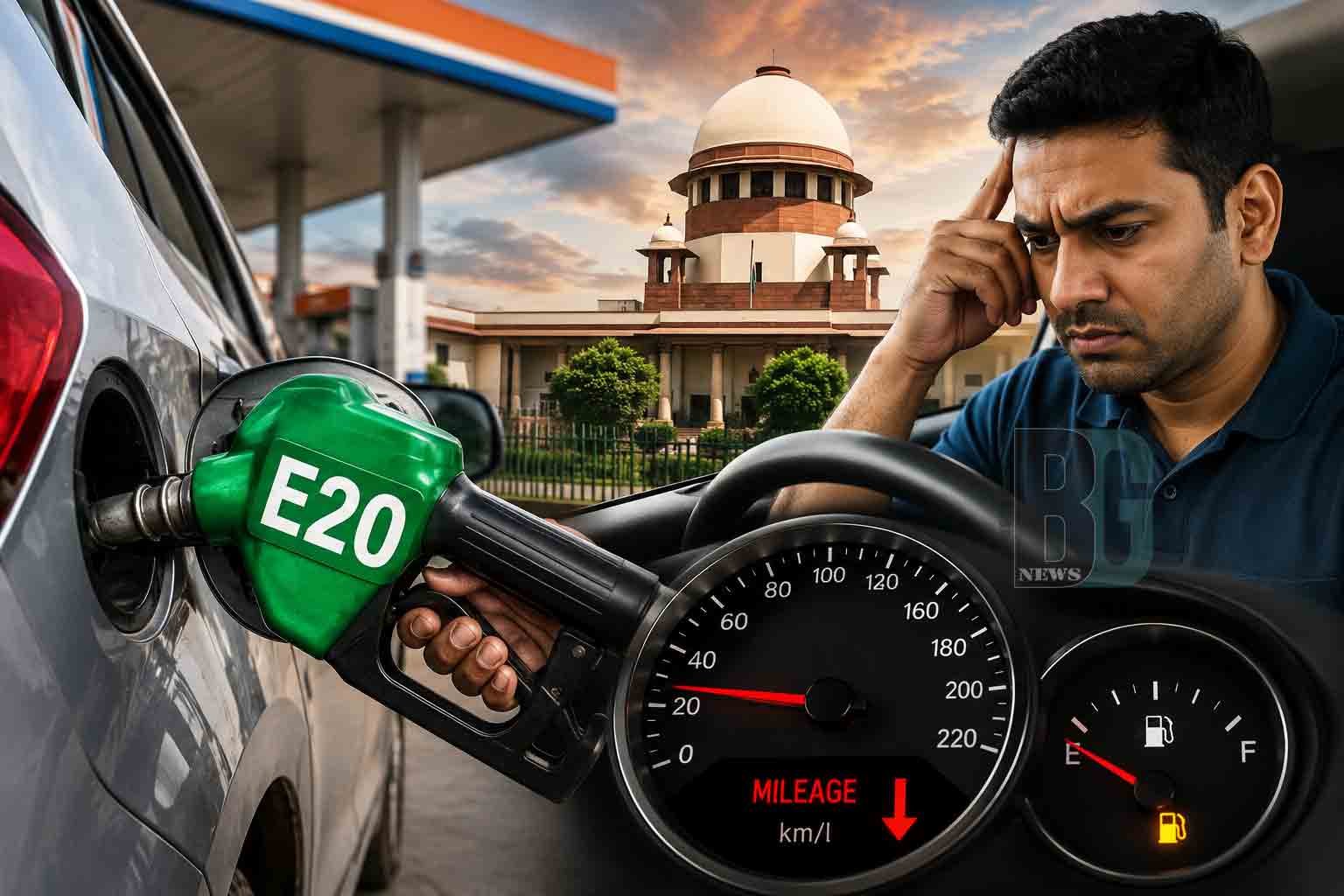
The Centre’s ambitious E20 (20% ethanol blended petrol) programme has once again come under scrutiny after reports from motorists across India claimed that the fuel reduces vehicle mileage. While fuel companies and government officials acknowledge that ethanol blended fuel can lead to some reduction in fuel efficiency, the government continues to defend the policy, saying its long term benefits outweigh the drawbacks.
The controversy gained momentum after Anuraj Shatabdi, Chief General Manager of Bharat Petroleum (BPCL), stated that E20 petrol can cause a slight reduction in mileage because ethanol contains less energy per litre than conventional petrol. He explained that this is a scientifically expected outcome and not a defect in the fuel itself.
Union Petroleum Minister Hardeep Singh Puri has also accepted that a small drop in mileage is possible. However, he said the impact varies depending on the vehicle, driving habits, traffic conditions and maintenance. According to the minister, E20 petrol also offers benefits such as lower crude oil imports, reduced emissions and improved energy security.
Despite these acknowledgements, many vehicle owners across the country remain dissatisfied. Numerous consumers have reported noticeable drops in mileage after switching to E20 petrol, arguing that the increased fuel consumption offsets any savings and raises their overall running costs. Consumer groups have also questioned whether motorists were adequately informed about the possible impact before the nationwide rollout.
Adding to the debate, Union Road Transport and Highways Minister Nitin Gadkari has repeatedly maintained that E20 fuel does not significantly reduce mileage and has consistently promoted ethanol blending as an environmentally friendly and economically beneficial policy. His statements have drawn criticism from some motorists, who argue that their real world experience differs from the government’s assurances.
The issue reached the Supreme Court during a case involving ethanol allocation to oil marketing companies. Initial media reports claimed that the Attorney General for India, R. Venkataramani, had told the court that the E20 programme was “An ongoing experiment” and that its full impact would become clear only next year.
However, the Attorney General’s Office later issued an official clarification, strongly denying those reports. It stated that the Attorney General never described the E20 programme as an experiment before the Supreme Court and said the media reports were “Completely False” and did not reflect the actual submissions made in court. According to the clarification, the government’s arguments were focused on protecting the national ethanol blending policy and maintaining stable ethanol supplies for oil companies, not on questioning the programme itself.
The differing public statements have created confusion. On one hand, officials from the petroleum sector and the Petroleum Ministry acknowledge that a slight mileage reduction is technically possible. On the other hand, the government continues to defend the E20 policy and rejects suggestions that it is still an experimental programme.
As the nationwide rollout continues, the debate over E20 petrol is expected to persist, with consumers seeking greater transparency about its real world impact on fuel efficiency while the government emphasizes its broader economic and environmental objectives.