
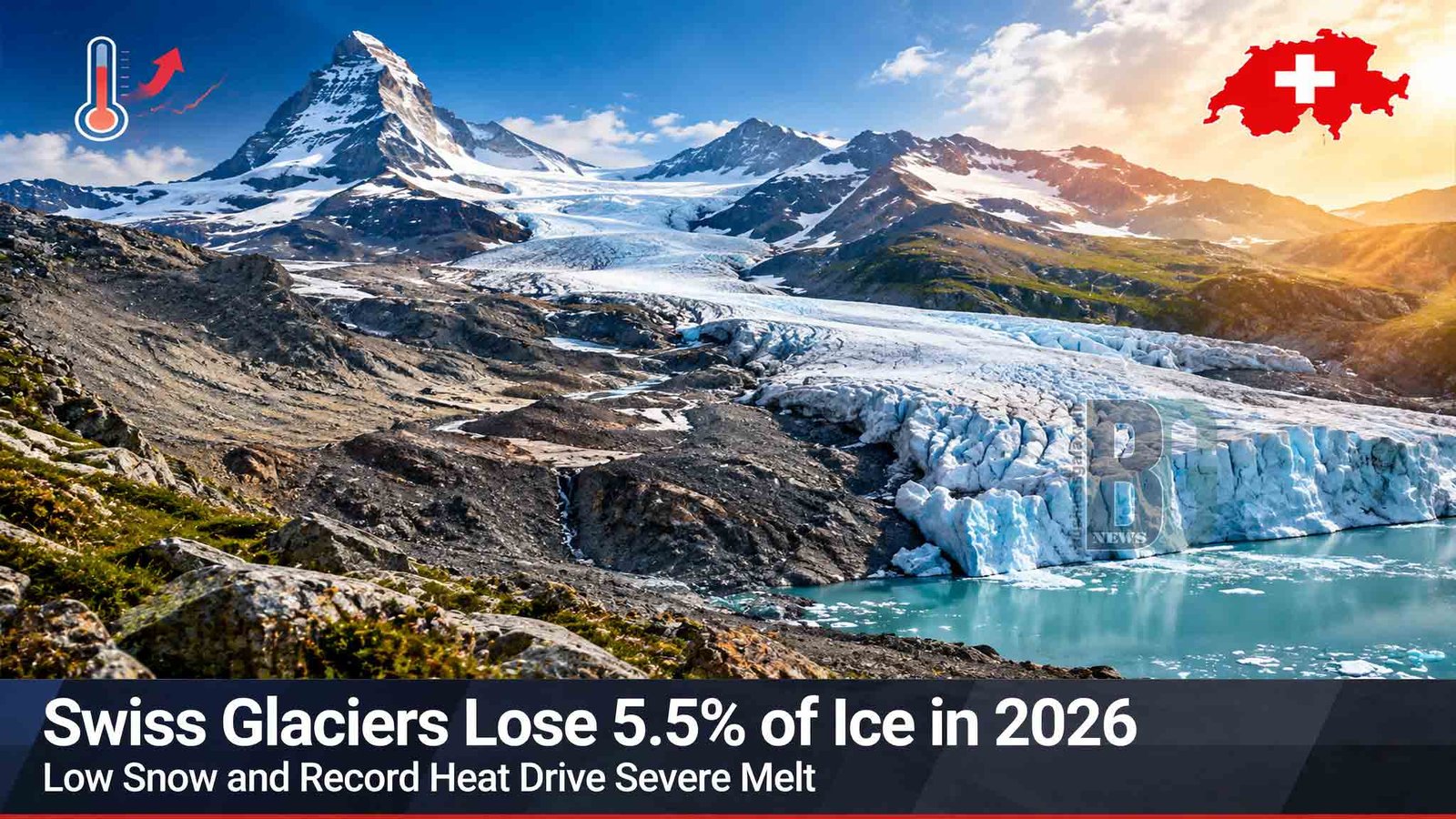
Switzerland’s glaciers have suffered another year of severe ice loss, with scientists reporting that 5.5% of the country’s glacier volume disappeared during 2026. The loss is the second largest percentage decline recorded, highlighting the rapid changes taking place across the Swiss Alps.
According to the latest data from the Swiss Glacier Monitoring Network (GLAMOS) and the Swiss Commission for Cryosphere Observation of the Swiss Academy of Sciences, the extreme melting was driven by a combination of unusually low snowfall during the winter of 2025-26 and exceptionally warm conditions during the summer.
Nearly 20% Lost in Five Years
- The latest figures show that Switzerland has lost nearly one fifth of its total glacier volume in just five years.
- Scientists say the scale and frequency of major melting events are becoming increasingly concerning. While 2026 did not surpass the record ice loss recorded in 2022, it was nevertheless one of the most severe years observed.
Low Winter Snow Left Glaciers Vulnerable
- The winter of 2025-26 was among Switzerland’s 10 least snowy winters since measurements began.
- Normally, snow covering a glacier provides protection from summer sunlight and heat. When there is little snow, bare ice is exposed earlier, allowing it to melt more rapidly when temperatures rise.
- This was followed by hot and dry conditions from May through September. For 76 days, the freezing level rose above 4,000 metres a Swiss record leaving even high altitude glaciers exposed to unusually strong melting.
Several Glaciers Suffered Major Losses
- Researchers found that the average thickness of individual glaciers declined by approximately 2.5 to 4 metres during the year. Some glacier tongues lost as much as 10 metres of ice.
- The Aletsch, Rhone and Clariden glaciers were among those experiencing their greatest recorded melt in 2026. Several smaller glaciers have already disappeared completely.
Billions of Litres of Meltwater
- The rapid melting also produced an enormous amount of water.
- Between July and September alone, Swiss glaciers released approximately 2.2 trillion litres of water, according to the latest scientific assessment. This is more than four times the annual drinking-water consumption of Swiss households.
- The additional meltwater can temporarily help reduce water shortages during hot summers. However, scientists warn that this is not a sustainable solution because continued glacier shrinkage means there will eventually be less ice available to provide this additional water.
Why This Matters Beyond Switzerland
- Switzerland’s glaciers are part of the wider Alpine water system and contribute to rivers that flow across Europe, including the Rhine and Rhône, as well as other major river systems.
- Glacier loss therefore has implications beyond tourism and the Swiss mountains. Continued retreat can affect seasonal water availability, hydropower, ecosystems and mountain environments.
Is This a Warning Sign for the Earth?
- Scientists consider the rapid disappearance of glaciers an important indicator of a warming climate.
- The loss of Swiss glaciers alone will not determine the future of the planet, but the broader global pattern is significant. Glaciers and ice sheets around the world are also experiencing substantial changes.
- The Swiss data demonstrate how warmer temperatures and changes in snowfall can rapidly alter mountain ice reserves. Scientists say limiting further warming is important for slowing these changes and protecting remaining ice.
What Scientists Are Watching
- The key concern is not simply one exceptionally warm summer, but the repeated occurrence of extreme melting years.
- GLAMOS continues to monitor Switzerland’s glaciers through field measurements and long term records. The latest assessment provides another indication of how quickly the Alpine glacier landscape is changing.
- The situation is therefore a serious climate and water management concern, but it should not be presented as evidence that Earth is facing an immediate planetary collapse. The scientific evidence points instead to a continuing long term change in glaciers, water resources and mountain ecosystems.
Source: Swiss Glacier Monitoring Network (GLAMOS), Swiss Academy of Sciences (SCNAT), ETH Zurich.