
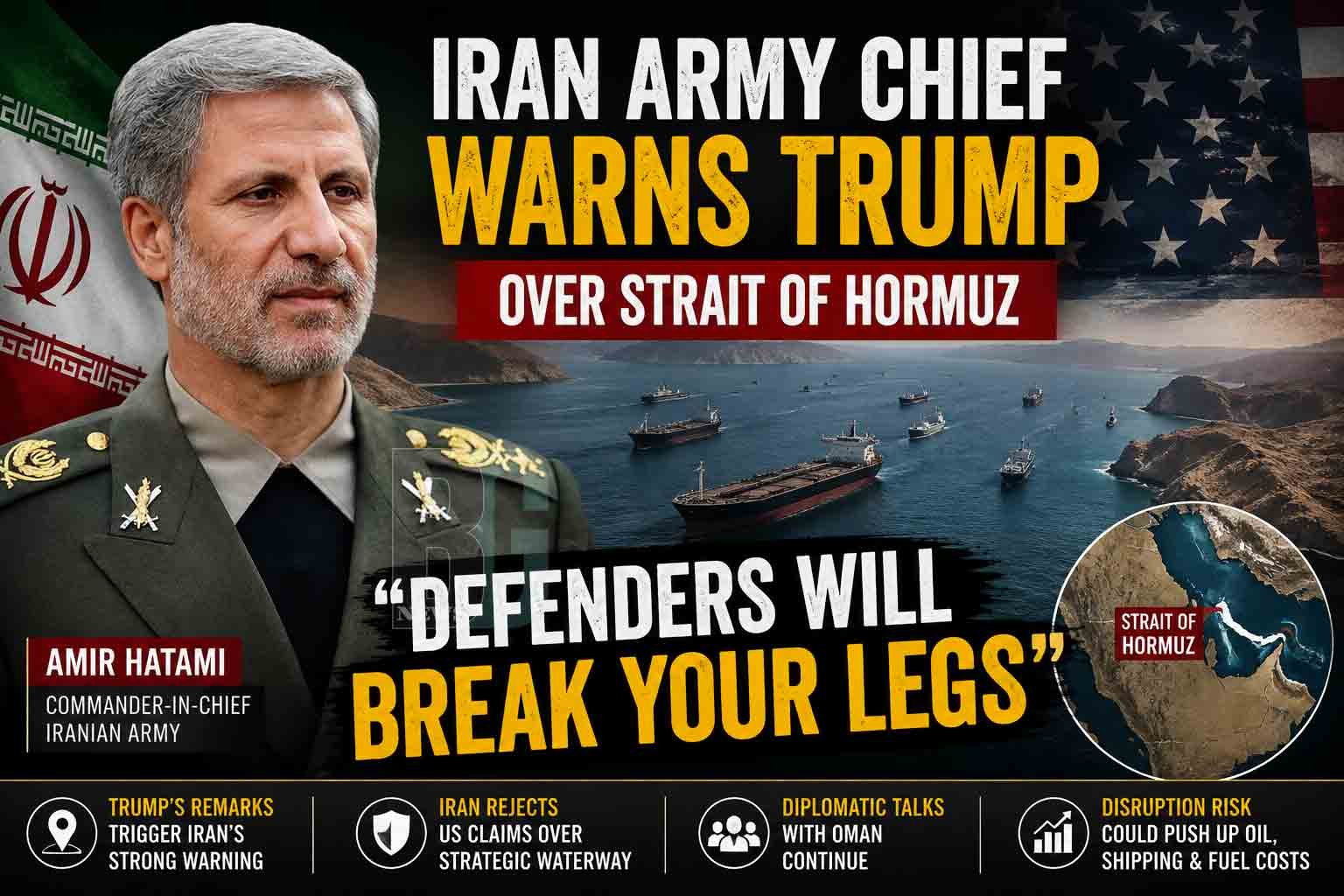
Tehran: Iran’s Army chief, Major General Amir Hatami, has issued a sharp warning to US President Donald Trump after Trump said he planned to declare the Strait of Hormuz a US territory.
Hatami said treating the issue as a joke would be a serious mistake and warned that Iran has defenders who would “Break your legs” The remarks were reported by Iranian state media and widely reported internationally on August 16.
What triggered the warning?
- Trump said on August 14 that after the United States finished defeating Iran, he would “Soon” declare the Strait of Hormuz a territory of the United States. The comments came amid the continuing US-Iran conflict and a major dispute over control of the strategic waterway.
- A White House official subsequently indicated that Trump’s remarks were intended as a joke, according to reports.
- Iran, however, responded seriously.
- Iranian Deputy Foreign Minister Kazem Gharibabadi said the Strait of Hormuz has been, remains and will remain Iranian, while insisting that its opening and closure would be determined by Iran.
Iran rejects US claims over Hormuz
- The Strait of Hormuz connects the Persian Gulf with the Gulf of Oman and is one of the world’s most important energy routes.
- The United States has claimed that it has effective control of the waterway through its military presence and blockade operations. Tehran rejects that claim and says Iran retains control over the strait.
- The disagreement has become one of the central flashpoints in the broader US-Iran confrontation.
Why the Strait of Hormuz matters
The waterway is strategically important because it is a major route for oil and other energy shipments from the Gulf.
The continuing disruption has already affected international shipping and energy markets. Any further escalation could increase:
➤ Crude oil prices
➤ Shipping and insurance costs
➤ Fuel prices
➤ Inflationary pressure
➤ Risks to global energy supplies
For countries such as India, which depend heavily on imported crude oil, prolonged disruption could have significant economic consequences.
Iran-Oman talks continue
- Despite the aggressive rhetoric, diplomatic efforts over the waterway are continuing.
- Iranian Foreign Minister Abbas Araghchi said Tehran was continuing discussions with Oman regarding shipping routes through the Strait of Hormuz. However, Iran has linked any reopening of the waterway to the United States fulfilling commitments under an earlier understanding.
- This indicates that diplomacy remains possible even as military and political tensions remain high.
Risk of further escalation
- Hatami’s warning does not by itself represent an announcement of a new Iranian military operation. It is, however, another indication of how sharply rhetoric between Washington and Tehran has escalated.
- The dispute over Hormuz now involves military pressure, maritime security, energy supplies and competing claims over control of the waterway.
- Any direct confrontation involving commercial vessels or military forces could further destabilise the region and put additional pressure on global energy markets.
What it means for India
- India is particularly exposed to developments around the Strait of Hormuz because of its dependence on imported crude oil.
- A prolonged disruption could raise international oil prices and increase India’s import bill, potentially putting pressure on the rupee, transportation costs and inflation.
- Indian businesses and consumers will therefore be watching developments in the Gulf closely.
Business Galaxy Takeaway
Iran’s Army chief Amir Hatami has strongly warned Donald Trump over his remarks about making the Strait of Hormuz a US territory.
While Washington and Tehran continue to exchange tough statements, diplomatic discussions involving Oman are also continuing.
The biggest concern for the global economy is whether the confrontation remains at the level of political and military pressure or develops into a wider disruption of commercial shipping and energy supplies.
For India, the key risks are higher crude prices, a larger import bill and renewed inflationary pressure.
Note: Statements attributed to Iranian and US officials reflect their respective positions and claims, developments around the Strait of Hormuz remain fluid.