
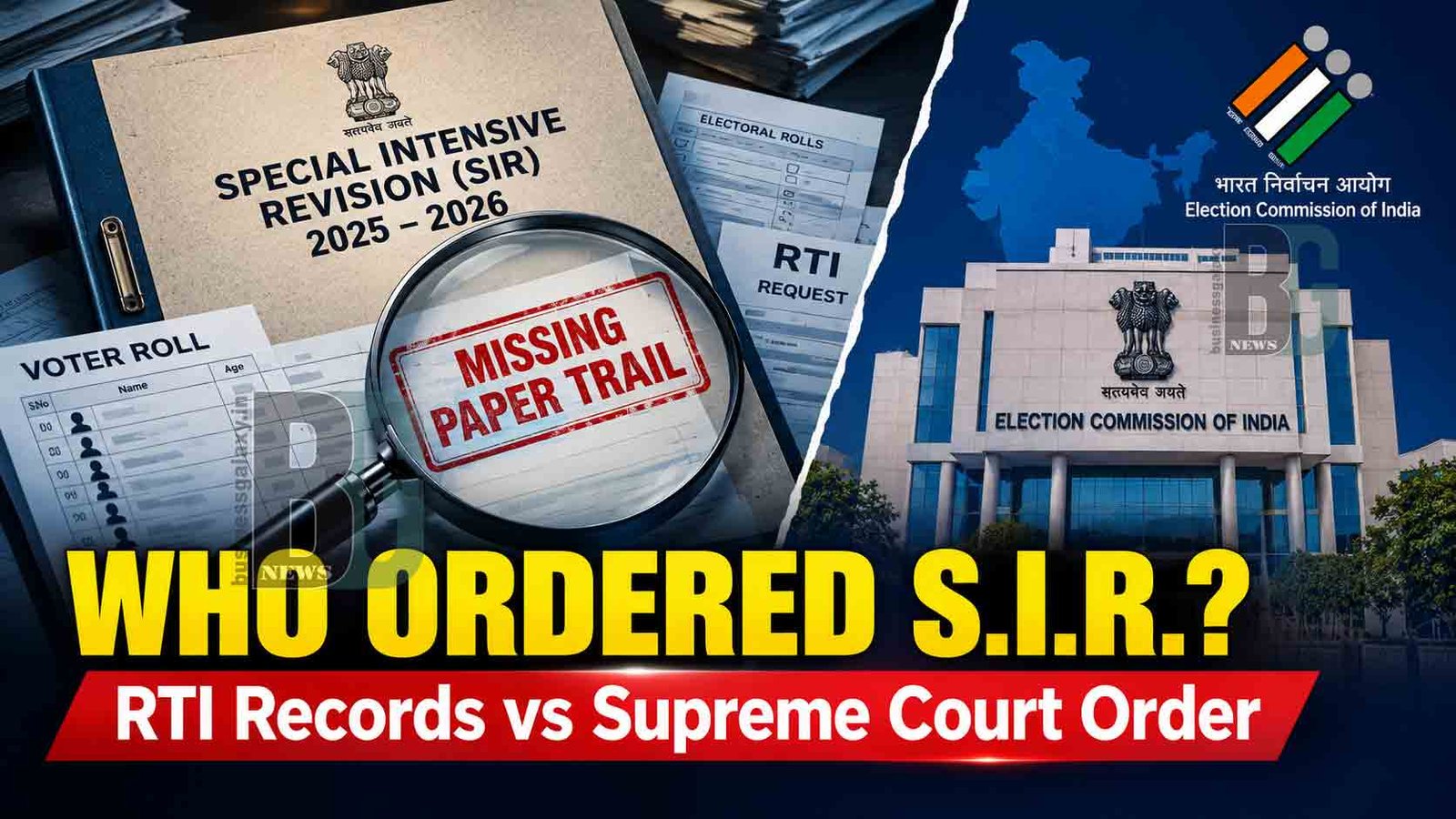
A Right to Information (RTI) response from the Election Commission of India (ECI) has sparked a broader debate over the decision making process, file notings, and internal record keeping behind the nationwide rollout of the Special Intensive Revision (SIR) of electoral rolls.
The controversy gained public attention after transparency activist Anjali Bhardwaj sought records from the Election Commission regarding the background studies, file references and administrative deliberations that led to the exercise.
While public discussion has produced conflicting claims, a step by step examination of the statutory framework, official orders, RTI responses and judicial records reveals what is legally established and what remains a legitimate administrative question.
The Origin: The Bihar SIR Order
The Special Intensive Revision involves door-to-door verification, voter information validation, and the preparation of updated electoral rolls in accordance with election laws.
- June 24, 2025: The Election Commission issued an official order directing an SIR across every Assembly constituency in Bihar.
- Legal Basis: The Commission cited its constitutional mandate under Article 324, read alongside Section 21(3) of the Representation of the People Act, 1950.
- Judicial Confirmation: On May 27, 2026, the Supreme Court of India examined the Bihar exercise and affirmed the Election Commission’s authority to conduct a special revision under this statutory framework.
This establishes that the Bihar SIR was formally ordered and legally executed by the Election Commission.
What the RTI Application Asked vs. What the ECI Responded
On July 28, 2025, an RTI application was filed seeking recorded studies, file notings, independent assessments, and internal minutes that documented how and when the decision to initiate SIR was taken.
On September 27, 2026, the response from ECI Principal Secretary and First Appellate Authority T.C. Kom became public, stating that the Commission had “so far not taken any decision on initiating a Special Intensive Revision (SIR) across the country in 2025.”
To understand this statement accurately, two technical factors must be considered:
-
The Scope of “Material Form” under RTI Law: Under Section 2(f) of the RTI Act, 2005, a Central Public Information Officer (CPIO) can only provide information that exists “in material form” on record. The Appellate Authority’s statement indicates that as of that date, no physical file notings or written proposals for a nationwide SIR existed in the CPIO’s record.
-
Regional vs. Nationwide Scope: The June 24, 2025 order was specifically framed for Bihar. The RTI response confirmed that a single, overarching decision for a nationwide rollout had not been documented in material form at that specific junction, even as regional phases progressed.
Does the RTI Prove an External Authority Ordered SIR?
No.
The RTI response does not name the Union Government, the Ministry of Home Affairs, or any other executive body as the authority behind the SIR. Furthermore, none of the public documents or court proceedings establish that an external authority issued directives to the Commission.
Asserting that “the RTI proves another authority ordered the SIR” is an inaccurate extrapolation of the record. The RTI simply highlights a gap in the administrative paper trail for the nationwide expansion at that point in time.
Legal Nuance: Section 21(3) and the Nature of “SIR”
The legal framework surrounding electoral revisions involves a distinct procedural nuance:
- Statutory Power: Section 21(3) of the Representation of the People Act, 1950, empowers the Election Commission to direct a “special revision” for reason recorded in writing.
- Procedural Departure: While standard Summary Revisions occur routinely, an “Intensive Revision” involves comprehensive door to door verification, shifting a higher burden of verification onto the voter and local administrative machinery.
- Constitutional Framework: While the Supreme Court recognized the ECI’s broad plenary powers under Article 324 to ensure clean electoral rolls, legal commentators and former election officials have noted that large scale intensive revisions require robust, documented internal justifications to explain why routine summary revisions were deemed insufficient.
ECI’s Clarification and Internal Deliberations
- On September 26, 2026, the Election Commission addressed the controversy, clarifying that decisions regarding the SIR schedule, scope, and phased implementation were taken with the unanimous approval of the full Commission. The ECI affirmed that both the initial June 24, 2025 Bihar order and subsequent expansions were formally approved by the Election Commissioners.
- This statement addresses the question of Commission wide consensus. However, it sits alongside broader media coverage regarding internal deliberations and administrative timelines, underscoring why the timing of file notings remains a focal point for transparency advocates.
Summary of Facts
What Is Documented Record:
- The ECI legally issued the June 24, 2025 order for the Bihar SIR under Article 324 and Section 21(3).
- The Supreme Court affirmed the ECI’s statutory authority to conduct special revisions.
- An RTI response noted that as of the query date, no written record existed in material form for a nationwide 2025 SIR.
- The ECI formally clarified in September 2026 that all SIR decisions were unanimously approved by the full Commission.
What Is Unsubstantiated:
- That the Union Government or Home Ministry ordered or directed the SIR.
- That an external body usurped the Election Commission’s constitutional function.
Conclusion
- The debate surrounding the Special Intensive Revision is not a question of whether the Election Commission possesses the legal mandate to revise electoral rolls the law and the Supreme Court have clearly established that it does.
- Instead, the core unanswered question centers on administrative transparency and institutional chronology: Through what exact paper trail, file notings, recorded reasons, and internal dates did the Commission transition from a state specific order in Bihar to a nationwide phased implementation?
- Providing access to those underlying recorded reasons and file notings would offer full clarity on the administrative process behind one of the country’s most significant electoral exercises.