

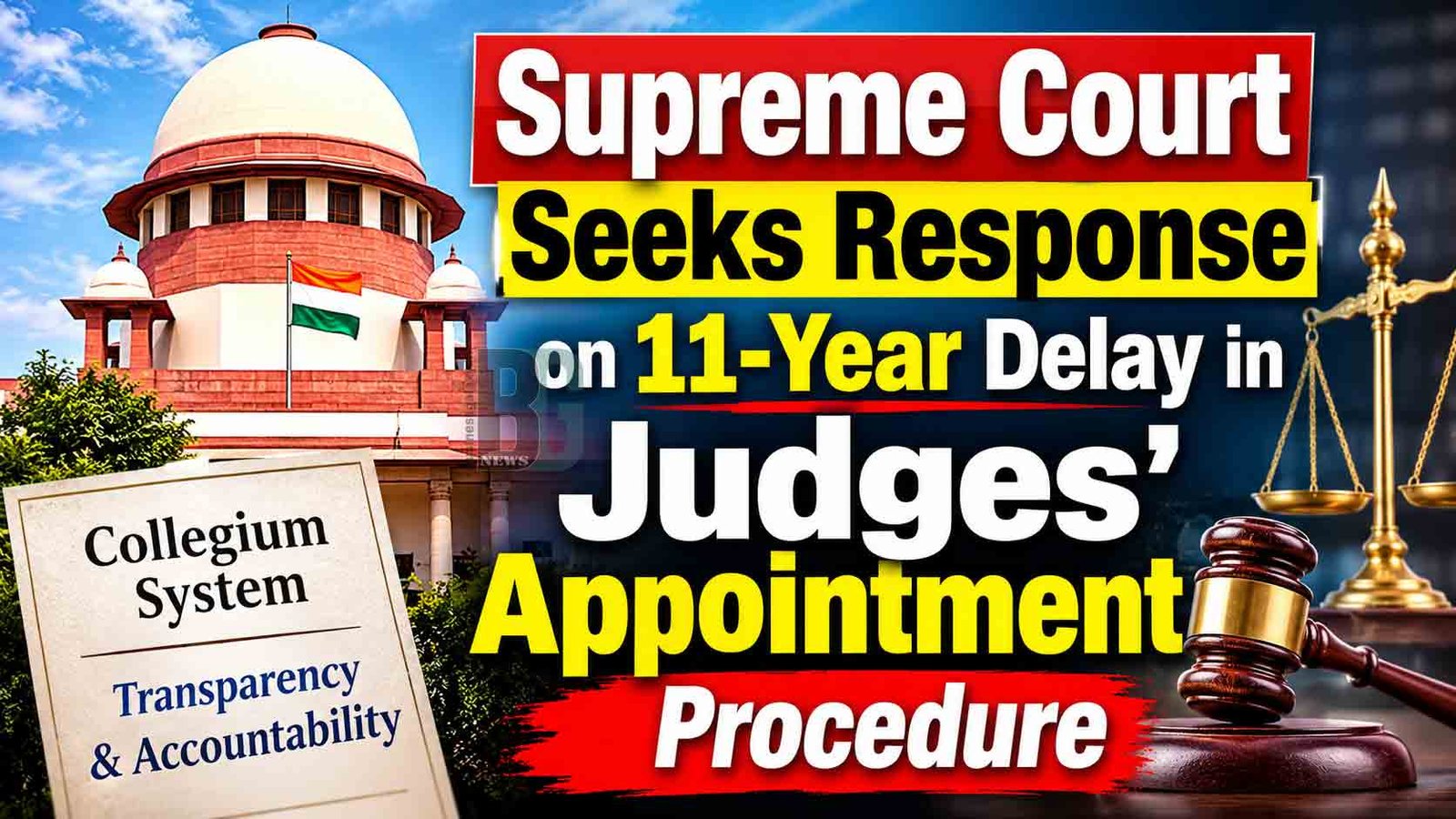
NEW DELHI, November 24, 2026: The Supreme Court of India has sought responses from the Union Government and the Supreme Court administration over a nearly 11 year delay in finalising the revised procedure for appointing judges to the Supreme Court and High Courts.
The development follows a Public Interest Litigation (PIL) filed by NGO Lok Prahari, which has raised concerns about transparency, accountability and the absence of clearly defined selection criteria for judicial appointments.
A bench comprising Justice M.M. Sundresh and Justice P.B. Varale issued notice on November 18, seeking responses on the petition.
The matter brings renewed attention to the long pending revision of the Memorandum of Procedure (MoP), which governs judicial appointments under the Collegium system.
What is the Memorandum of Procedure (MoP)?
- The Memorandum of Procedure is a framework that regulates the appointment, elevation and transfer of judges to India’s higher judiciary.
- It establishes the process through which the Supreme Court Collegium recommends candidates and the Union Government considers those recommendations.
- The existing procedure dates back to 1999. Its revision became necessary following the Supreme Court’s landmark 2015 judgment striking down the National Judicial Appointments Commission (NJAC) Act and retaining the Collegium system.
- The Constitution Bench had called for improvements to the appointment process, including greater transparency and clearly defined procedures.
- However, the revised MoP has remained pending for nearly 11 years.
What has the petition demanded?
The NGO Lok Prahari has sought directions to the Union Government and the Chief Justice of India (CJI) to complete the revision of the MoP.
Its major demands include:
- Transparent selection criteria: Clearly defined eligibility requirements for candidates seeking appointment as judges.
- Public disclosure: Publication of appointment procedures and eligibility criteria on the websites of the Supreme Court, High Courts and Department of Justice.
- Collegium transparency: Making the minutes of Supreme Court and High Court Collegium meetings accessible under the Right to Information (RTI) Act, 2005.
- Permanent secretariat: Establishing dedicated secretariats to support the functioning of the Collegium.
- Complaint mechanism: Creating a proper system to examine complaints against candidates being considered for judicial appointments.
- Written records: Maintaining proper minutes of Collegium discussions, including dissenting opinions.
The petition has also requested that the revised procedure be finalised within one month after the necessary consultation between the judiciary and the government.
Why has the revision been delayed?
- The issue dates back to October 2015, when a five-judge Constitution Bench struck down the NJAC Act, which sought to introduce a new mechanism involving both the judiciary and executive in judicial appointments.
- The judgment retained the Collegium system but recognised the need to improve its functioning.
The revision process subsequently faced differences between the government and judiciary over several matters, including:
- The government’s proposed role in rejecting candidates on national security grounds.
- The structure and functioning of a permanent Collegium secretariat.
- The balance between executive involvement and judicial independence.
Although discussions and exchanges of proposals continued, a revised MoP has not been formally finalised.
In February 2026, Union Law Minister Arjun Ram Meghwal informed the Rajya Sabha that the revision process remained under consideration.
What happens next?
- The Supreme Court has sought responses from the concerned respondents. The Union Government and Supreme Court administration will have to present their positions before the matter proceeds further.
- The Court has not yet delivered a final judgment on the petition or ordered the immediate implementation of a revised appointment procedure.
- The proceedings could become significant for future discussions on judicial transparency, accountability and the relationship between the executive and judiciary.
Why is this important?
- The appointment of judges to constitutional courts is central to the independence and credibility of India’s judicial system.
- While judicial independence is essential, transparency in selection procedures and accountability in institutional functioning are equally important.
- The case raises an important constitutional question: How can India maintain judicial independence while ensuring that the process of appointing judges is transparent, consistent and accountable to the public?
- The outcome may influence future reforms in India’s higher judicial appointment system.