

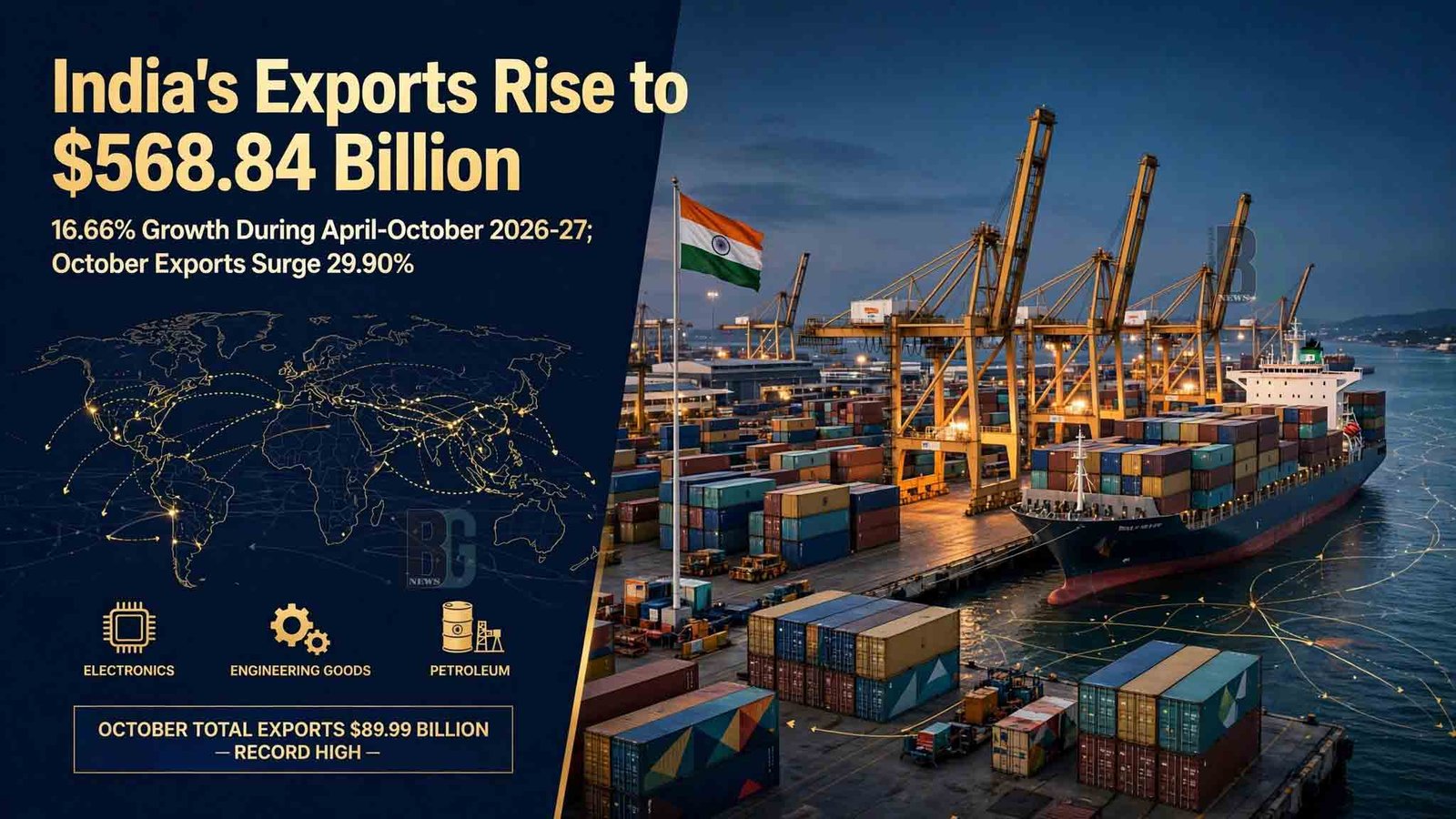
October Exports Surge 29.90% as Electronics, Petroleum, Engineering Goods and Gems & Jewellery Drive Growth
New Delhi: India’s total exports of merchandise and services are estimated to have reached US$568.84 billion during April-October 2026-27, registering a growth of 16.66% compared with US$487.59 billion during the corresponding period of the previous financial year, according to data released by the Ministry of Commerce and Industry.
The export performance reflects growth across several major sectors, including petroleum products, electronic goods, engineering products, gems and jewellery and chemicals.
October Records Strong Export Growth
India’s total exports during October 2026 are estimated at US$89.99 billion, marking a significant increase of 29.90% compared with US$69.27 billion in October 2025.
The growth was supported by strong performance in both merchandise and services exports.
- Merchandise exports reached US$49.47 billion, compared with US$34.11 billion in October 2025.
- Services exports were estimated at US$40.51 billion, compared with US$35.17 billion a year earlier.
- Merchandise exports registered 45.06% growth during October.
Electronics and Engineering Goods Lead Sectoral Growth
Several major export categories recorded significant increases during October 2026.
| Export sector | Year on year growth |
|---|---|
|
Petroleum products |
140.21% |
|
Electronic goods |
62.70% |
|
Gems & jewellery |
40.06% |
|
Organic & inorganic chemicals |
36.20% |
| Engineering goods |
36.01% |
The performance highlights the contribution of manufacturing and industrial products to India’s export expansion.
Non-Petroleum Exports Also Show Strong Performance
- India’s non-petroleum exports during April-October 2026-27 reached US$259.22 billion, registering an increase of 18.01% compared with US$219.66 billion during the corresponding period last year.
- This indicates that export growth was not limited to petroleum products and also extended to other sectors of the economy.
Major International Markets Record Export Growth
- India also recorded growth across several important overseas markets during April-October 2026-27.
Some of the major destinations showing increased exports included:
| Export destination | Growth |
|---|---|
|
Singapore |
107.50% |
|
Malaysia |
106.87% |
|
Spain |
88.38% |
|
South Africa |
62.20% |
|
Sri Lanka |
60.42% |
|
Hong Kong |
47.61% |
|
Japan |
41.02% |
|
China |
37.71% |
| Germany |
14.53% |
| United States |
14.48% |
Trade Deficit Remains an Important Concern
- Despite the strong export performance, India’s total imports during April-October 2026-27 were estimated at US$662.19 billion, compared with US$570.84 billion during the same period last year.
- Consequently, India’s overall merchandise and services trade deficit widened to US$93.35 billion, compared with US$83.25 billion a year earlier.
- For October alone, total imports reached US$110.07 billion, exceeding exports of US$89.99 billion.
- This indicates that although exports are growing, imports are also increasing and remain higher than exports.
Government Measures to Support Export Growth
The government continues to support exporters through various foreign trade policy measures, including:
- Foreign Trade Policy 2023: Provides the framework for promoting India’s international trade.
- RoDTEP Scheme: Provides refunds of eligible unrebated duties and taxes on exported products.
- Advance Authorisation: Allows duty free imports of eligible inputs used in export production.
- Export Promotion Capital Goods Scheme: Supports the import of capital goods at zero customs duty, subject to prescribed export obligations.
These measures aim to improve export competitiveness, support manufacturers and expand access to international markets.
Conclusion
- India’s export growth during April-October 2026-27 reflects positive performance across manufacturing, petroleum, electronics, engineering and services sectors. However, the widening trade deficit highlights the importance of strengthening domestic production, increasing export competitiveness and managing import dependence.
Source: Ministry of Commerce and Industry, Government of India – Press Information Bureau