
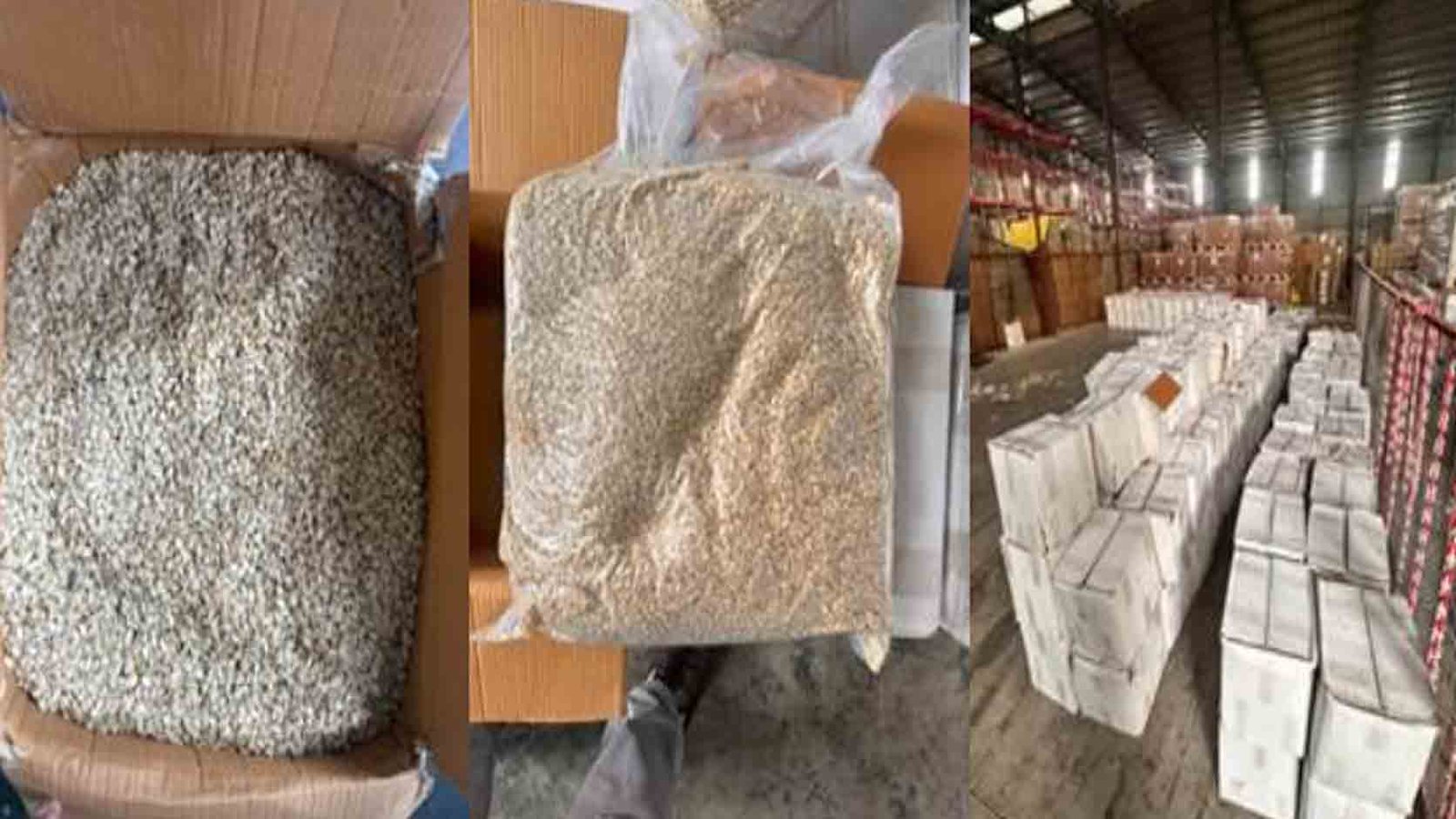
New Delhi: The Directorate of Revenue Intelligence (DRI) has seized approximately 25,000 kilograms of watermelon seeds suspected to have originated in Pakistan and arrested two persons for their alleged involvement in an attempt to bypass India’s import restrictions on Pakistani goods.
According to a Press Information Bureau (PIB) release dated October 23, the operation was conducted under Operation Deep Manifest between September 11 and October 22, 2026. Investigators allege that the consignment was routed through Dubai and falsely declared as originating in the United Arab Emirates (UAE) to conceal its Pakistani origin.
The seized consignment has an estimated market value of ₹2.02 crore.
Consignment Intercepted at Nhava Sheva Port
- Acting on specific intelligence, DRI officers examined a consignment imported through Nhava Sheva Port in Maharashtra. The goods were declared as UAE origin muskmelon seeds.
- However, examination revealed that the consignment contained watermelon seeds, with documentary evidence indicating that the goods originated in Pakistan, according to the DRI.
- Officials said the investigation uncovered a suspected transshipment arrangement intended to disguise the actual country of origin.
How the Alleged Import Scheme Worked
- According to the preliminary investigation, the consignment was initially shipped from Karachi Port in Pakistan to Jebel Ali Port in Dubai.
- At Dubai, the goods were transferred into different containers and loaded onto another vessel for onward transportation to India. Investigators allege that the change of containers and vessels, combined with incorrect declarations and fabricated import documents, was intended to conceal the Pakistani origin of the seeds.
- The DRI said documentary evidence traced the consignment’s movement from Pakistan through Dubai to India.
- The consignment was seized on October 14, 2026, under the relevant provisions of the Customs Act, 1962.
Earlier Consignment of 22,000 Kg Also Under Scrutiny
- The investigation also uncovered an earlier import of approximately 22,000 kilograms of muskmelon seeds in February 2026 from the same Dubai based supplier.
- That consignment was also declared as originating in the UAE. According to the DRI, evidence of a similar transshipment arrangement has raised questions about the declared origin of those goods.
- Together, the two consignments account for 46,920 kilograms of watermelon and muskmelon seeds suspected to be of Pakistani origin, according to the PIB release.
Two Persons Arrested
- The DRI arrested two persons on October 22, 2026, in connection with the alleged operation.
- According to the investigation, one is the son of the Importer Exporter Code (IEC) holder and the owner and director of the Dubai based supplier company. The other is his cousin, who allegedly handled import related formalities and domestic sales in India.
- The arrests form part of the ongoing investigation into the suspected misdeclaration of goods and the alleged circumvention of India’s import restrictions.
Why Are Pakistani Goods Banned?
- Following the Pahalgam terror attack in April 2025, the Government of India prohibited the direct or indirect import or transit of goods originating in or exported from Pakistan, citing national security and public policy concerns.
- The prohibition was introduced through Directorate General of Foreign Trade (DGFT) Notification No. 06/2025-26, dated May 2, 2025.
- The PIB release also states that watermelon seeds have been subject to import restrictions since July 1, 2024, under the applicable DGFT notification.
- The DRI said the suspected import violated the applicable import policy and customs requirements.
Previous DRI Actions Against Suspected Misdeclared Imports
The latest seizure follows other enforcement actions targeting goods allegedly routed through third countries to conceal their Pakistani origin.
According to the DRI, these include:
- September 2026: Seizure of more than 362 metric tonnes of Pakistani origin dry dates routed through Dubai and intercepted at a container freight station in Ambad, Nashik.
- October 2026: Detection of an alleged illegal import involving 295 containers carrying approximately 7,311 metric tonnes of Pakistani origin industrial or Himalayan rock salt routed through Colombo, Sri Lanka.
These cases highlight the agency’s focus on suspected customs fraud and attempts to evade India’s import restrictions.
Investigation Continues
- The DRI said it remains committed to identifying networks involved in customs fraud and the circumvention of import prohibitions.
- The latest case highlights the role of country of origin verification and documentary checks in enforcing India’s trade restrictions.
- The allegations against the arrested persons remain subject to the legal process, and further investigation will establish the full extent of the suspected operation.
Source: Press Information Bureau (PIB), Government of India, press release dated October 23, 2026.
Business Galaxy: Reporting Facts. Shaping Futures.