
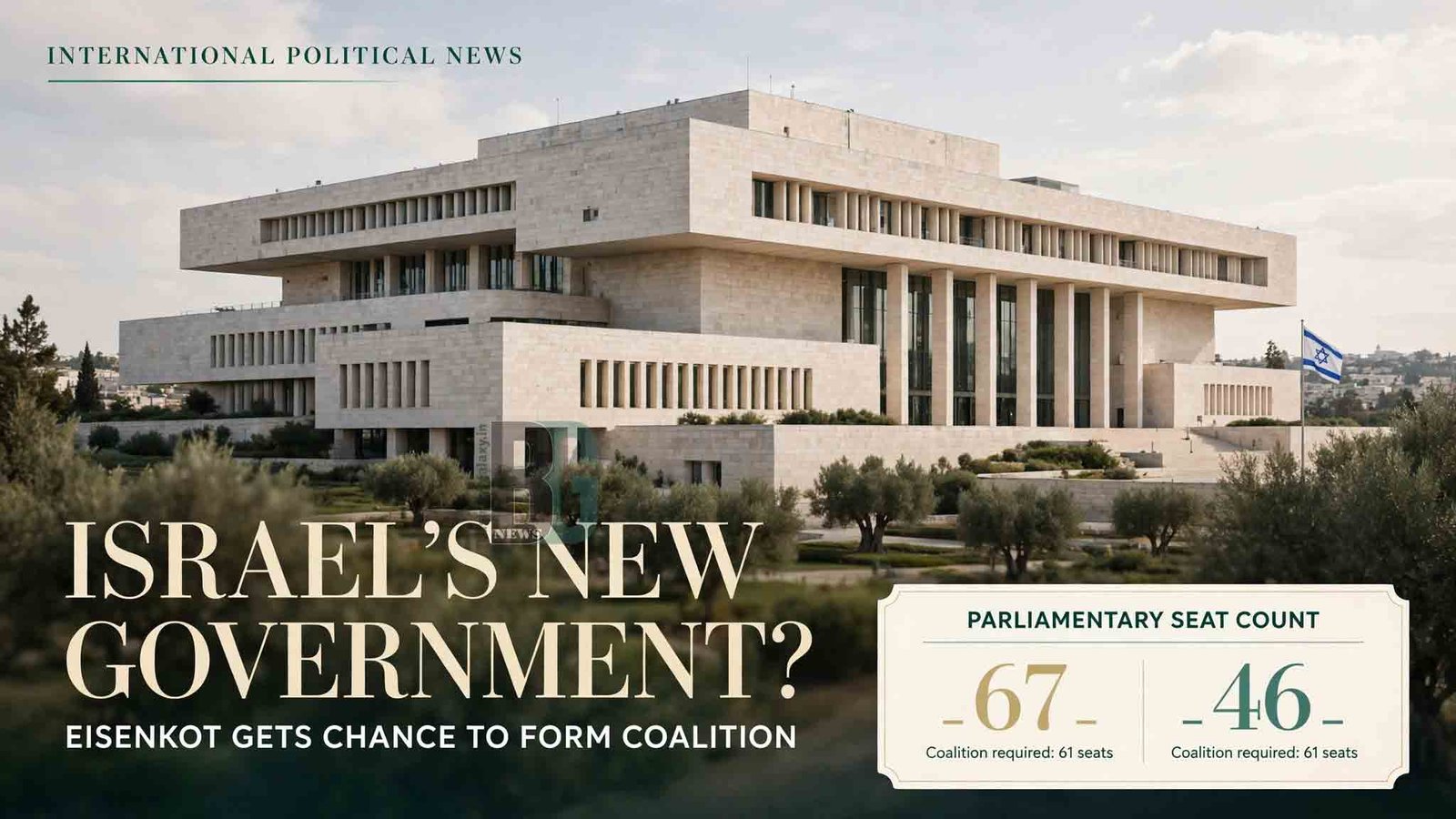
JERUSALEM: Israeli President Isaac Herzog has selected opposition leader Gadi Eisenkot to attempt to form the country’s next government, marking a significant political development following the October 27 parliamentary elections.
- The decision gives Eisenkot, leader of the Yashar party and a former chief of the Israel Defense Forces (IDF), the first opportunity to assemble a governing coalition and potentially replace incumbent Prime Minister Benjamin Netanyahu.
- The announcement came on Saturday, November 7, after President Herzog held consultations with political parties and representatives across the political spectrum.
- According to the President’s Office, parliamentary factions representing 67 members of the Knesset recommended Eisenkot for the premiership, while factions representing 46 lawmakers backed Netanyahu. A seven-member faction did not recommend either candidate.
Eisenkot to Receive 28 Days to Form Government
- President Herzog has invited Eisenkot to the President’s Residence on Sunday, November 8, at 5 pm local time, to formally receive the mandate to form the next government.
- Under Israeli law, he will have 28 days to negotiate with political parties and establish a coalition. The president can grant an additional extension of up to 14 days if required.
- If Eisenkot fails to secure sufficient parliamentary support, the mandate could be given to another candidate, potentially Netanyahu.
Election Results Leave Israel Without a Clear Majority
- The October 27 parliamentary elections produced a divided political landscape in Israel’s 120 member Knesset.
- Netanyahu’s Likud party secured 27 seats, while Eisenkot’s Yashar party won 21 seats.
- The broader political blocs remained short of the 61 seats required for a parliamentary majority.
According to the reported final seat distribution:
- Netanyahu’s political bloc: 53 seats.
- Eisenkot’s four party opposition bloc: 48 seats.
- Joint List and Ra’am: 19 seats combined.
The two Arab-led political groups supported Eisenkot during the presidential consultations, helping him secure recommendations from 67 lawmakers.
Arab Parties Support Becomes Important
- The Joint List and Ra’am, two Arab-led political groups that together hold 19 seats, have backed Eisenkot’s bid to form the next government.
- Their support has strengthened his position in the presidential consultations. However, their recommendations do not automatically mean they will join his governing coalition.
- Eisenkot faces difficult negotiations because several parties within his opposition bloc have reservations about forming a government with Arab-led parties.
- Other possible coalition arrangements include cooperation with ultra Orthodox parties or an attempt to establish a broader national unity government.
Netanyahu Calls for National Unity Government
- Following Herzog’s announcement, Netanyahu called for the formation of a national unity government, proposing cooperation between his Likud party and opposition parties.
- However, Eisenkot has maintained his opposition to serving in a government led by Netanyahu, making negotiations over a possible unity arrangement challenging.
- The coming weeks will be crucial in determining whether Eisenkot can secure the parliamentary support required to become Israel’s next prime minister.
What Happens Next?
- Eisenkot must now negotiate with political parties to secure at least 61 votes in the 120 member Knesset.
- If he succeeds, he could become Israel’s next prime minister. If he fails, President Herzog may give another candidate an opportunity to form a government. A failure by subsequent candidates could eventually lead to another election.
- The political developments come amid continuing security challenges, the conflict involving Iran and disagreements over the government’s handling of the Gaza war.
- The outcome of the coalition negotiations could significantly influence Israel’s domestic politics, security policies and regional diplomatic relations.