
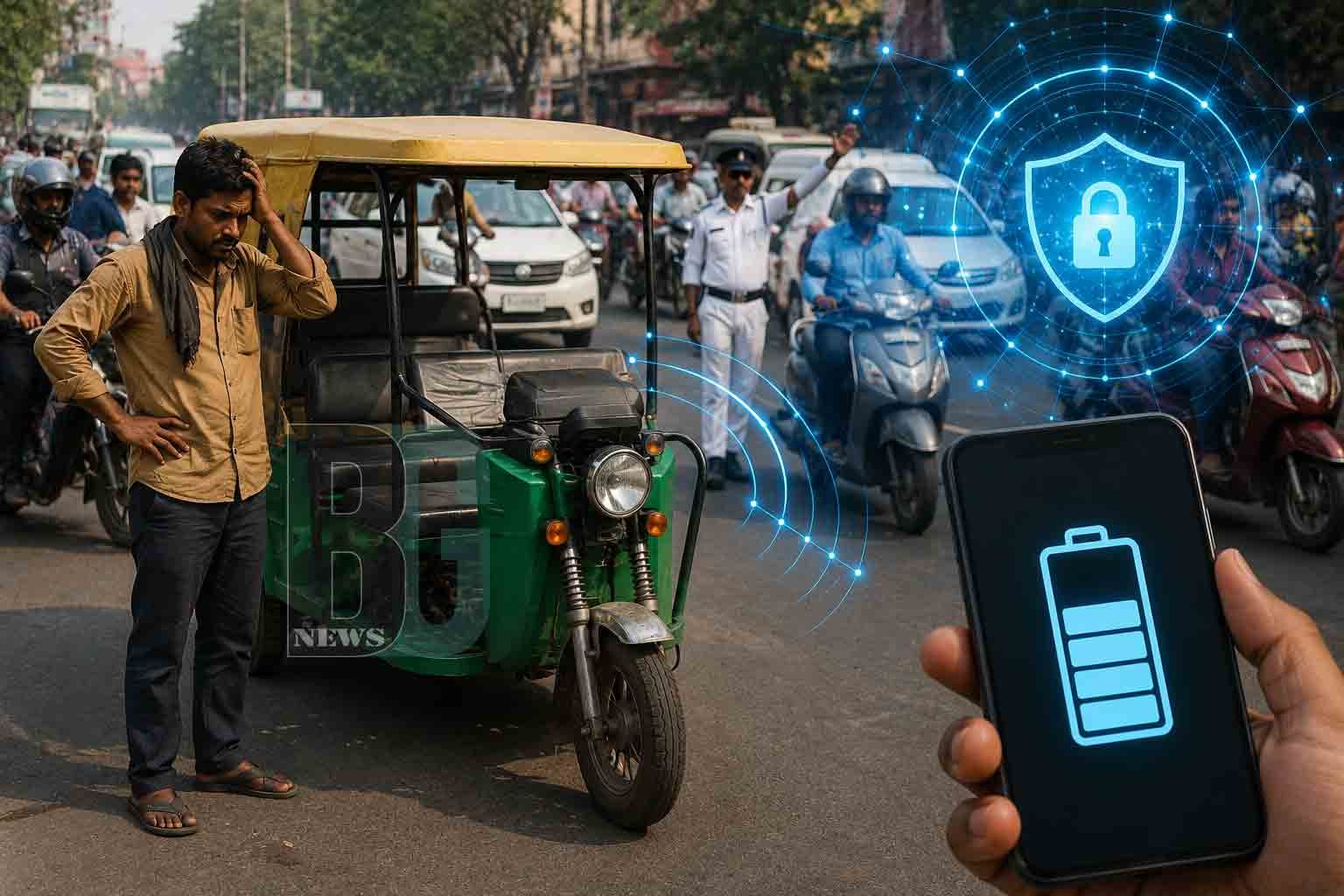
A viral social media trend involving the remote disabling of e-rickshaws has sparked serious concerns about road safety and cybersecurity. Videos circulating online show teenagers and young adults allegedly using a smartphone application to switch off compatible e-rickshaws while they are moving or stopped in traffic, leaving drivers stranded in the middle of busy roads.
Several clips show confused drivers attempting to restart their vehicles, while others are forced to push their e-rickshaws for long distances. The incidents have raised fears that such actions could lead to traffic congestion, accidents, or injuries, particularly if a vehicle suddenly loses power in a crowded area.
According to reports, the application involved is BAT-BMS, a legitimate battery management app developed by China’s Shenzhen Grenergy Technology. The app is designed to help owners monitor battery health and manage compatible Bluetooth enabled lithium batteries. However, experts say some low cost Battery Management Systems (BMS) used in certain e-rickshaws and electric scooters reportedly lack adequate Bluetooth security, making them vulnerable to unauthorized access if someone is within a short distance.
Not Just a Prank A Serious Safety Risk
Road safety experts warn that remotely disabling any moving vehicle can have dangerous consequences. A sudden loss of power may cause vehicles to stop unexpectedly, increasing the risk of rear end collisions, injuries to passengers, or traffic disruptions.
The trend has also been criticized for targeting drivers who rely on e-rickshaws as their primary source of income. For many families, even a few hours without work can mean a significant financial loss.
Cybersecurity professionals stress that technology designed for maintenance and monitoring should never be misused to interfere with someone else’s property.
How E-Rickshaw Owners Can Protect Their Vehicles
Drivers and fleet operators can take several precautions to reduce the risk of unauthorized access:
- Purchase batteries and Battery Management Systems from trusted manufacturers that include secure Bluetooth authentication.
- If Bluetooth is not required, ask the battery supplier or service centre to disable it or secure it with a password.
- Keep battery firmware updated whenever updates are provided by the manufacturer.
- Avoid sharing Bluetooth pairing information with unauthorized persons.
- Park vehicles in well-lit, monitored locations whenever possible.
- Contact the battery manufacturer if unusual battery behaviour or unexpected shutdowns occur.
- Replace outdated battery management systems that lack modern security features.
What Battery Manufacturers Should Do
Experts say manufacturers also have a responsibility to improve product security by:
- Requiring password protected Bluetooth connections.
- Using encrypted communication between the app and battery.
- Allowing only the registered owner to control battery settings.
- Releasing regular security updates.
- Including tamper alerts and access logs.
What Authorities Can Do
The incident highlights the need for stronger cybersecurity standards for connected electric vehicles. Experts suggest governments and regulators could consider:
- Introducing mandatory cybersecurity standards for Bluetooth enabled battery systems.
- Requiring certification before connected battery systems are sold in India.
- Directing manufacturers to issue software updates for vulnerable products.
- Working with app stores to remove or restrict applications that can be easily misused.
- Launching awareness campaigns to educate drivers about securing connected devices.
- Encouraging manufacturers to establish customer support and security helplines for affected users.
Legal Consequences
Intentionally disabling another person’s vehicle without permission may amount to offences under India’s criminal and cyber laws if it causes damage, injury, or disruption. Authorities may investigate such incidents depending on the circumstances and evidence available.
A Reminder About Responsible Technology Use
While some social media users have portrayed the trend as a harmless prank or a way to target allegedly reckless drivers, many others have condemned it, noting that it endangers public safety and threatens the livelihoods of e-rickshaw operators.
Technology should be used responsibly. What appears to be a viral challenge online can have real world consequences for innocent drivers, passengers and everyone sharing the road.