
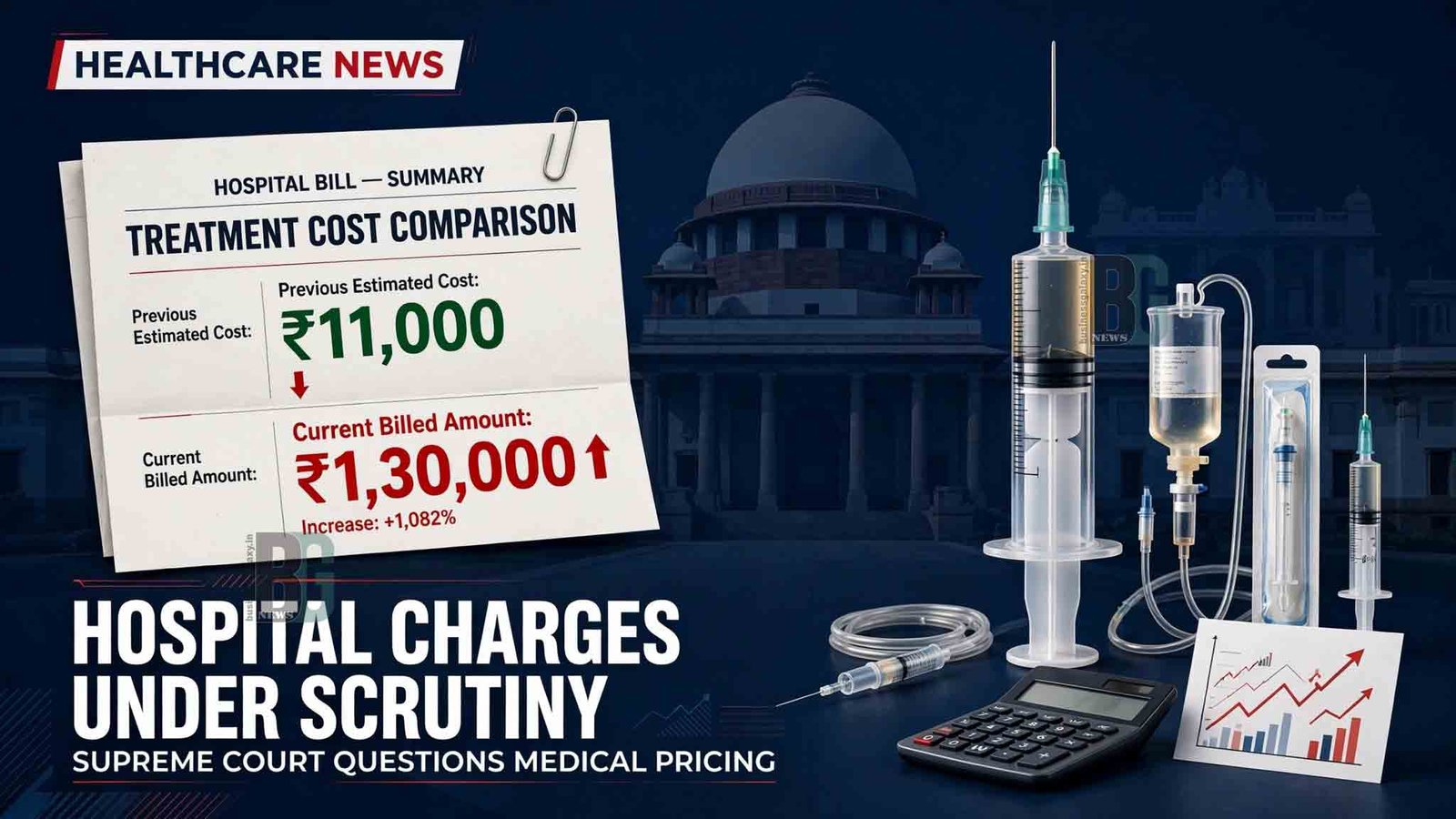
The Supreme Court of India has raised serious concerns over the high prices of medicines and medical consumables charged to patients by hospitals. During a hearing on October 27, 2026, the Court questioned how a cancer injection reportedly available to a medical distributor for ₹11,000 was charged at ₹1.30 lakh by a private hospital.
The example was brought to the Court’s attention during proceedings on petitions seeking stronger regulation of medicine prices, generic prescriptions and trade margins on medical devices.
Cancer injection price difference questioned
- During the hearing, the Court referred to the case of a medical distributor whose wife was undergoing cancer treatment at a private hospital.
- According to the account presented before the bench, the distributor told the hospital that he could obtain the chemotherapy injection at a dealer price of ₹11,000. However, the hospital reportedly refused to administer the medicine supplied by him and charged ₹1.30 lakh for the injection.
- The bench of Justices Vikram Nath and Sandeep Mehta questioned the justification for such a substantial price difference and raised concerns about the financial burden on patients and their families.
- It is important to note that this was an example presented during court proceedings and should not be treated as proof that all private hospitals follow similar billing practices.
Maharashtra FDA survey highlights major price differences
- The issue of medical consumable pricing had also come under scrutiny following a survey highlighted by Maharashtra Food and Drug Administration Commissioner Tukaram Mundhe.
- The survey identified substantial differences between the trade prices and printed maximum retail prices (MRPs) of commonly used hospital consumables.
Some reported examples include:
- IV infusion set: Trade price ₹11.05; printed MRP ₹325.
- Disposable syringe: Trade price ₹6.75; printed MRP ₹57.20.
- Catheter: Trade price ₹29.41; printed MRP ₹310.
The IV infusion set example represents a markup of approximately 2,841% over its reported trade price.
However, the difference between a trade price and printed MRP does not automatically represent the profit earned by a hospital. The final amount charged to a patient and the margins earned at different stages of the supply chain may vary.
The findings have raised questions about pricing transparency and the need for stronger monitoring of medical consumables.
Supreme Court examines the existing pricing framework
- The petitions before the Supreme Court raise concerns about the regulation of non-scheduled medicines, the availability of generic alternatives and trade margins on medical devices.
- Under the existing framework, the National Pharmaceutical Pricing Authority (NPPA) regulates the ceiling prices of scheduled medicines and certain notified products. Many non-scheduled medicines and medical consumables are not subject to the same type of individual ceiling price control.
- The Centre has defended its approach to medicine pricing, while private hospital representatives have argued that hospitals also have significant operating expenses, including infrastructure, equipment, nursing, infection control and round the clock services.
- The Supreme Court questioned whether such costs could justify the substantial differences highlighted during the hearing.
- After hearing the arguments, the bench reserved its order. Therefore, the Court’s observations should not be confused with a final judgment or a newly implemented price control policy.
What can patients do about excessive hospital bills?
Patients and their families should carefully examine hospital bills and retain supporting documents, particularly when they notice unexplained or unusually high charges.
They can take the following steps:
- Request an itemised bill: Ask the hospital to provide a detailed breakdown of medicines, injections, consumables, procedures and other charges.
- Keep supporting documents: Preserve prescriptions, payment receipts, medicine packaging, diagnostic reports and discharge summaries.
- Raise a written complaint: Submit the complaint to the hospital’s grievance officer or administration and retain an acknowledgement.
- Approach the state drug regulatory authority: For suspected medicine overpricing or violations of drug pricing rules, patients can approach the relevant State Drugs Control Administration or Food and Drug Administration.
- Use the National Consumer Helpline: Consumers can register grievances through the National Consumer Helpline by calling 1915 or visiting consumerhelpline.gov.in.
- Consider consumer legal remedies: If the dispute remains unresolved, patients may seek legal advice about approaching the appropriate Consumer Commission.
The National Consumer Helpline provides a pre litigation grievance redressal mechanism. Filing a complaint does not automatically guarantee a refund or compensation.
Why transparent medical billing matters
- Patients seeking emergency care or life saving treatment are often in a difficult position to compare prices or negotiate charges. Transparent billing, clear pricing information and effective regulation are important to protect patients from unfair financial burdens.
- The Supreme Court proceedings have brought renewed attention to the need for a fair balance between healthcare costs, hospital operations and patients right to affordable treatment.
Business Galaxy | Responsible Journalism. Public Awareness.
Patients should verify the details of their bills and seek clarification before making allegations of fraud or overcharging. Each complaint should be examined on its own facts and supporting evidence.