
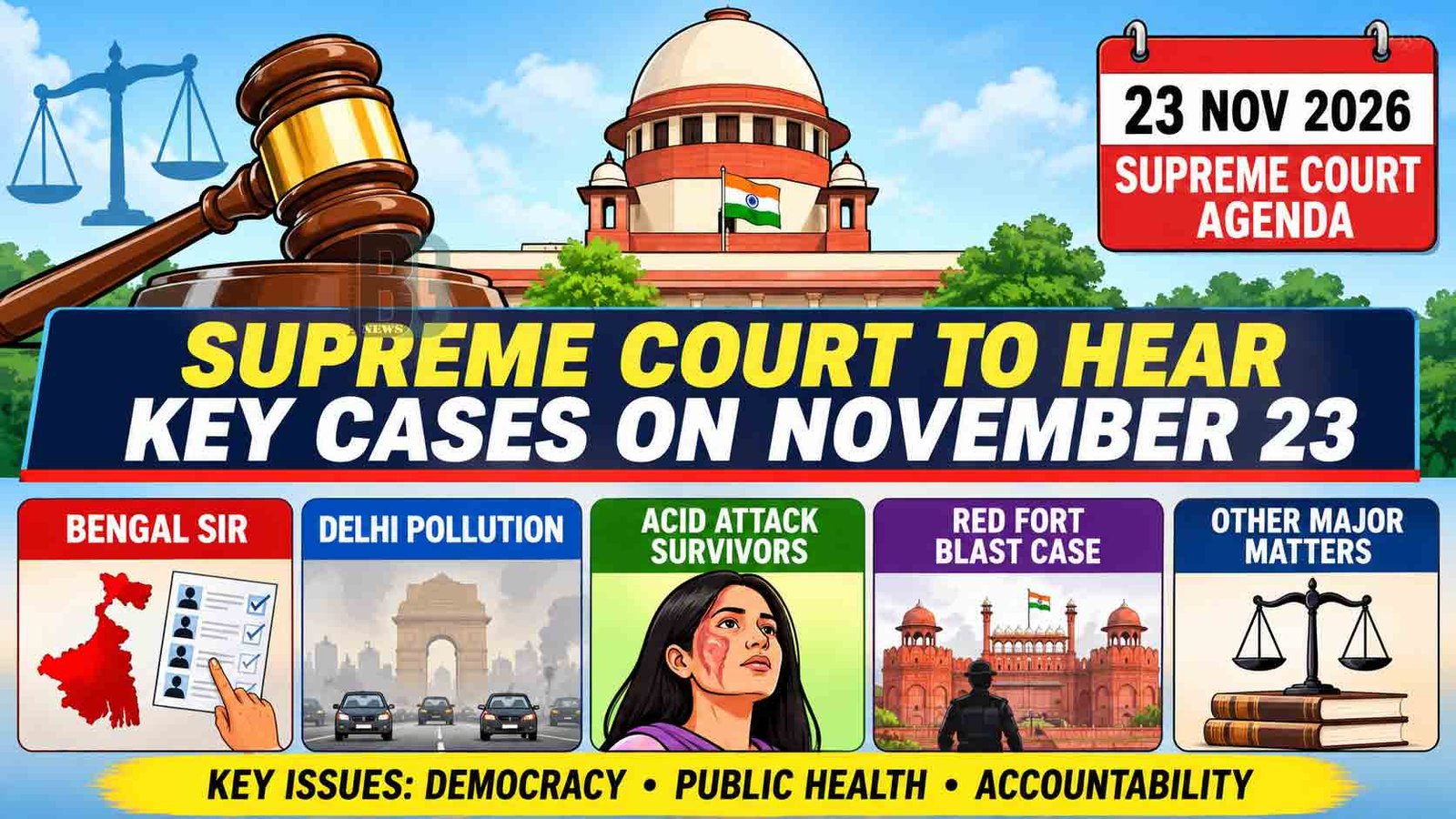
The Supreme Court of India is scheduled to hear several important cases on Monday, November 23, 2026, including petitions challenging aspects of the Special Intensive Revision (SIR) of electoral rolls in West Bengal and proceedings concerning air pollution in the National Capital Region (NCR).
The hearings are significant because they involve electoral rights, transparency in voter list revision, environmental protection and government accountability.
The day’s Supreme Court schedule also includes several other sensitive legal matters, including bail pleas connected with terror related cases and petitions concerning victims of acid attacks.
1. West Bengal SIR: Electoral Roll Revision Under Judicial Scrutiny
- One of the major matters before the Supreme Court concerns the Election Commission of India’s Special Intensive Revision of electoral rolls in West Bengal.
- Former West Bengal Chief Minister Mamata Banerjee and other political leaders have approached the Supreme Court over issues relating to the SIR exercise. Separate petitions filed by Congress leader Rahul Gandhi and other INDIA bloc leaders also raise concerns about alleged irregularities in the electoral roll revision process.
- The dispute centres on the process of verifying voter eligibility, the treatment of voters whose names are flagged or excluded, and the safeguards available to people who challenge decisions affecting their inclusion in electoral rolls.
Why this matters:
- Electoral rolls determine who is eligible to exercise the right to vote.
- Incorrect deletion of eligible voters can affect their democratic rights.
- The Election Commission’s procedures and transparency are central to public confidence in elections.
- Effective appeal mechanisms are important for voters who dispute their exclusion.
Earlier, the Election Commission informed the Supreme Court that approximately 93% of the appeals decided by the relevant tribunals up to the reported cut-off had resulted in the inclusion of affected voters. However, the Commission also cautioned that the disposed cases were not necessarily representative of all pending appeals.
2. Delhi-NCR Air Pollution: Supreme Court Seeks Stronger Action
- Another important matter concerns the continuing air pollution crisis in Delhi and the surrounding National Capital Region.
- The Supreme Court has been monitoring pollution-control measures through suo motu proceedings and has expressed concern over the contribution of vehicular emissions to deteriorating air quality.
- In its November 6 order, a bench headed by Chief Justice of India Surya Kant, along with Justices Joymalya Bagchi and V. Mohana, directed Delhi and neighbouring states to provide detailed information about measures taken to control pollution from vehicles.
The authorities asked to respond include:
- Delhi Government
- Municipal Corporation of Delhi (MCD)
- Delhi Police Traffic Department
- Haryana Government
- Rajasthan Government
- Uttar Pradesh Government
The Court sought information on enforcement against over age and non-compliant vehicles, Pollution Under Control (PUC) certificates, vehicle inspections, challans and restrictions on the entry of polluting vehicles into the NCR.
It also asked the authorities to present short-term and long-term measures supported by a time bound implementation roadmap.
3. Acid Attack Survivors: Compensation, Rehabilitation and Protection
- The Supreme Court is also scheduled to hear a petition seeking better compensation, rehabilitation and protection for acid attack survivors.
- The matter raises important concerns about the long term physical, psychological and financial difficulties faced by survivors and the need for effective government support.
- The petition highlights the importance of rehabilitation, access to medical treatment, financial assistance and protection of survivors’ rights.
4. Red Fort Blast Case: Bail Plea Before the Supreme Court
- The Court’s schedule also includes a bail plea filed by Jasir Bilal in connection with the November 10, 2025 car bomb blast near the Red Fort in Delhi.
- The matter concerns an accused in a serious terror related investigation. The hearing is part of the judicial process and should not be treated as a determination of guilt.
5. Other Important Matters Listed
The Supreme Court’s November 23 schedule also includes:
- Nayeem Ahmad Khan: Bail plea in a terror funding case involving a Kashmiri separatist leader.
- Godhra train burning case: Appeals arising from the 2002 incident, including connected appeals by convicts and the Gujarat government.
- Morbi bridge collapse: Petition by an association representing families and relatives of victims of the October 30, 2022 tragedy.
- Unauthorised constructions: Petitions concerning unauthorised structures and commercial use of residential properties.
Why These Hearings Are Important
The day’s court schedule brings together several issues that directly affect ordinary citizens:
- Democracy: Protection of eligible voters and transparency in electoral processes.
- Public Health: Accountability for measures to control dangerous air pollution.
- Human Rights: Justice, compensation and rehabilitation for acid attack survivors.
- National Security and Justice: Judicial scrutiny of bail matters in serious criminal investigations.
- Public Accountability: Justice for victims of major public tragedies.
Business Galaxy – Editorial Perspective
- The proceedings concerning West Bengal’s SIR deserve particular attention because electoral roll accuracy is fundamental to democratic participation. Every eligible citizen must have a fair opportunity to exercise their right to vote and there must be transparent procedures to address wrongful exclusions.
- Similarly, the Delhi-NCR pollution proceedings highlight the need for governments and enforcement agencies to move beyond temporary restrictions and develop effective, long-term solutions.
The larger question is whether judicial directions will translate into measurable action and accountability on the ground.