
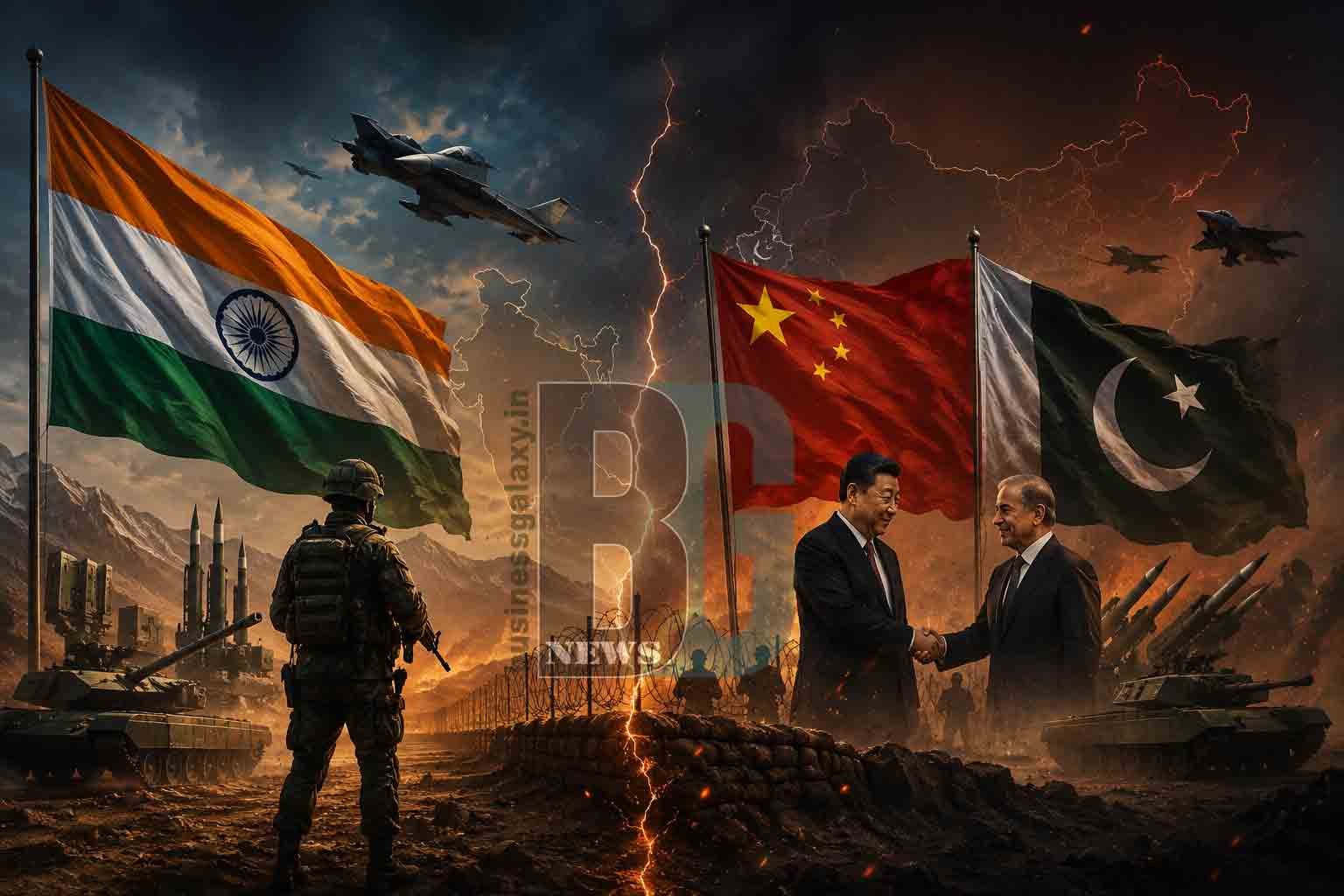
China has officially acknowledged for the first time that its personnel provided on ground technical support to Pakistan during last year’s military conflict with India, known in New Delhi as “Operation Sindoor.” The revelation has intensified discussions over the growing strategic and defence cooperation between Beijing and Islamabad.
The admission came through interviews aired on Chinese state broadcaster CCTV, where engineers from the Aviation Industry Corporation of China (AVIC) described their experiences supporting Pakistan’s air force operations during the conflict.
Background of the Conflict
Tensions between India and Pakistan sharply escalated after the April 22 terror attack in Pahalgam, Jammu and Kashmir, which killed 26 people. In response, India launched Operation Sindoor, targeting nine terror-related locations in Pakistan and Pakistan occupied Kashmir (PoK).
Indian authorities stated that the strikes were aimed at infrastructure linked to terror groups including Jaish-e-Mohammed, Lashkar-e-Taiba, and Hizbul Mujahideen. According to Indian officials, more than 100 terrorists were killed during the operation.
China’s First Public Admission
In the CCTV interview, AVIC engineer Zhang Heng revealed that Chinese technical teams were stationed at support bases in Pakistan during the confrontation. He described hearing fighter jets taking off continuously and air raid sirens sounding throughout the operation.
Zhang said the Chinese team worked under difficult conditions, with temperatures nearing 50 degrees Celsius, while ensuring that the aircraft and systems supplied to Pakistan operated effectively during combat.
The comments marked the first official confirmation from Beijing that Chinese personnel were directly involved in providing operational technical assistance to Pakistan during the India-Pakistan clash.
Focus on Chinese Fighter Jets
Pakistan’s air force operates Chinese-made J-10CE fighter jets, considered among the most advanced export aircraft developed by China. Pakistan remains the only foreign operator of the J-10C series outside China.
Chinese engineers involved in the programme described the aircraft’s battlefield performance as proof of the close cooperation between Chinese developers and Pakistani operators. Officials connected to the project said they were confident in the aircraft’s capabilities and viewed the conflict as a major real world test of the platform.
Pakistan had ordered 36 J-10CE fighters along with PL-15 long-range missiles from China in 2020 as part of its military modernization efforts.
India’s Concerns Over China-Pakistan Defence Ties
Indian military officials have repeatedly warned about the deepening defence relationship between China and Pakistan. In July 2025, senior Indian Army officers stated that nearly 81 percent of Pakistan’s military hardware was of Chinese origin.
Lieutenant General Rahul R Singh, India’s Deputy Chief of Army Staff for Capability Development and Sustenance, had described Pakistan as a “live laboratory” for Chinese military technology during discussions about lessons learned from Operation Sindoor.
According to Lt Gen Singh, China provided extensive support to Pakistan during the conflict, including intelligence and technical assistance. He also claimed that Pakistan had access to live updates regarding certain Indian military movements during high level military talks.
Indian officials argued that the conflict demonstrated the need for stronger air defence systems and faster modernization of India’s military infrastructure.
Expanding Chinese Military Exports
Data from international defence research groups show that China has become Pakistan’s largest weapons supplier over the past decade. Since 2015, China has reportedly exported billions of dollars’ worth of military equipment to Pakistan, including fighter aircraft, drones, missiles, radar systems and naval assets.
The Pakistan Air Force already operates jointly developed JF-17 Thunder fighter jets alongside the more advanced J-10C aircraft. Reports also suggest that Pakistan may soon induct Chinese-made J-35 stealth fighter jets, which would significantly expand its air combat capabilities.
Strategic Implications
Security analysts believe China’s public acknowledgement could further complicate India-China relations, which have remained tense due to border disputes and regional rivalry.
The disclosure also highlights how future India-Pakistan conflicts may increasingly involve advanced Chinese military technology and support systems. Analysts say the development could push India to accelerate defence partnerships with countries such as the United States, France and Japan while strengthening indigenous military capabilities.
A recent assessment by the US Defence Intelligence Agency reportedly noted that India considers China its primary strategic challenge, while Pakistan is viewed as a secondary but closely linked security concern.