

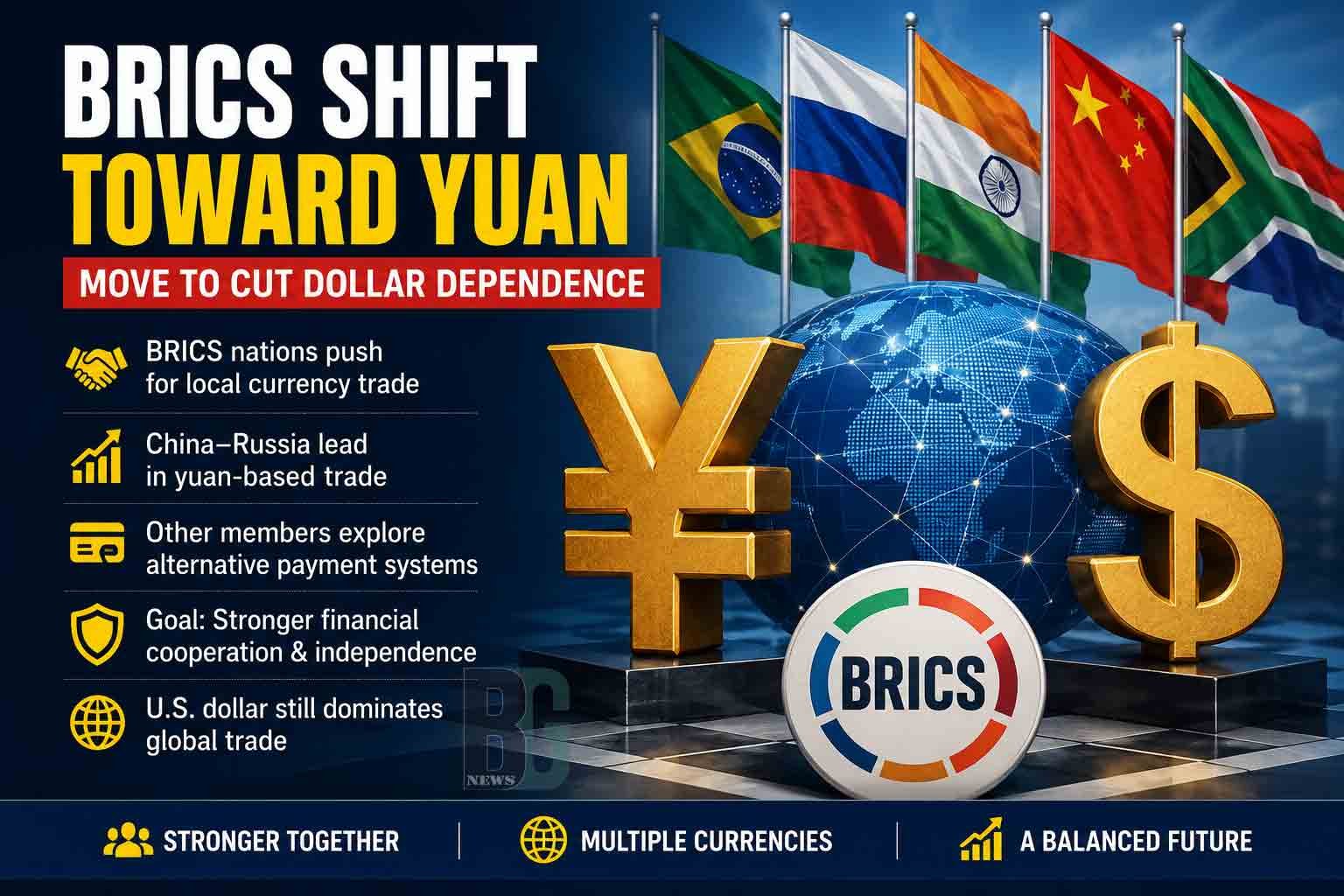
In a significant development in global economic discussions, member nations of BRICS are increasingly focusing on reducing their reliance on the U.S. dollar for international trade. Recent meetings within the bloc have highlighted a growing interest in using local currencies including China’s yuan for cross-border transactions.
The push comes as countries seek greater financial independence and resilience amid shifting geopolitical and economic dynamics. Leading this trend are China and Russia, which have already expanded the use of the yuan in bilateral trade, especially in energy and commodities. Their efforts are often cited as early examples of what a more diversified global payment system could look like.
Other BRICS members, including India, Brazil and South Africa, are also exploring mechanisms to settle trade in their own currencies. This includes discussions on improving financial cooperation, developing new payment platforms, and reducing dependence on traditional Western dominated systems.
One area of focus is the creation of alternative payment systems that can operate alongside or independently of existing global networks. While no unified BRICS currency has been officially launched, the idea continues to be discussed as part of long term economic strategy.
Despite these developments, analysts caution that the U.S. dollar remains the dominant global currency, accounting for a major share of international reserves and trade settlements. The transition toward a multipolar currency system is expected to be gradual and complex, requiring strong coordination among member nations.
Experts also note that while de-dollarisation efforts are gaining momentum, they are not aimed at completely replacing the dollar in the near future. Instead, the goal is to create a more balanced and flexible global financial system where multiple currencies can play a larger role.
Conclusion
The discussions within BRICS reflect a broader shift in the global economic landscape, where emerging economies are seeking greater control over their financial systems. While the yuan and other local currencies are gaining traction, the U.S. dollar’s position remains strong for now.