

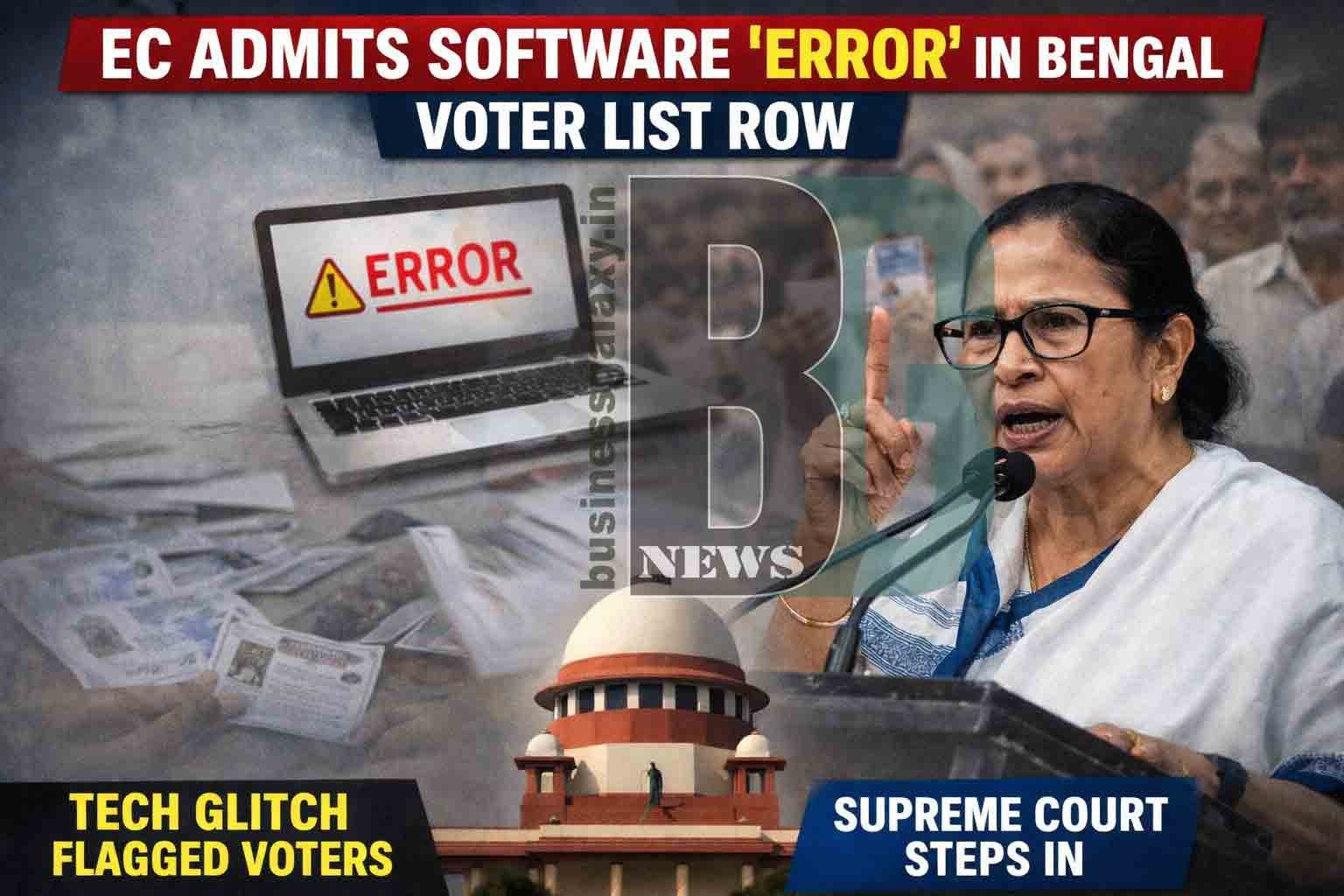
New Delhi/Kolkata: The controversy over the Special Intensive Revision (SIR) of electoral rolls in West Bengal has exposed serious weaknesses in the Election Commission of India’s (ECI) technology driven voter verification system, raising questions about administrative responsibility and the protection of citizens’ voting rights.
What the ECI Clarified and Accepted
ECI officials acknowledged that the software used to compare old and new voter data has technical limitations and often fails to understand spelling variations, regional naming styles and minor clerical differences.
As a result, the system flagged thousands of legitimate voters as “logical discrepancies,” triggering notices and verification procedures.
However, while the ECI has not officially admitted to deleting names due to error, it has accepted that:
- The software can wrongly mark genuine voters as doubtful.
- Manual verification is required to correct these errors.
- The technology cannot accurately interpret linguistic or cultural name variations.
This indirect admission has strengthened claims that automation without safeguards can harm real voters.
Supreme Court’s Decision
The Supreme Court intervened after petitions challenged the SIR process and its impact on voters.
The Court:
- Directed the ECI to be “more careful and sensitive” while issuing notices.
- Warned that minor spelling or clerical mismatches must not lead to voter exclusion.
- Stressed that the right to vote is a constitutional right and cannot be undermined by technical systems.
- Sought assurance that no genuine voter would be removed without proper human verification.
The Court’s remarks underline that technology cannot replace constitutional duty.
Who Is Responsible for Citizens Suffering?
The controversy has highlighted the human cost of administrative lapses:
- Elderly voters, migrant workers and rural residents were forced to run from office to office to prove identity.
- Many received notices without clear explanation.
- Fear spread that names could vanish from voter lists due to spelling errors.
Responsibility lies with:
- The ECI’s IT and data management system for deploying flawed matching tools.
- Field officers tasked with delivering and explaining notices.
- The absence of strong grievance redressal before launching mass revisions.
- What was meant to clean voter rolls turned into a process that shook public confidence in electoral fairness.
How This Is Important for Other States
The Bengal case serves as a warning for future SIR exercises across India:
- Other states may face similar software mismatches due to diverse languages and name spellings.
- Automated systems risk excluding poor, uneducated and digitally unaware citizens.
- Courts may step in again if voter rights are threatened.
Experts say:
“If the same software is used nationally without reform, millions could face wrongful scrutiny.”
The lesson is clear: technology must support democracy, not endanger it.
Political and Institutional Fallout
The row has sharpened political tensions, with the ruling Trinamool Congress accusing the Centre and ECI of voter suppression, while the BJP denies interference.
Yet beyond politics, the real issue remains:
👉 Can a constitutional body afford technological negligence when democracy itself is at stake?
📌 Conclusion
The Bengal SIR episode has exposed how administrative shortcuts and faulty software can disrupt the lives of ordinary citizens and damage trust in elections.
With the Supreme Court watching and the public demanding answers, the Election Commission now faces a critical test:
Fix the system, restore confidence and ensure no voter is punished for a computer’s mistake.