

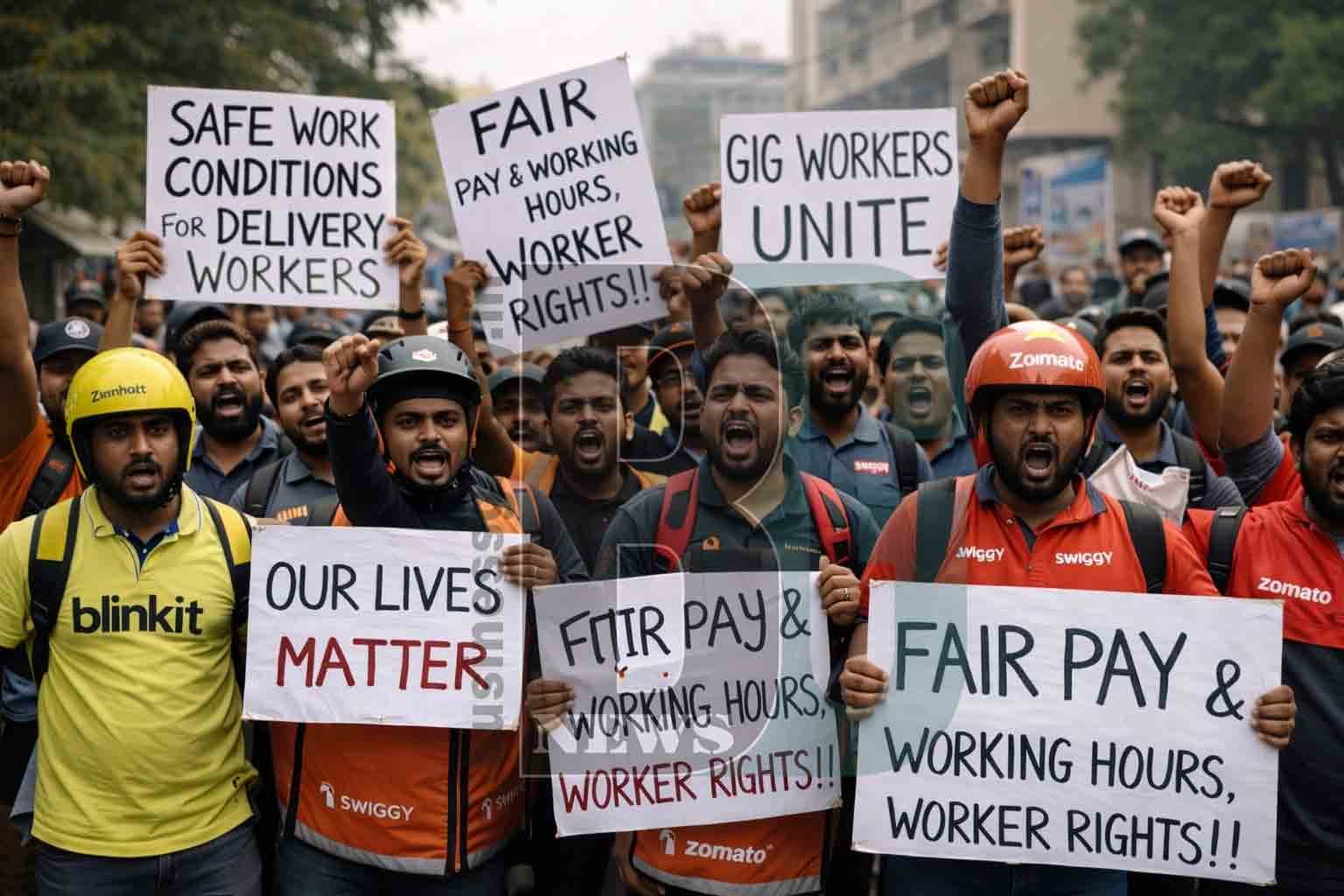
The nationwide flash strike by app based delivery workers on December 31, 2025, followed by Blinkit’s decision to withdraw its 10 minute delivery promise in the second week of January 2026, has had a significant impact on India’s gig and platform labour market. These developments have reopened debates on worker safety, employment relations and the role of collective bargaining in the rapidly growing gig economy.
The strike, which saw participation from delivery partners across multiple cities, highlighted growing dissatisfaction over working conditions, pay structures and algorithm-driven work pressures. Workers protested against long working hours, low incentives and the risks involved in meeting unrealistic delivery targets, especially under time-bound delivery models promoted by major e-commerce and food delivery platforms.
Blinkit’s reversal of its 10-minute delivery norm was seen as a direct outcome of sustained pressure from workers and labour groups. The ultra-fast delivery model had been aggressively marketed as a competitive advantage, with companies projecting speed as a symbol of efficiency and customer convenience. However, delivery workers argued that the model forced them to take unsafe routes, violate traffic rules and ignore basic safety precautions to meet strict timelines.
Although Blinkit was the first to publicly withdraw the 10 minute delivery promise, it was not the only company operating under such a framework. Other major platforms including Big Basket, Zepto, Zomato and Swiggy had also adopted similar time based delivery assurances as part of their branding strategies. Workers and labour experts warned that these policies placed disproportionate risk on delivery personnel, while companies continued to benefit from faster turnarounds and higher order volumes.
Labour rights advocates say the rollback has challenged the long standing narrative that gig work offers flexibility and independence without risks. Instead, they argue, the recent events have exposed how platform workers remain subject to strict algorithmic control while being denied formal employee status and labour protections.
“These companies treat workers as independent contractors, but their work is closely monitored and penalised if targets are not met. This blurs the line between employment and self employment,” a labour researcher said.
The developments have also revived discussions around occupational safety in the gig sector. Delivery workers frequently face road accidents, exhaustion and exposure to extreme weather conditions. With time bound delivery models, these risks are amplified. Worker unions and collectives are now demanding minimum safety standards, accident insurance, regulated working hours and transparent pay systems.
Importantly, the Blinkit decision has strengthened the belief among gig workers that collective action can bring change. While gig workers traditionally operate in isolation, recent strikes and protests suggest a shift towards organised resistance. Labour groups view this as a crucial step in building bargaining power in a sector where workers have limited legal recognition.
Government officials have acknowledged the need to study recent developments. Experts say the episode could influence future labour policy, especially regarding the classification of gig workers and their entitlement to social security benefits.
As platforms continue to expand and compete on speed and cost, workers warn that sustainability must not come at the cost of human lives. The rollback of the 10-minute delivery model has become a symbol of resistance against unsafe work practices and has forced the industry to reconsider its approach to hyper-fast delivery.
The events of late 2025 and early 2026 may mark a turning point in India’s gig economy, where worker voices are becoming harder to ignore and the question of fair and safe employment is once again in the public spotlight.