

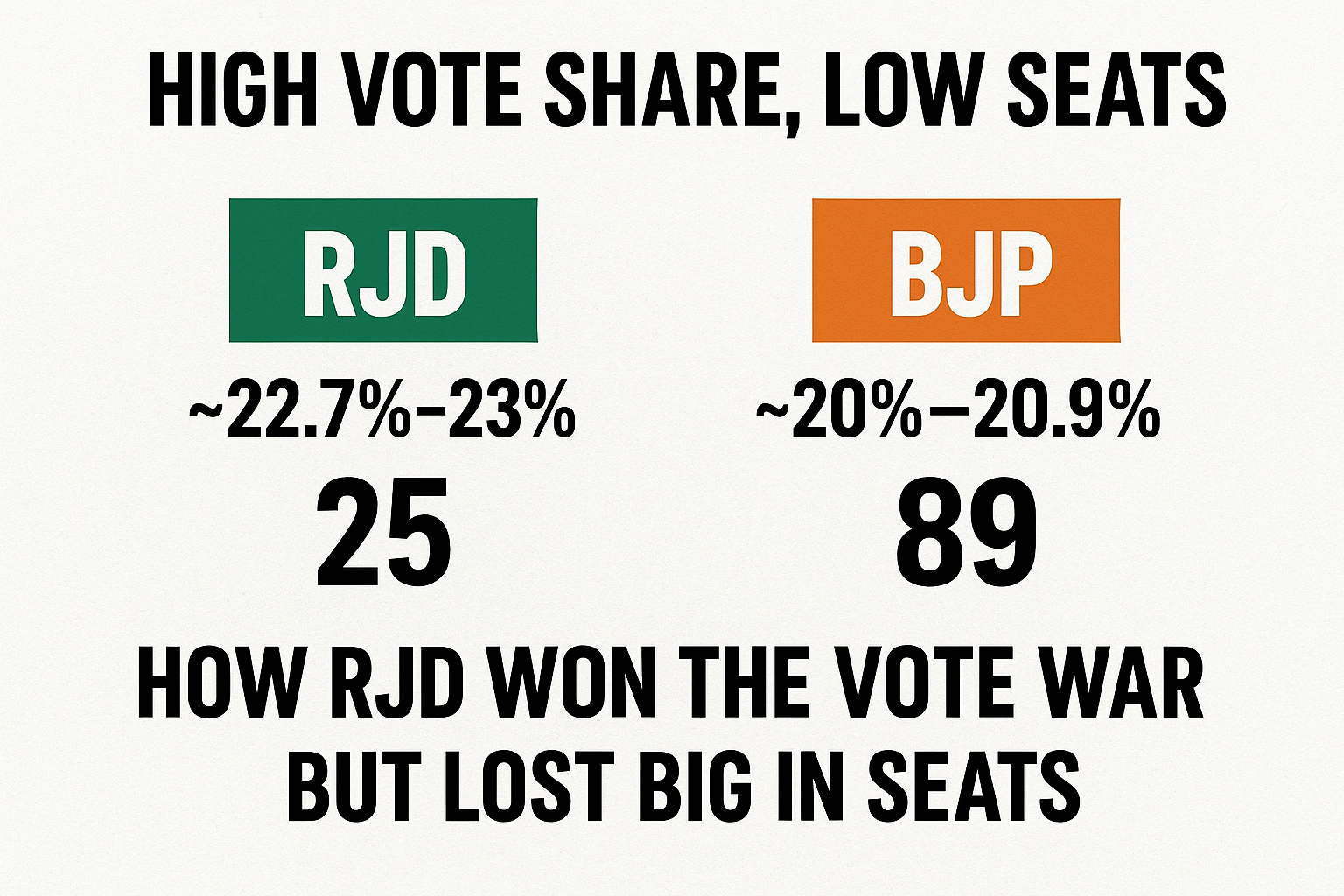
In one of the most surprising outcomes of the Bihar Assembly elections, Tejashwi Yadav’s Rashtriya Janata Dal (RJD) secured the highest vote share of any political party yet ended up with one of its lowest seat tallies in recent years. Meanwhile the BJP despite having a lower vote share, swept a massive number of assembly seats.
The result has revived a national debate on India’s First Past The Post (FPTP) electoral system and how the distribution of votes often matters more than total votes received.
RJD Won the Vote Share Battle But Not the Seat Battle
Data from the Bihar election shows that:
- RJD secured around 22.7% 23% vote share, the highest among all parties.
- BJP’s vote share was around 20% 21%, lower than RJD’s.
- Yet BJP won nearly 90 seats while RJD managed only about 25 seats.
This paradox more votes but fewer seats has sparked intense political discussion across Bihar and Delhi.
Why Did This Happen? The 5 Big Reasons
- The FPTP System: Vote Share, Seat Share
India’s electoral system awards victory to the candidate with the highest votes in each seat, not the party with the highest overall votes.
RJD got a large number of votes Across many constituencies, but often finished Second by narrow margins.
These votes add to its vote share but do not become seats. - RJD Contested More Seats
RJD contested in far more constituencies than BJP.
When a party contests more seats, even its Losing votes add to its vote percentage.
But losing votes Do not convert into legislative power.
This inflated RJD’s vote share without improving seat numbers. - Geographical Concentration of RJD Support
RJD runs strongest in specific regions and among certain demographic groups.
This leads to huge vote margins in strongholds but weaker performance elsewhere.
As a result, the party Accumulates many votes but Fails to win enough constituencies statewide. - Efficient Vote Conversion by NDA
The BJP led NDA alliance targeted constituencies strategically.
They focused on winnable seats, coordinated alliances, avoided vote splitting and ensured better booth level efficiency.
This helped NDA Convert smaller vote shares into more seats, outperforming RJD in key battlegrounds. - Fragmented Opposition Votes
Many constituencies witnessed multi cornered contests.
Opposition votes were divided between RJD, Congress, Left parties and independents.
This fragmentation resulted in NDA winning many seats with Plurality, Not majority, giving them a clear advantage.
What the Result Means Politically
1. RJD’s Support Base Is Intact
A vote share above 22% shows RJD still has deep roots and widespread support, especially among younger voters and core communities.
2. Strategy Matters More Than Popularity
The election confirms that popularity alone cannot win elections under FPTP.
Parties need precise, constituency level planning, alliance strength and targeted campaigning.
3. Lesson for the Opposition
If the opposition hopes to challenge NDA, it must:
- Coordinate alliances more tightly,
- Avoid vote splitting,
- Expand beyond traditional strongholds, and
- Focus on seat specific strategies.
4. NDA’s Organizational Strength
NDA’s disciplined ground machinery, coordinated alliance and micro level constituency management played a decisive role in translating fewer votes into more wins.
Bottom Line
The 2025 Bihar election has become a textbook case of the vote share seat share mismatch.
RJD may have won the Vote war but BJP and NDA won the Seat war and in India’s parliamentary politics, seats decide power.
This election will be remembered as a reminder that Every vote counts, but how and where it is counted matters even more.