
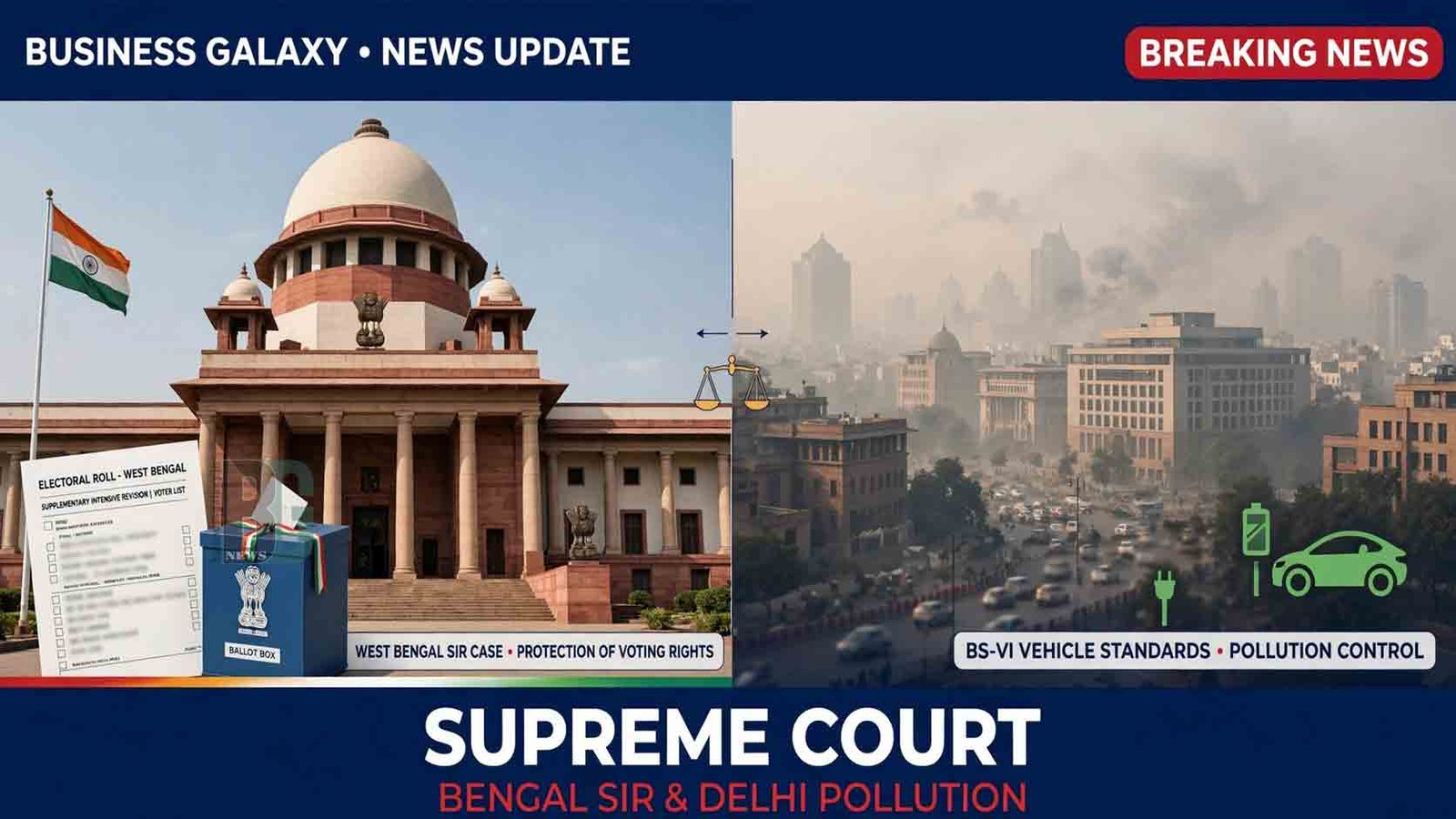
The Supreme Court of India on Monday took up two important public interest matters concerning electoral rights in West Bengal and worsening air pollution in Delhi-NCR. In the West Bengal case, the Court directed appellate tribunals to prioritise appeals filed by voters whose names were deleted from electoral rolls during the Special Intensive Revision (SIR) exercise. In a separate hearing on air pollution, the Court considered restricting vehicles operating in Delhi to those complying with Bharat Stage VI (BS-VI) emission standards.
The two developments are significant for democratic participation and environmental protection.
1. Bengal SIR: Deleted Voters to Get Priority in Appeals
A three judge bench headed by Chief Justice of India Surya Kant, along with Justices Joymalya Bagchi and V. Mohana, directed the appellate tribunals dealing with West Bengal’s SIR related disputes to prioritise appeals filed by voters whose names were removed from the electoral rolls.
The Court instructed the tribunals to divide pending appeals into two categories:
- Appeals filed by voters seeking restoration of their deleted names.
- Appeals challenging the inclusion of certain individuals in the electoral rolls.
The bench said appeals seeking restoration of deleted names should receive priority, while appeals challenging the inclusion of voters could be deferred for the time being.
The Court also gave special priority to appeals involving voters from areas under the Kolkata Municipal Corporation, considering the upcoming municipal elections.
Nearly 38.31 Lakh Appeals Pending
The scale of the dispute is reflected in the figures presented before the Court.
According to information placed before the Supreme Court:
- Approximately 38.31 lakh appeals have been filed in connection with the SIR exercise.
- Around 22.21 lakh appeals seek restoration of deleted voter names.
- Approximately 16.10 lakh appeals challenge the inclusion of names in the electoral rolls.
- Petitioners told the Court that only slightly more than one lakh appeals had been decided so far.
- Advocate Prashant Bhushan submitted that approximately 93 per cent of the appeals decided had resulted in directions favouring the restoration of deleted voters’ names.
The petitioners also highlighted that more than two lakh voters from the Kolkata Municipal Corporation area had been excluded and that their appeals were still pending.
Supreme Court Asks Election Commission to Increase Tribunals
- Considering the large number of pending appeals, the Supreme Court directed the Election Commission of India (ECI), in consultation with the Chief Justice of the Calcutta High Court, to increase the strength of the appellate tribunals.
- The Court also asked the Election Commission to identify alternative premises in different parts of Kolkata to make the appeal process more accessible and facilitate faster disposal of cases.
- During the hearing, senior advocate Gopal Sankaranarayanan questioned the legal authority behind appeals filed by officials from the West Bengal Chief Electoral Officer’s office challenging the inclusion of voters.
- However, the Court did not give a final ruling on that legal question. It directed that such inclusion related appeals be deferred for the time being.
- The latest directions aim to ensure that voters whose names have been deleted receive an opportunity to have their cases examined without unnecessary delay.
2. Delhi Pollution: Supreme Court Considers BS-VI Only Vehicle Policy
- In a separate hearing concerning air pollution in Delhi-NCR, the Supreme Court indicated that it was considering allowing only vehicles complying with Bharat Stage VI (BS-VI) emission standards to operate in the national capital.
- The bench headed by Chief Justice Surya Kant, along with Justices Joymalya Bagchi and V. Mohana, discussed stricter measures to address recurring air pollution and vehicular emissions.
- The Court also proposed a five year plan to gradually keep commercial vehicles out of Delhi by shifting goods unloading facilities to warehouses located near the city’s borders.
- Under the proposed arrangement, commercial vehicles could unload goods at these facilities, while smaller battery operated or other non-polluting vehicles could transport essential commodities into the city.
- The proposal aims to reduce emissions from heavy commercial vehicles without disrupting the supply of essential goods, including vegetables, fruits and other daily necessities.
Important clarification: The BS-VI only restriction and the five-year commercial vehicle plan were discussed as possible measures during the hearing. They should not be interpreted as an already implemented blanket ban.
Wider Significance
- The two proceedings highlight important challenges facing India.
- The West Bengal SIR matter concerns the protection of electoral rights and the need for an effective appeal mechanism for citizens whose names have been removed from voter lists.
- The Delhi pollution matter highlights the need for long term environmental planning, cleaner transportation and stronger measures to control vehicular emissions.
- Both developments demonstrate the Supreme Court’s involvement in matters directly affecting citizens democratic rights, public health and quality of life.
Source: Supreme Court proceedings dated November 23, 2026