
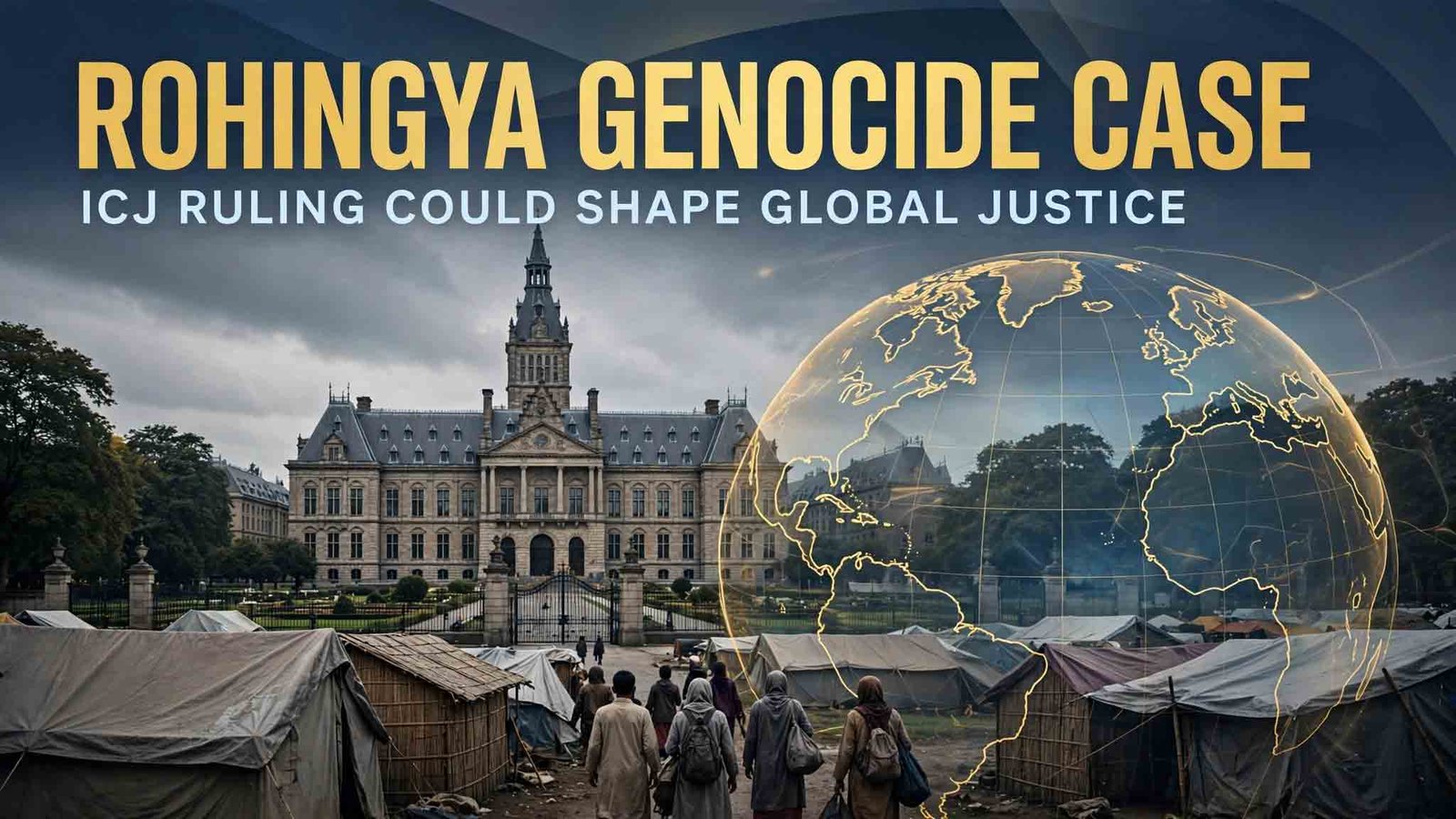
The International Court of Justice (ICJ), the United Nations highest judicial body, is set to deliver a landmark judgment on November 19, 2026, in a case accusing Myanmar of committing genocide against its Rohingya Muslim minority during the military crackdown in 2017.
The ruling, brought by The Gambia under the 1948 Genocide Convention, could become a defining moment for international justice and the long-running struggle of Rohingya refugees seeking recognition, accountability and the right to return to their homeland.
The judgment is scheduled to be delivered at the Peace Palace in The Hague, Netherlands.
Background: What Happened to the Rohingya?
- In August 2017, Myanmar’s military launched a major security operation in Rakhine State following attacks by Rohingya insurgents on security posts.
- The military campaign was accompanied by reports of widespread killings, sexual violence, village burnings and other serious abuses, according to United Nations investigators.
- More than 700,000 Rohingya fled across the border into Bangladesh to escape the violence. They joined others who had previously been displaced, creating one of the world’s largest refugee crises.
- Approximately 1.2 million Rohingya refugees remain in Bangladesh, many living in overcrowded camps in Cox’s Bazar, with limited access to stable livelihoods, education and essential services.
How Did the Case Reach the International Court of Justice?
- In November 2019, The Gambia filed a case against Myanmar at the ICJ, alleging violations of the 1948 Convention on the Prevention and Punishment of the Crime of Genocide.
- The Gambia argued that Myanmar had failed to prevent and punish genocidal acts against the Rohingya population.
- In January 2020, the ICJ ordered Myanmar to take provisional measures to prevent acts prohibited under the Genocide Convention, preserve evidence and submit regular reports on compliance.
- In July 2022, the Court rejected Myanmar’s preliminary objections and confirmed that it had jurisdiction to hear the case.
- The main hearings on the merits took place from January 12 to January 29, 2026.
What Will the International Court Decide?
- The central legal question is whether Myanmar’s actions against the Rohingya constituted genocide under the 1948 Genocide Convention.
- To establish genocide, the Court must assess whether prohibited acts were committed with the specific intention of destroying, in whole or in part, a protected national, ethnic, racial or religious group.
- This requirement of proving specific genocidal intent is one of the most difficult elements in international genocide cases.
- Myanmar has rejected the allegations, describing the military operation as a legitimate counterterrorism response. The Gambia has argued that Myanmar bears responsibility for violations of the Genocide Convention.
What Could the Ruling Mean for Rohingya Refugees?
The judgment could have significant consequences for the approximately 1.2 million Rohingya refugees living in Bangladesh.
- International Recognition and Justice
A finding that Myanmar committed genocide would provide important legal recognition of the suffering experienced by the Rohingya community and establish Myanmar’s international responsibility. - Possibility of Reparations
The Gambia has requested reparations for victims and other remedies, including measures addressing the rights of the Rohingya community. - Right to Return
The case also seeks recognition of the Rohingya’s right to return to Myanmar. However, a court ruling alone cannot guarantee their safe return. Security, citizenship rights, freedom of movement and living conditions in Rakhine State would remain critical issues. - Continued International Pressure
A judgment against Myanmar could increase diplomatic and international pressure for accountability, protection of the Rohingya and implementation of the Court’s orders.
However, the ruling will not automatically end the refugee crisis or provide immediate resettlement.
Why Is This Case Important for Future Genocide Cases?
The judgment is expected to attract international attention because it could influence how international courts interpret and apply the Genocide Convention in future cases.
Legal experts will closely examine how the 15-member ICJ bench evaluates evidence, establishes specific intent and determines the responsibility of a state for alleged genocidal acts.
The decision could also provide important legal guidance for other ongoing international disputes involving genocide allegations, including:
- Israel and Gaza: South Africa has brought a separate case against Israel at the ICJ, alleging violations of the Genocide Convention in Gaza. Israel strongly denies the allegations.
- Russia and Ukraine: Ukraine has also brought proceedings involving the interpretation and application of the Genocide Convention.
The Myanmar judgment will not automatically determine the outcomes of these separate cases. However, its legal reasoning could be examined by lawyers, governments and international institutions.
Can the ICJ Enforce Its Judgment?
The International Court of Justice is different from the International Criminal Court (ICC).
- ICJ: Deals with legal disputes between states and determines whether countries have violated international obligations.
- ICC: Prosecutes individuals accused of genocide, war crimes, crimes against humanity and other crimes within its jurisdiction.
The ICJ’s judgments are final and legally binding on the parties to the case. However, the Court does not have its own enforcement force.
If Myanmar fails to comply, the matter can be brought before the United Nations Security Council, which may consider further action.
Bangladesh Hopes for Justice and Repatriation
- Bangladesh is closely watching the judgment because it continues to host a large Rohingya refugee population.
- On November 19, Bangladesh Prime Minister’s adviser on finance and planning, Rashed Al Mahmud Titumir, expressed hope that the ICJ judgment would strengthen international efforts to secure justice and create conditions for the eventual return of Rohingya refugees.
- He also called for international investment in education, healthcare and economic activities in Myanmar, particularly in Rakhine State, to help create conditions for refugees to rebuild their lives with dignity and security.
- Bangladesh has maintained that the long term solution to the refugee crisis lies in addressing the situation inside Myanmar.
What Happens Next?
- The ICJ judgment scheduled for November 19, 2026, is a significant development in the legal proceedings initiated by The Gambia.
- For Rohingya refugees, the outcome represents an important opportunity for international recognition and accountability. For the wider international community, it could provide valuable legal guidance on how states are held responsible under the Genocide Convention.
- Nevertheless, any lasting solution will require more than a legal judgment. Ensuring the safety, dignity, citizenship rights and voluntary return of Rohingya refugees will remain a major challenge for Myanmar, Bangladesh and the international community.
Source: International Court of Justice (ICJ), Reuters, Associated Press, Anadolu Agency and The Daily Star.