
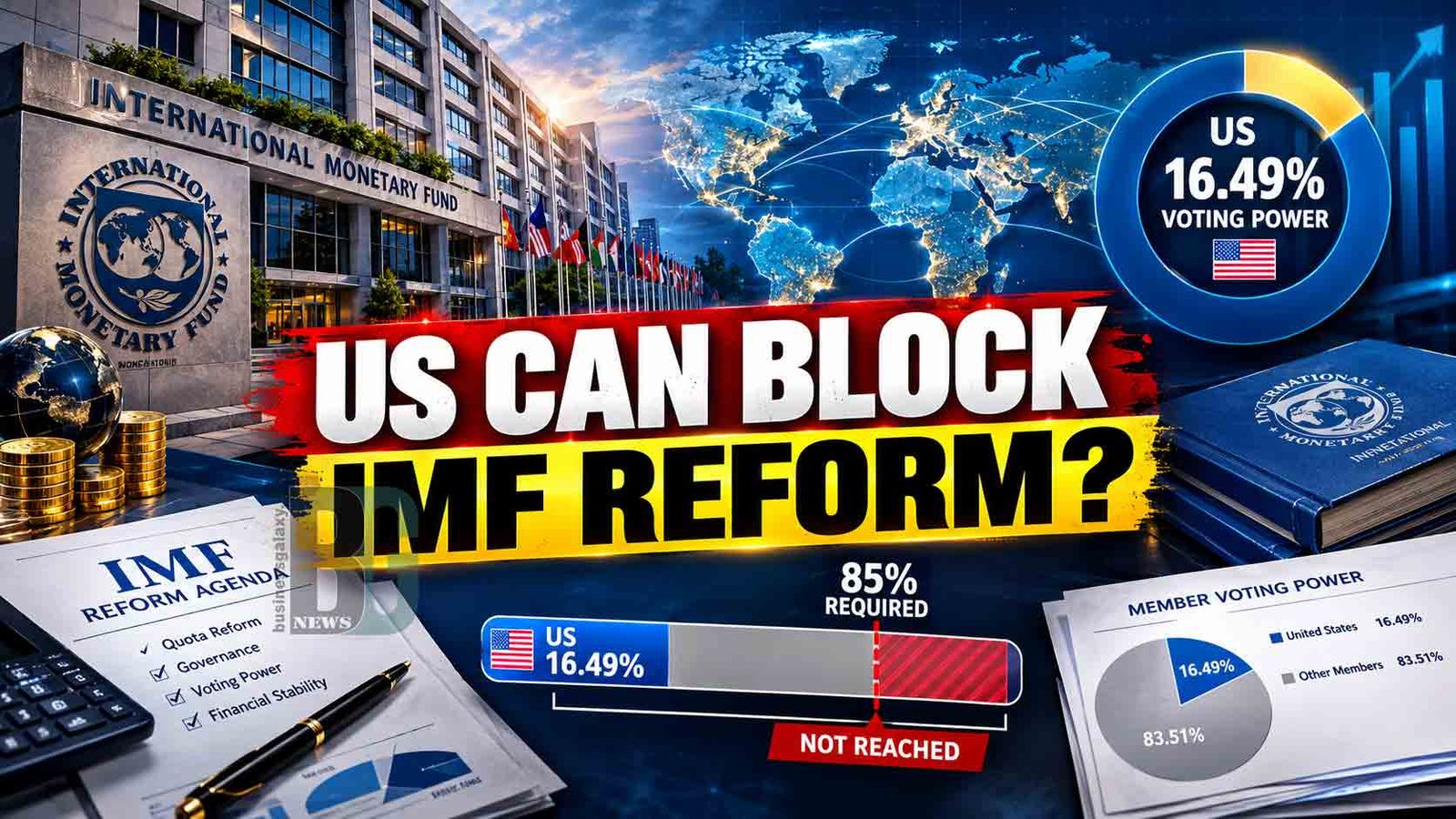
The United States holds the largest voting share in the International Monetary Fund (IMF), giving Washington significant influence over major decisions involving the global financial institution.
According to IMF voting data, the United States currently holds about 16.49% of total voting power. Japan is the second largest individual member, while other major economies including China, Germany, France and the United Kingdom also hold significant voting shares.
Why 16.49% Matters
- The IMF does not operate on a simple one-country-one-vote system. Voting power is largely linked to members quotas, which broadly reflect their position in the global economy.
- For certain major decisions, the IMF’s rules require an 85% majority of total voting power.
- Because the United States controls more than 15% of the IMF’s voting power, it can prevent an 85% majority from being reached if it votes against a proposal that requires this threshold.
- This gives the United States what is commonly described as an effective veto over certain major institutional decisions.
What Can the US Block?
- The 85% requirement applies to specific major decisions under the IMF’s Articles of Agreement. These include changes to members’ quotas and amendments to the IMF’s Articles.
- Therefore, it would be inaccurate to say that the United States can block every IMF decision.
- Most routine IMF decisions are subject to different voting requirements and cannot simply be stopped by the United States acting alone.
Debate Over IMF Reform
- The distribution of voting power has become an increasingly important issue as emerging economies have grown significantly since the current quota structure was established.
- Countries including China and other emerging economies have argued that IMF voting rights should better reflect the changing structure of the global economy.
- The debate is particularly important because quota shares influence both a country’s financial contribution and its voting power within the institution.
- A 2026 analysis of IMF governance noted that the Fund’s current reform debate faces a major institutional dilemma: meaningful redistribution of voting power could reduce the U.S. share below the level needed to retain its effective veto.
IMF Reform and the US Position
- The IMF has continued discussions on quota and governance reform. In April 2026, member countries adopted the Diriyah Guiding Principles on IMF Quota and Governance Reforms, which called for reforms that improve the Fund’s legitimacy and better reflect members changing positions in the world economy.
- However, reaching agreement on how voting shares should be redistributed remains difficult because increasing the share of one group of countries generally means reducing the relative share of others.
Why the Issue Matters
- The IMF plays a major role in the international financial system. It provides financial assistance to countries facing balance of payments problems, monitors economic conditions and provides policy advice to its members.
- Because of this role, the distribution of voting power has broader implications for global economic governance.
- The U.S. voting share reflects its historical and economic importance within the IMF, but critics argue that the institution’s governance structure does not fully reflect today’s global economic balance.
- Supporters of the current system argue that voting power should continue to reflect members financial contributions and economic weight rather than population alone.
A Continuing Global Debate
- The question of IMF governance is therefore not simply about the United States.
- It also involves the growing economic influence of countries such as China, India, Brazil and other emerging economies, as well as the representation of developing and low income countries.
- Any major restructuring of IMF voting power would require broad agreement among its members and, for decisions subject to the 85% threshold, U.S. support would be essential.