
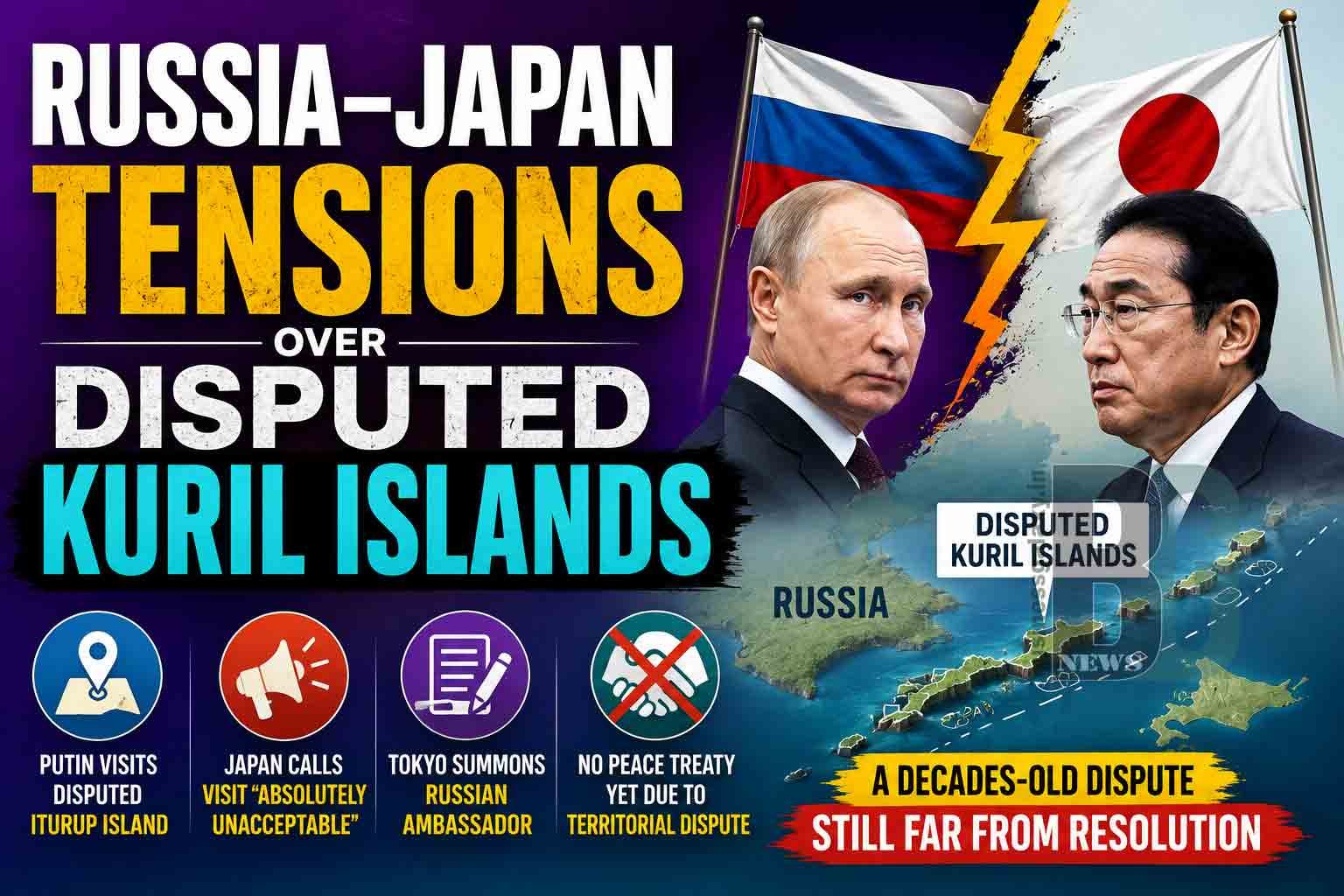
Tokyo/Moscow: Tensions between Russia and Japan have risen sharply after Russian President Vladimir Putin visited Iturup Island, one of four southern Kuril Islands controlled by Russia but claimed by Japan.
Putin’s visit on Thursday, August 13, 2026, was his first visit to the disputed Kuril Islands. The trip immediately triggered a strong protest from Tokyo and further strained already difficult relations between the two countries.
Japan Calls Putin’s Visit “Absolutely Unacceptable”
- Japanese Prime Minister Sanae Takaichi strongly condemned Putin’s visit, describing it as “Absolutely unacceptable”
- Japan maintains that the four islands Iturup, Kunashir, Shikotan and the Habomai islets are inherently Japanese territory and refers to them as the Northern Territories.
- Japan’s Foreign Minister Toshimitsu Motegi also protested the visit and Tokyo summoned Russia’s ambassador over the issue.
Why Are the Islands Disputed?
- The territorial dispute dates back to the final days of World War II.
- The Soviet Union seized the islands in 1945 following Japan’s surrender. Russia has administered the islands ever since, while Japan has continued to claim the four southern islands.
- The dispute has remained unresolved for decades and is one of the major reasons Russia and Japan have never formally concluded a World War II peace treaty.
Putin Visits Local Facilities
- During his visit to Iturup, Putin toured local facilities, including a Fish processing plant, a School and a Hospital and met local residents and regional officials.
- The visit was presented by Moscow as part of Putin’s trip to Russia’s Far East and an effort to highlight economic development in the region.
- Putin’s presence on the disputed territory also served as a strong reaffirmation of Russia’s control over the islands.
Russia Rejects Japan’s Territorial Claim
- Moscow continues to regard the islands as Russian territory and has rejected Japan’s objections.
- Russian officials have maintained that Russia’s sovereignty over the islands is based on the post World War II settlement.
- The Kremlin’s position remains fundamentally different from Japan’s claim, leaving little immediate prospect of resolving the territorial dispute.
Relations Already Under Strain
- The latest confrontation comes after relations between Moscow and Tokyo deteriorated significantly following Russia’s invasion of Ukraine in 2022.
- Japan joined Western countries in imposing sanctions on Russia and has increasingly strengthened its security cooperation with the United States and other partners.
- Russia has criticised Japan’s sanctions and its growing security alignment with Western countries.
Strategic Importance of the Kuril Islands
- The disputed islands are strategically important because of their location between the Sea of Okhotsk and the Pacific Ocean, close to Japan’s northern territory of Hokkaido.
- The wider Kuril chain also has military and economic importance for Russia, including access to fishing grounds and strategic waters.
- The islands have therefore remained much more than a historical territorial dispute, they are also linked to security and military concerns in the wider Asia Pacific region.
What Could Happen Next?
- Putin’s visit is unlikely to immediately change control of the islands, but it could further complicate already strained Russia-Japan relations.
- Japan’s strong diplomatic response shows that Tokyo continues to treat the Northern Territories issue as a major national concern.
- With Russia maintaining control and Japan refusing to abandon its territorial claim, the dispute remains one of the longest running unresolved territorial issues in East Asia.
The latest development is significant because the territorial dispute has remained unresolved since the end of World War II and has prevented Russia and Japan from signing a formal peace treaty.