
India is preparing to revise its taxation structure on tobacco and related products after the end of the GST Compensation Cess. Public health experts have urged the Centre to raise Central excise duty sharply because tobacco remains one of the nation’s deadliest addictions.
But one question keeps returning:
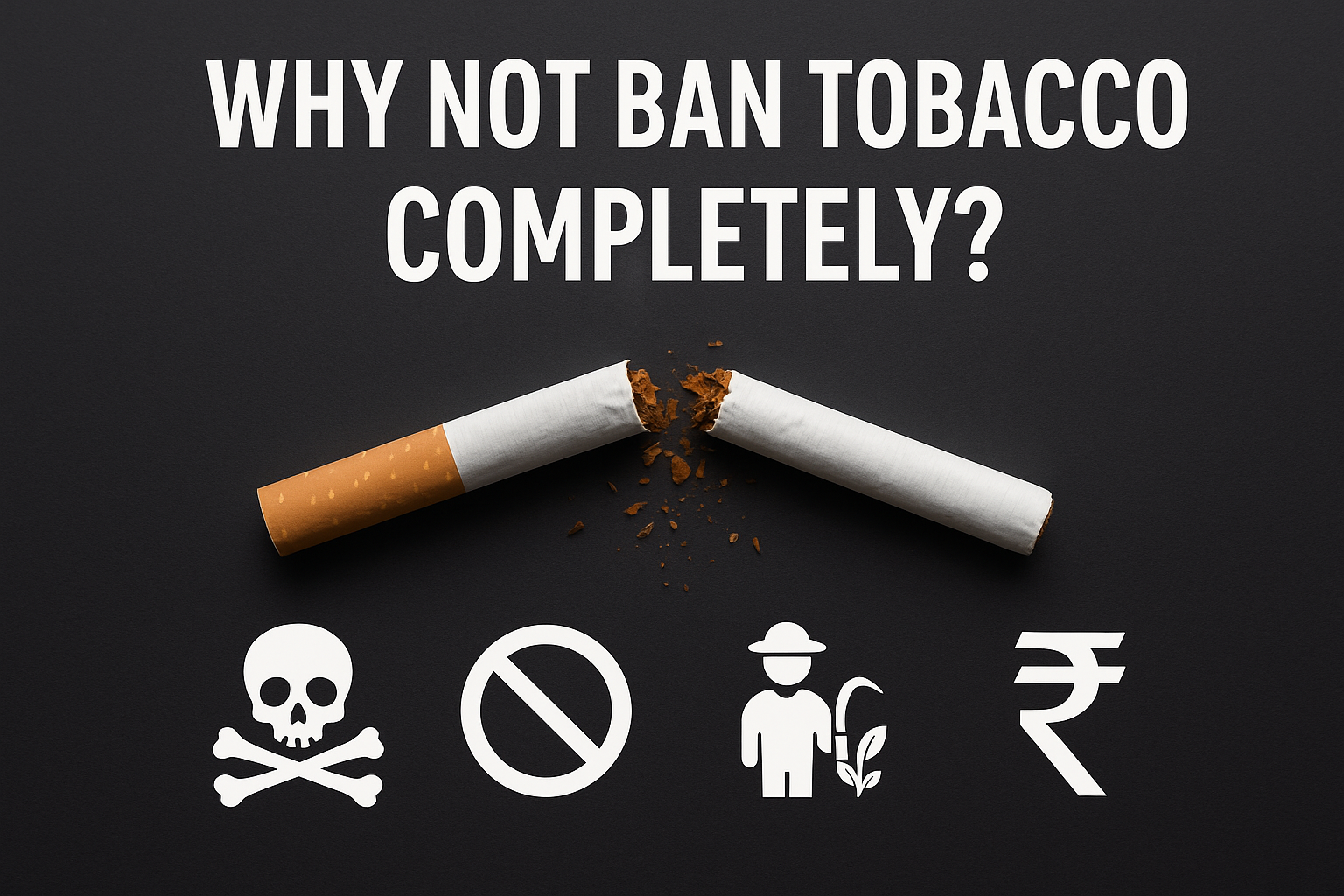
If tobacco is so dangerous and causes cancer why doesn’t the government simply ban its production?
The answer is complex, and it reveals the difficult balance between Health priorities, Economics and Ground realities.
Tobacco: A Legal Killer India Struggles to End
There is no debate about the danger. Tobacco is responsible for:
- Over 1 million deaths every year in India
- Rising cases of Oral, Lung, Stomach and Throat cancers
- Long term financial burden on families and the healthcare system
- Addictive behaviour that starts young and ruins livelihoods
Given the severe human cost, a complete ban looks morally justified. However, India’s policymakers face deeper challenges.
1. A Complete Ban Could Push Crores Into Illegal Trade
Globally, whenever tobacco was banned or heavily restricted, it led to:
- A massive Black market
- Smuggling from neighbouring countries
- Unregulated and even more harmful products
- Strengthening of criminal networks
India already struggles with illegal cigarettes. A total ban would expand this underground economy dramatically, making regulation nearly impossible.
2. Millions of Livelihoods Depend on Tobacco
Tobacco is not only a bad habit it is also a major agricultural and industrial sector.
- Around 45 lakh farmers grow tobacco across states like Andhra Pradesh, Karnataka, Gujarat and Telangana
- Another 60 – 70 lakh people work in Beedi rolling, Packaging, Transport and Distribution
- Many are women from low income households who rely on this work for survival
A sudden ban would hit these families first not the corporations.
3. Tobacco Taxes Fund India’s Healthcare & Welfare Schemes
Tobacco is among the most heavily taxed goods in India. These taxes:
- Generate Tens of thousands of crores every year
- Help fund Health programs, Cancer institutes and Social schemes
- Discourage consumption by keeping prices high
If tobacco is banned entirely, governments lose this revenue overnight.
4. Addiction Cannot Be Eliminated by Bans Alone
Most tobacco users are addicted not simply “Choosing to smoke.”
A ban would not stop addiction, it would only push it into unsafe and unregulated channels.
Public health experts warn that:
- Heavy taxes
- Strict advertising bans
- Graphic warnings
- School level awareness
- Cessation clinics
are more effective than prohibition.
5. India’s Political Reality: Minimal Public Support for a Ban
A blanket ban requires large scale public support. Yet:
- Millions use tobacco daily
- Many see it as a personal choice
- Political leaders avoid bans that may hurt certain professions or communities
Without social acceptance, a prohibition is unlikely to succeed.
The Better Path: Stronger Regulation, Not Total Ban
While a complete national ban is difficult today, India can still save millions of lives through aggressive policy reforms:
✔ Raise central excise duty sharply
Taxes should be high enough to discourage consumption, especially among youth.
✔ Support farmers to shift to alternative crops
With government incentives, tobacco farmers can move to cotton, pulses, or horticulture.
✔ Expand de-addiction centres
Every district should have accessible counselling and quit line support.
✔ Strict enforcement on illegal cigarettes
Criminal networks thrive on tax differences better surveillance is essential.
✔ School level awareness
Behaviour change begins early.
Conclusion: A Ban Sounds Simple, But Reality Is Complicated
Tobacco kills but banning it overnight may create new problems without solving the old ones.
India needs a Transition strategy, not a sudden prohibition. Higher taxes, Regulated production, Farmer support and Nationwide awareness can achieve what bans rarely do: a slow, steady decline in consumption.
The goal should not only be to punish tobacco
But to protect people.