
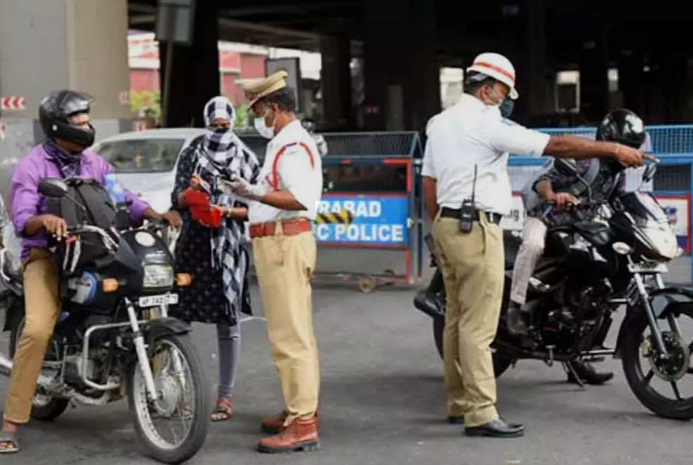
The Telangana High Court has issued a notice to the state government and police authorities regarding alleged irregularities in the functioning of the state’s e-challan system for Traffic violations. The court has questioned both Excessive fines and the practice of offering discounts on Pending Challans.
What Triggered the Case
The issue came before the court after a citizen, V. Raghavendra Chary, approached the High Court challenging a challan of ₹1,235 for triple riding on a two Wheeler.
He argued that under the Motor Vehicles Act, 1988 the fine should not exceed ₹100 ₹300. He also pointed out that the challan did not mention any legal provision, making it illegal under the Central Motor Vehicles Rules 1989.
During the hearing the court noted that even if the offence were categorized as “Dangerous Driving,” the fine should not exceed ₹1,000, and the penalty imposed was higher than allowed.
Court’s Directives
The bench headed by Justice N.V. Shravan Kumar issued key directions:
- The state and police must file a counter affidavit explaining the legal basis of the e-challan system.
- The Integrated E-Challan portal must be Upgraded Immediately to display the exact law and Penalty Provision for every challan issued.
- The court criticized the practice of issuing Discounts on Challans stating that these Weaken legal Deterrence and may encourage repeated violations.
The matter has been posted for further hearing on 9 December 2025.
What This Means for Motorists
If implemented properly, motorists across Telangana may experience significant changes:
- Challans that Do not Cite legal Provisions may be open to legal challenge.
- The public will get Clearer Information on fines through portal upgrades.
- The system may become more Transparent and less Arbitrary reducing the burden of unexpected high fines.
Broader Context
Thousands of vehicle owners in Hyderabad have complained in recent years about:
- Excessive fines
- Multiple challans for the same violation
- Errors due to camera or software glitches
The High Court’s intervention is expected to drive reforms that Prioritize Transparency, legal compliance and Fairness, instead of revenue focused enforcement.