
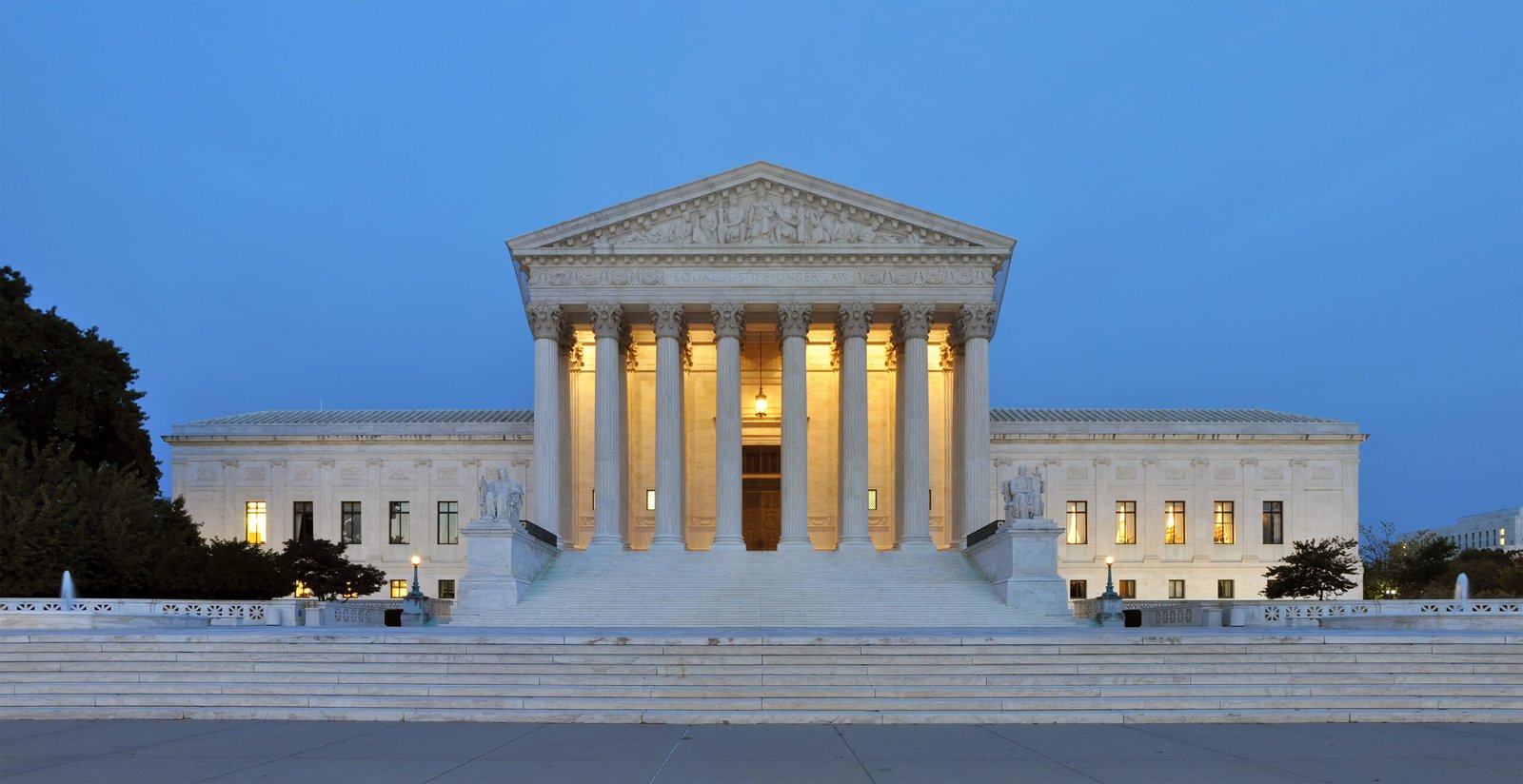
Washington, D.C.: The Supreme Court began oral arguments this week in a high stakes case that could reshape the limits of executive economic authority in the United States. At issue is the legality of sweeping global tariffs imposed by President Donald J. Trump under emergency authority a move his administration defends as vital to protecting American industry and national security.
What’s at Stake
The case consolidates several lawsuits including V.O.S. Selections, Inc. v. Trump challenging the wide ranging tariffs that the Trump administration imposed under the 1977 International Emergency Economic Powers Act (IEEPA).
Under these tariffs, hundreds of billions of dollars of imports faced duty increases. The White House argued that economic imbalances and threats to U.S. manufacturing justified emergency action.
Critics, however, contend that such tariff authority belongs exclusively to Congress under the Constitution and that the IEEPA does not clearly grant the president the sweeping power to impose taxes or tariffs on imports without legislative consent.
Courtroom Dynamics and Lines of Argument
During Wednesday’s hearing, justices from across the ideological spectrum expressed deep skepticism about the administration’s argument. The key question: are tariffs a form of tax and if so, can the president impose them without Congress?
Chief Justice John G. Roberts asked whether the levies essentially amounted to “taxes on Americans,” and if that power rests solely with Congress. Justice Sonia Sotomayor remarked,
“You want to say tariffs are not taxes, but that’s exactly what they are.”
Solicitor General John Sauer, representing the Trump administration, defended the tariffs as regulatory tools to manage foreign commerce during emergencies not revenue raising measures. He cited historical precedent, including the 1971 tariffs under President Richard Nixon, to argue that presidents have long exercised broad discretion in trade policy during crises.
Several justices, however, raised concerns under the “major questions doctrine” suggesting that if an issue carries vast economic or political significance, Congress must give explicit authorization.
Legal Context and Lower Court Rulings
Before reaching the Supreme Court, two lower courts had struck down portions of Trump’s tariff regime. The United States Court of International Trade and the Federal Circuit Court of Appeals both ruled that the IEEPA did not provide authority for such broad and indefinite tariff actions, calling them unconstitutional expansions of executive power.
Notably:
- The trade court found that the emergency declaration used to justify the tariffs was insufficient and that applying them across nearly all imports was “ultra vires and contrary to law.”
- The appeals court affirmed the ruling in August 2025 but allowed the tariffs to remain temporarily while the Supreme Court considers the case.
Potential Outcomes and Implications
The Supreme Court’s ruling expected by mid 2026 will carry major economic and constitutional consequences:
- If the tariffs are upheld, President Trump’s authority to impose sweeping trade measures under emergency powers would be strengthened, cementing executive dominance over U.S. trade policy.
- If struck down, future administrations would likely need congressional approval for similar actions, restoring more legislative control over tariffs and taxation.
Analysts warn that overturning the tariffs could cause temporary market disruption, refund claims and trade uncertainty, though limited tariffs under other trade laws would remain intact.
Broader Significance
This case extends beyond trade policy it’s a constitutional test of who controls America’s economic direction: the President or Congress. No previous president has used the IEEPA to impose global tariffs, making this a historic confrontation between the branches of government.
President Trump has described the case as “one of the most important in the history of the country,” arguing that restricting presidential authority would leave the U.S. “defenseless in the face of unfair foreign practices.”
In Summary
The Supreme Court’s review of President Trump’s tariff powers could redefine the balance between Congress and the White House on economic governance. The decision will determine whether future presidents can unilaterally reshape global trade or whether such power must return to the legislature. Either way, the outcome will leave a lasting imprint on both constitutional law and international commerce.