
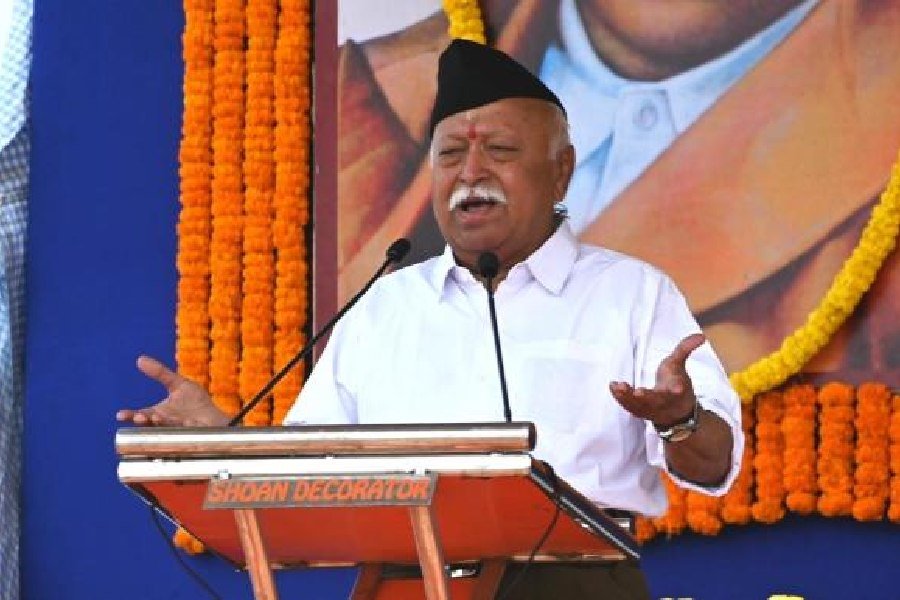
Rashtriya Swayamsevak Sangh (RSS) chief Mohan Bhagwat has said that people from all faiths, including Muslims and Christians, are welcome to join the RSS, provided they identify themselves as the children of Bharat Mata and as part of the broader Hindu society.
Speaking during a two day lecture series in Bengaluru, Bhagwat emphasized that the RSS does not discriminate on the basis of caste or religion. “Anyone who regards this land as their mother and respects its culture can be part of the Sangh,” he said, stressing that the organization’s ideology is based on cultural nationalism rather than religious identity.
“Muslims Can Join, But Once They Do”
Addressing the question of whether Muslims can join the RSS, Bhagwat clarified that the Sangh is open to everyone. However, he added a key condition that once an individual joins, they are no longer identified by their separate religious label.
“Muslims or Christians may join, but once they join the Sangh, their separate identity is kept aside. They join as part of the larger Hindu society and as children of Bharat Mata,” Bhagwat explained.
He added that within the RSS, no records are maintained of members religion or caste. “In the Sangh, we do not ask who belongs to which caste or religion. We are all one family serving the nation,” Bhagwat said.
An Attempt at Broader Outreach
Bhagwat’s remarks come as the RSS marks 100 years of its founding and continues efforts to expand its social reach beyond traditional Hindu groups. The statement is seen as part of an ongoing attempt to portray the RSS as an inclusive cultural organization rather than a purely religious one.
At the same time, the assertion that members must consider themselves part of the “Hindu society” has sparked debate. Critics argue that the condition effectively requires minorities to set aside their distinct religious identities, potentially limiting genuine pluralism within the organization.
Mixed Reactions
Political leaders and commentators have offered mixed responses. Hyderabad MP Asaduddin Owaisi criticized Bhagwat’s statement, calling it “Hypocritical,” and argued that the RSS’s idea of unity erases religious diversity.
Supporters of Bhagwat, however, view his remarks as a gesture of openness, emphasizing that the RSS has always upheld the idea of a united national culture beyond sectarian divisions.
Background
Founded in 1925, the RSS describes itself as a socio cultural organization devoted to nation building. Its critics, however, often accuse it of promoting a majoritarian vision. Bhagwat, who has been the Sarsanghchalak (chief) since 2009, has in recent years sought to position the RSS as more inclusive and socially modern while maintaining its core philosophy of Hindutva as a cultural identity rather than a strictly religious one.
Conclusion
Bhagwat’s statement that Muslims can join the RSS if they accept cultural nationalism as their identity underlines both the organization’s attempt at wider outreach and the continuing debate about what “inclusivity” means within the framework of the Sangh’s ideology.