

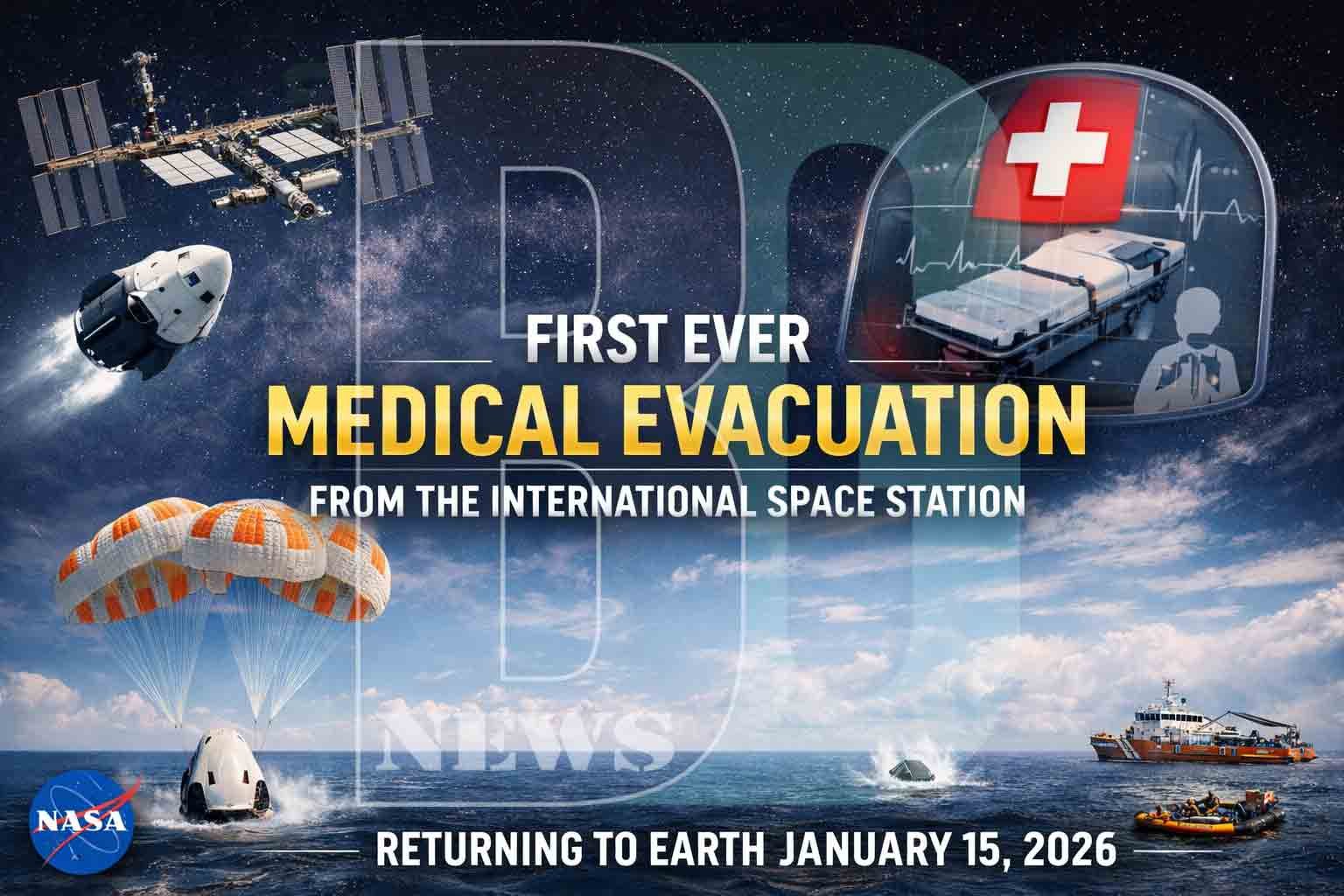
NASA has announced an unprecedented medical evacuation from the International Space Station (ISS) after one crew member developed a health issue that cannot be fully treated aboard the station. This marks the first time in the ISS’s 25 year history that a mission has been cut short for medical reasons.
Reason for Evacuation
The decision came after a medical concern arose with one of the four astronauts on SpaceX’s Crew‑11 mission, which had been expected to last six months. NASA officials say the affected astronaut is stable, but the health issue requires further evaluation and care on Earth, where medical capabilities are more comprehensive. The identity of the astronaut and specific details of the condition have not been disclosed, in accordance with medical privacy protocols.
NASA emphasized that astronaut health and safety take priority over mission objectives, and this early return reflects that policy.
Crew‑11 Mission & Return Timeline
The Crew‑11 mission includes astronauts from NASA, JAXA (Japan) and Roscosmos (Russia). The four‑person crew arrived at the ISS in August 2025 aboard the SpaceX Crew Dragon Endeavour spacecraft. Under the revised plan:
- Undocking from the ISS is scheduled for January 14, 2026.
- Splashdown off the coast of California in the Pacific Ocean is expected on January 15, 2026.
These dates may change depending on weather and recovery conditions.
Operational Changes on the ISS
Before departure, ISS crew members conducted a change of command ceremony, handing control of the station from the current commander to another experienced astronaut to ensure continuous operations after Crew‑11 leaves.
Once Crew‑11 returns to Earth, a reduced ISS crew will remain aboard the station until the next scheduled rotation arrives. NASA and SpaceX are also evaluating whether the next crew launch can be moved earlier to maintain station operations.
Significance
This evacuation highlights NASA’s commitment to astronaut welfare and preparedness for medical contingencies during long duration spaceflight. It is a historic step that underscores both the risks of human space travel and the importance of international cooperation aboard the ISS.