
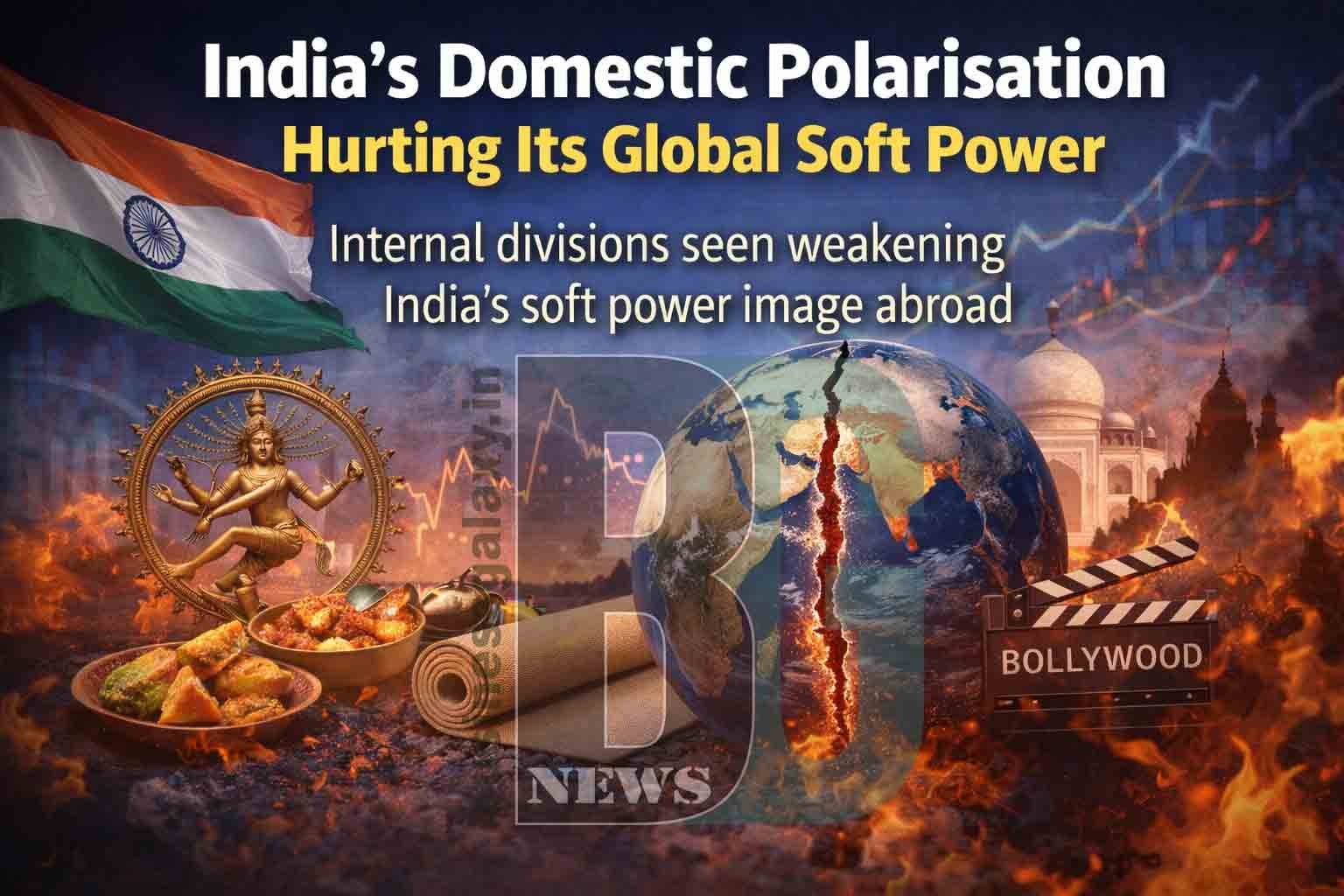
Recent political and social developments within India are increasingly drawing international attention, raising concerns that the country’s sharply polarised domestic discourse is beginning to affect its standing abroad. Analysts say internal divisions, once largely seen as a domestic matter, are now spilling into the global arena and weakening India’s ability to project influence through culture, values and reputation.
The Global Soft Power Index, which evaluates the soft power strength of 193 UN member states annually, noted in its 2025 report that a widening gap is emerging between countries with strong soft power and those struggling to maintain it. According to the index, stronger nations are improving their global perception faster, while weaker ones are falling further behind. The International Monetary Fund has also begun tracking soft power indicators across countries since 2024, signalling that reputation and influence are now being treated as measurable strategic assets.
The idea of “soft power” was introduced in the late 1980s by political scientist Joseph S. Nye Jr., who argued that a nation’s global influence does not depend solely on military strength or economic size. Cultural appeal, social values and lifestyle attractions also shape how countries are perceived. Examples such as Korean pop culture, Hollywood films, British music, yoga and Japanese martial traditions illustrate how culture can enhance a country’s global reach.
India has long sought to position itself as a soft power nation, highlighting its Music, Cuisine, Spiritual traditions, Yoga, Meditation, Pluralistic heritage and Film industry as pillars of its international image. While India does not consistently rank among the top countries in global soft power indices, it views these cultural strengths as central to its global identity and diplomatic outreach.
However, recent events suggest that some of these traditional markers of appeal are now being overshadowed by domestic political conflict. Observers note that symbols once associated with India’s cultural influence are increasingly viewed through the lens of internal divisions and political messaging, reducing their ability to generate goodwill abroad.
Experts warn that when cultural and social narratives become entangled with polarising politics, they risk losing their universal appeal. What once helped project India as an open and diverse society now faces the challenge of being interpreted as controversial or exclusionary in international discourse.
As global competition for influence intensifies, analysts argue that India’s future soft power strength will depend not only on how it promotes its culture abroad, but also on how it manages cohesion and inclusivity at home. Without addressing domestic polarisation, they caution, India may find it harder to sustain the global goodwill it has worked for decades to build.