
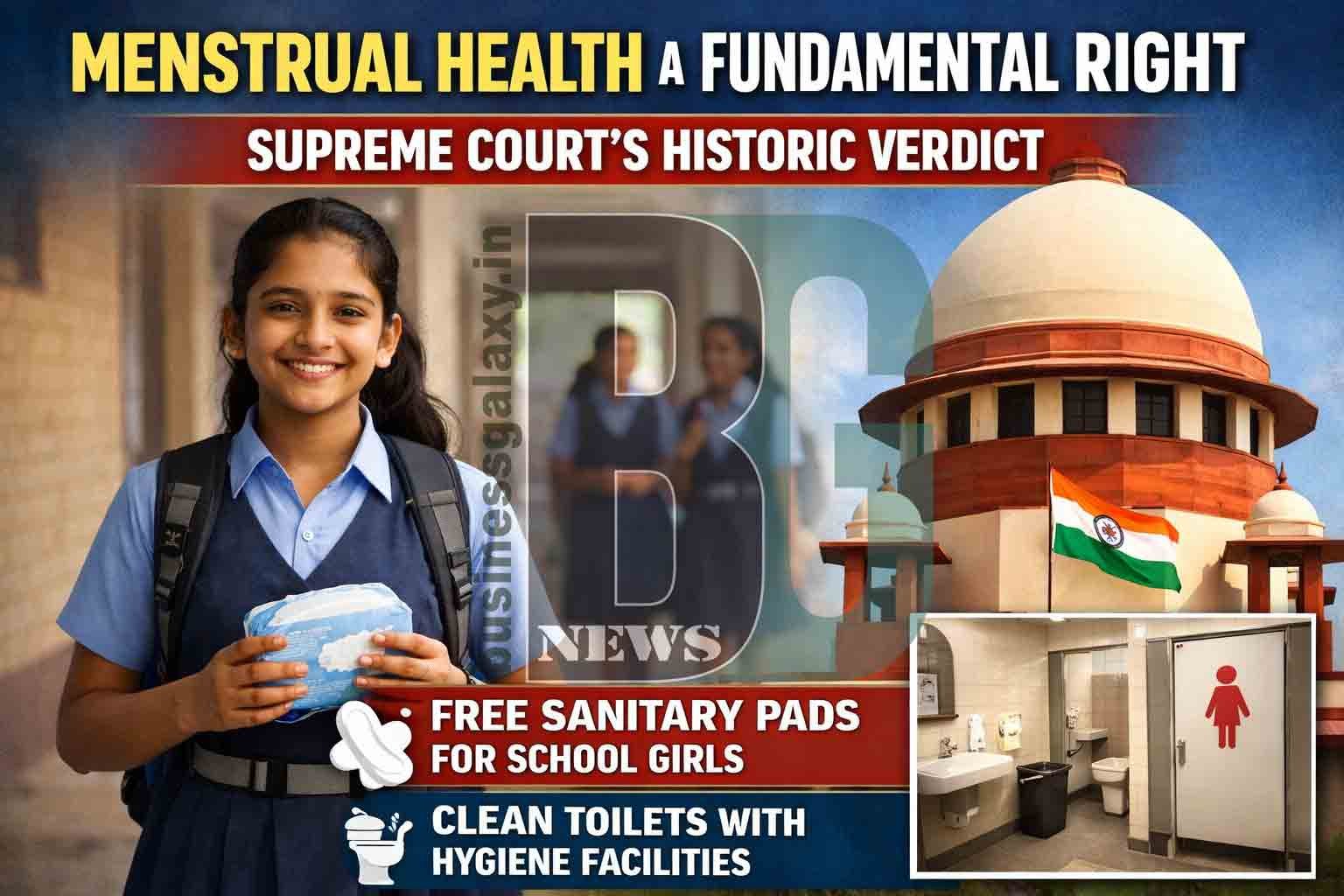
New Delhi: In a landmark judgment strengthening women’s and girls rights, the Supreme Court of India has ruled that menstrual health and hygiene are part of the Fundamental Right to Life and personal dignity under Article 21 of the Constitution. The Court also directed authorities to ensure that free sanitary pads are provided to school going girls across the country.
The Bench observed that access to menstrual hygiene products and proper sanitation facilities is essential for ensuring dignity, privacy, equality, and the right to education. It said that denying such access forces girls to skip school and suffer health risks, which violates their constitutional rights.
Court’s Key Observations
The Supreme Court stated that menstrual health is not a matter of charity or welfare alone, but a basic human right linked to the right to life and bodily autonomy. The judges noted that poor menstrual hygiene affects physical health, mental well-being, and social participation, particularly among adolescent girls from economically weaker sections.
The Court held that the State has a duty to ensure that every girl student can manage menstruation safely and with dignity while attending school.
Major Directions Issued
-
Free Sanitary Pads:
All States and Union Territories have been directed to ensure that biodegradable sanitary pads are supplied free of cost to girl students in both government and private schools. -
Separate and Hygienic Toilets:
Schools must provide separate functional toilets for girls, with running water, soap and facilities for menstrual waste disposal. Toilets must also be accessible for students with disabilities. -
Strict Monitoring:
Education departments have been instructed to monitor compliance. Schools that fail to follow these directions may face action, including cancellation of recognition or penalties. -
Implementation of Policy:
The Court emphasized effective implementation of existing menstrual hygiene policies so that benefits reach every eligible student without discrimination.
Background of the Case
The ruling came on a petition seeking uniform access to menstrual hygiene facilities for school-going girls across India. The Court noted that lack of sanitary products and clean toilets leads to absenteeism, school dropouts, and long term health problems.
It further said that menstruation should not be treated as a taboo or private burden but as a natural biological process that requires institutional support and public awareness.
Significance of the Judgment
This verdict establishes menstrual health as a constitutional right, linking it to dignity, equality and education. Legal experts believe the ruling will bring major changes in school infrastructure and health programmes nationwide.
The decision is expected to strengthen efforts to remove stigma around menstruation and ensure that no girl is denied education or health protection because of lack of basic facilities.