
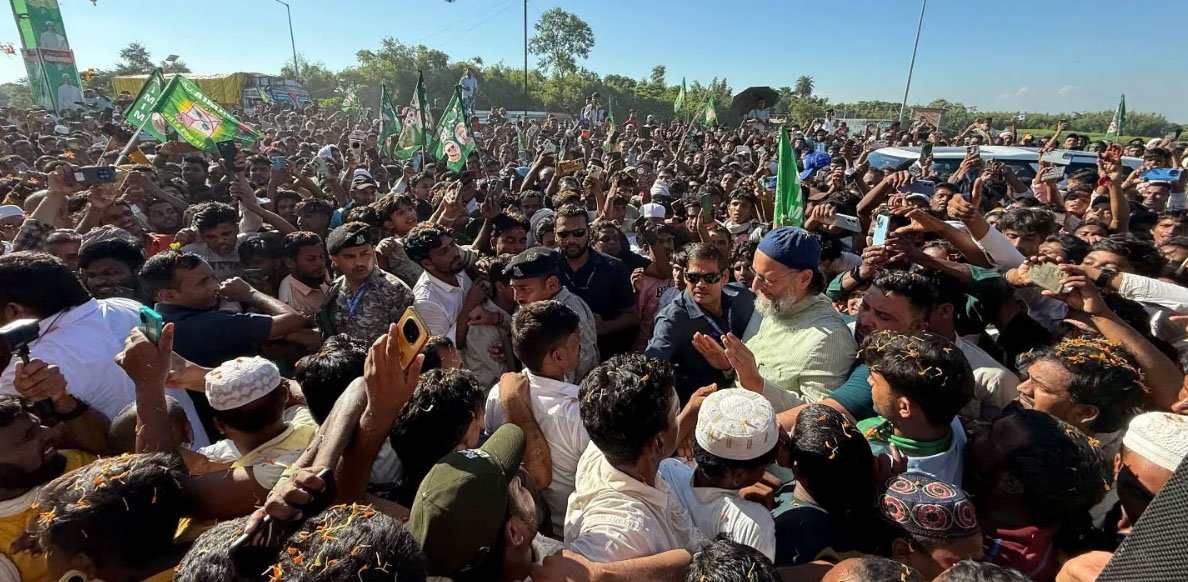
As Bihar sets its assembly polls in motion with voting scheduled on November 6 and 11, the political climate is heating up. Amid shifting alliances, candidate announcements, and voter list revisions, one party AIMIM is trying to carve its niche. Below is a detailed look at what’s unfolding in the field.
Election Machinery & Political Moves in Bihar
Election Logistics & Voter List Revision
- The Election Commission has begun the nomination process for the first phase covering 121 constituencies. Security protocols around nomination centers are tight limited entourage, videography, and restricted movement of crowds.
- The Special Intensive Revision (SIR) of the voter rolls, the first in 22 years, has been completed. The exercise involved adding new voters and purifying the rolls.
- Some districts have already declared school closures during the first phase of polling to facilitate smooth voting.
- The Bihar Election Commission has also rolled out 17 new election initiatives (like mobile deposit facilities, alternative ID documents, better voter access) aimed at enhancing the fairness and efficiency of the process.
Seat Sharing & Alliance Dynamics
- The NDA (BJP + JD(U) + allies) has finalized its internal seat sharing: Chirag Paswan’s party will get 26 seats, Jitan Ram Manjhi 8, Upendra Kushwaha 7.
- In conversations with LJP, BJP and its partners adjusted demands. LJP scaled down its demand from 35 seats to the current proposal of 26.
- On the opposition side, seat-sharing is still under negotiation among RJD, Congress, Left parties, and newcomer Jan Suraaj (Prashant Kishor’s outfit).
- In a boost to RJD, three JD(U) leaders recently defected, strengthening the Mahagathbandhan bench.
- BJP strategists are also vocal: BJP’s Giriraj Singh mocked Rahul Gandhi’s role in candidate selection via video calls, signaling confident messaging in the campaign.
Opinion Polls, Projections & Stakes
- A recent C Voter poll shows NDA holding a slight edge (40%), with Mahagathbandhan close behind (38.3%). Tejashwi Yadav emerges as the preferred chief ministerial candidate in that survey.
- Observers note that the state is still in play margins may shift with seat splits, turnout, micro-local dynamics, and alliance cohesiveness.
- Political activity is intense: in Madhepura, the administration is deploying over 20,800 election staff, registering new voters, and setting up thousands of polling booths.
AIMIM’s Bihar Strategy & Ground Moves
While AIMIM (led by Asaduddin Owaisi) is relatively small in Bihar compared to major state parties, it is making bold moves:
Candidate Selection & Controversy
- In Sherghati (Gaya district), AIMIM has nominated Shan Ali who, according to police records, faces charges in a 2016 case involving the death of a Station House Officer and is currently on bail. Party chief Asaduddin Owaisi described him as a ‘crusader against injustice,’ a remark that has drawn criticism from rival parties.
- This move signals that AIMIM is not shying from high stakes, controversial candidates a strategy that may maximize local identity politics or consolidate minority votes.
Alliance Talks & Seat Requests
- AIMIM’s Bihar leadership, led by Akhtarul Iman, has offered to join the Mahagathbandhan (RJD + Congress + allies) on condition of being allotted six seats, all in the Seemanchal region, where Muslim voter density is higher.
- But RJD and its allies appear ambivalent. While they fear vote splitting, they are cautious about conceding seats and political leverage.
- Owaisi has publicly appealed to Tejashwi Yadav and Lalu Prasad Yadav to include AIMIM without demanding ministry positions or perks though this outreach hasn’t yielded firm acceptance yet.
Past Record & Credibility Challenge
- In 2020, AIMIM won five seats in Seemanchal, but four of its MLAs defected soon afterward to RJD, leaving only one true AIMIM legislator. This history raises trust issues with voters and potential allies.
- Analysts argue that while AIMIM can act as a spoiler or vote shifter, its ability to expand beyond core Muslim-majority areas remains limited.
What’s Next & What to Watch
- Final candidate lists and seat sharing agreements will further clarify the battleground lines.
- Whether AIMIM’s conditional alliance proposals are accepted or rejected will influence whether it plays a role as ally, competitor, or spoiler.
- Turnout, especially in Seemanchal, and how well AIMIM can mobilize voters will matter.
- Election Commission monitoring, anti defection vigilance, and disciplinary enforcement will play key roles, especially to prevent post-election switching.
- The impact of defections (e.g. JD(U) leaders joining RJD) could reshape local strength in many seats formerly considered safe.