
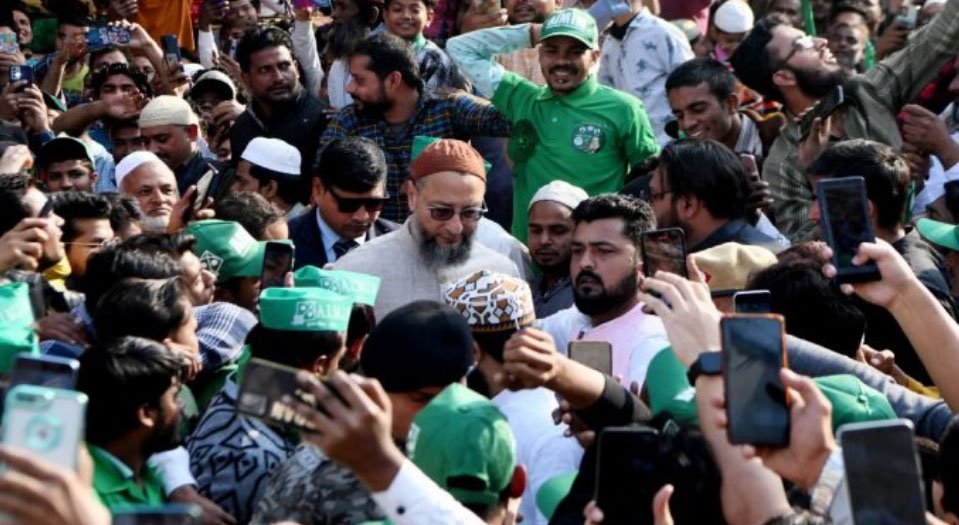
As the 2025 Bihar Assembly elections approach, the All India Majlis-e-Ittehadul Musclemen (AIMIM), led by Barrister Asaduddin Owaisi, is intensifying its efforts to expand its influence in the state. The party’s activities in Bihar are drawing significant attention, especially in regions like Seemanchal, which have substantial Muslim populations.
Campaign Initiatives and Alliance Proposals
Mr. Owaisi has initiated a four day campaign in the Seemanchal region, termed the ‘Seemanchal Nyay Yatra,’ aiming to engage with local communities and address their concerns. During his visit, he announced AIMIM’s readiness to form an alliance with the Rashtriya Janata Dal (RJD), provided the party is allocated six seats in the upcoming elections. Owaisi emphasized that excluding AIMIM from the alliance could inadvertently benefit the Bharatiya Janata Party (BJP), as it might lead to a division of secular votes.
In support of this proposal, AIMIM’s Bihar unit president, Akhtarul Iman, has formally written to RJD leader Tejashwi Yadav, requesting the party’s inclusion in the Mahagathbandhan. The letter underscores the importance of unity among secular forces to prevent vote splitting.
Political Reactions and Challenges
The proposal has sparked controversy within the political landscape of Bihar. Leaders from the RJD and its allies have expressed reservations about including AIMIM in the alliance. Critics argue that AIMIM’s presence could harm the secular vote bank, potentially aiding the BJP’s prospects. RJD spokesperson Mrityunjay Tiwari labeled AIMIM as the “B-Team of the BJP,” while JD(U) leader KC Tyagi also voiced concerns about the party’s inclusion.
AIMIM’s Independent Stance
Despite the challenges, Mr. Owaisi has reiterated that AIMIM cannot bear the sole responsibility of countering the BJP. He criticized the opposition INDIA bloc for its lack of effective strategy and leadership, suggesting that larger parties have failed to deliver results. Mr. Owaisi reaffirmed AIMIM’s commitment to advocating for marginalized communities and maintaining an independent political stance.
Conclusion
AIMIM’s activities in Bihar are reshaping the state’s political dynamics as the elections draw near. The party’s efforts to forge alliances and assert its position reflect its strategic approach to expanding its footprint in Bihar’s political arena. The unfolding developments will significantly influence the electoral landscape and the balance of power in the state.