

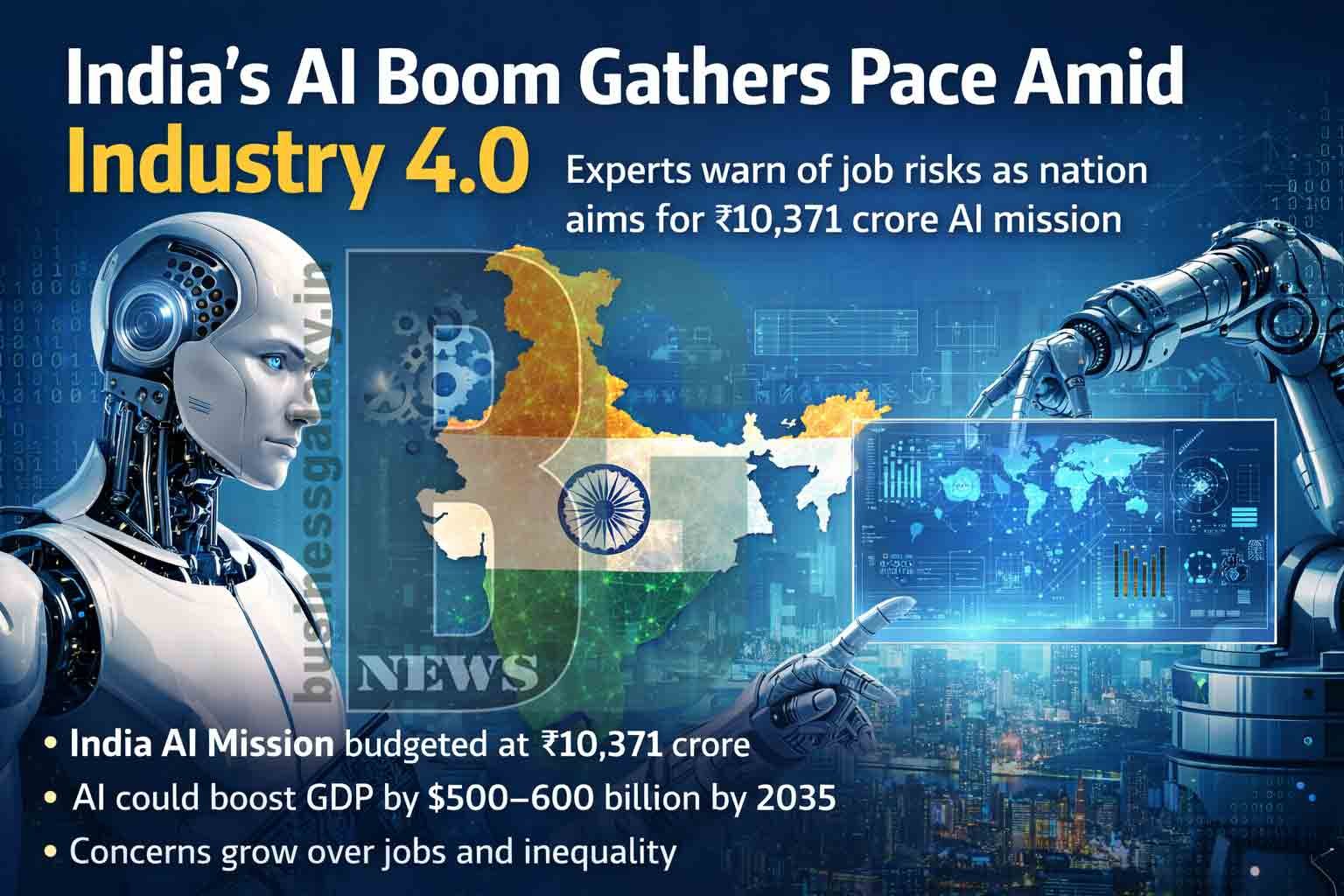
Robots and Artificial Intelligence (AI) are among the core technologies driving what is being described as the Fourth Industrial Revolution, also known as Industry 4.0. Like steam power in the first industrial revolution and electricity in the second, AI and automation are reshaping production systems, workplaces, and even daily life. However, as with earlier technological shifts, their influence extends beyond factories and offices into society and culture.
India is now counted among the fastest growing AI economies in the world, supported by a large digital population, a growing startup ecosystem and expanding computing capacity. While this rapid growth is often seen as a sign of technological progress, it has also raised an important question: should India celebrate this rise, or should it prepare for the risks that come with it?
Government Push for AI
In March 2024, the Union Cabinet approved the India AI Mission with a total outlay of ₹10,371.92 crore over five years. The mission aims to strengthen India’s AI infrastructure, promote research and innovation, and encourage the use of AI in sectors such as healthcare, agriculture, education and governance.
According to a report by NITI Aayog, the adoption of AI could add between $500 billion and $600 billion to India’s GDP by 2035, making it a major driver of future economic growth. The government has also highlighted AI as a key tool for improving public services, increasing productivity and enhancing decision-making in administration.
From Science Fiction to Daily Life
AI and robotics are no longer limited to research laboratories or science fiction films. They have entered everyday life through smartphones, online services, and automated systems used by banks, hospitals and government departments. The global release of ChatGPT in November 2022 marked a turning point by bringing generative AI into ordinary households and workplaces.
Today, AI tools are used for Writing, Translation, Customer service, Data analysis and Even creative work. Robots are increasingly visible in warehouses, manufacturing plants and logistics hubs, performing tasks that were earlier done by human workers.
Concerns Over Jobs and Inequality
Despite the promise of growth and efficiency, experts warn that AI and automation could disrupt employment, particularly in sectors that depend on routine and repetitive labour. India’s large workforce, especially in informal and low skilled jobs, could face uncertainty as machines replace certain types of human work.
The impact may be most severe for poor and marginalised communities in both urban and rural areas, where access to education and digital skills remains limited. While AI may create new jobs in technology and data services, these opportunities require specialised training that is not easily available to all.
Economists note that previous industrial revolutions created new forms of work over time, but the transition was often painful and uneven. Without strong policy support, AI-driven growth could widen the gap between skilled and unskilled workers.
Social and Cultural Effects
Beyond economics, AI and robotics are also influencing social behaviour and cultural practices. Automated decision making in welfare delivery, policing and recruitment raises concerns about bias and transparency. Increased dependence on digital tools is also changing how people communicate, learn and consume information.
In rural areas, where agriculture still supports millions of families, the use of AI in crop prediction and irrigation management offers benefits but also risks excluding small farmers who lack access to technology.
Need for Balanced Policy
Analysts argue that India’s challenge is not whether to adopt AI, but how to manage its impact responsibly. This includes investing in digital education, protecting workers through reskilling programmes, and ensuring that AI systems are transparent and accountable.
The India AI Mission includes provisions for training, ethical frameworks and public sector applications. However, experts say its success will depend on how well benefits reach ordinary citizens rather than remaining concentrated in large companies and urban centres.
Looking Ahead
Artificial Intelligence and robotics are set to play a defining role in India’s future development. They offer the potential for economic expansion, improved services and technological leadership. At the same time, they raise difficult questions about employment, inequality and social change.
As India moves deeper into the era of Industry 4.0, policymakers face a critical task: ensuring that technological progress does not leave behind those who are least equipped to adapt. Whether AI becomes a tool for inclusive growth or a source of new divisions will depend on the choices made today.