

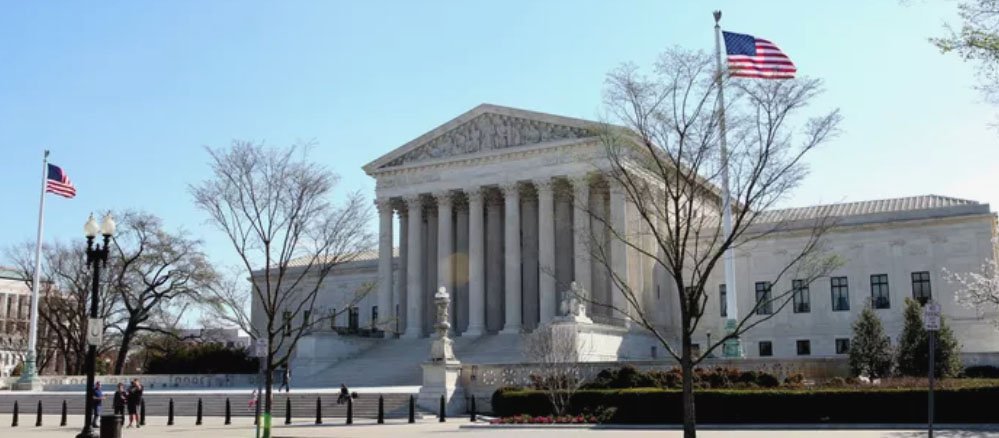
Washington, D.C.: In a day of major judicial developments, the U.S. Supreme Court handed President Donald Trump a significant legal victory by allowing his administration to enforce new rules restricting gender identification on U.S. passports. At the same time, the justices expressed sharp doubts about his use of emergency powers to impose sweeping tariffs under a decades old trade law.
Under the new directive, passport applicants must list the gender marker appearing on their original birth certificate, effectively preventing transgender and non-binary individuals from choosing an “X” or self identified gender marker. The 6 – 3 decision lifts a lower court injunction that had previously allowed self identification.
Critics called the move a serious setback for LGBTQ+ rights. “This is government imposed erasure,” said one advocacy group, accusing the administration of targeting a vulnerable community for political gain. Dissenting justices warned the ruling would cause “irreparable harm” to transgender Americans who rely on accurate identification for travel and employment.
White House officials defended the order, calling it a matter of “document integrity and international consistency.” The administration argued that gender markers must match a person’s official birth record to avoid “confusion in foreign affairs and border documentation.”
Meanwhile, in a separate hearing, the Supreme Court heard oral arguments on President Trump’s use of the International Emergency Economic Powers Act (IEEPA) to justify large scale tariffs on foreign goods. Several justices questioned whether the law gives the president authority to unilaterally alter import duties powers traditionally reserved for Congress.
Legal analysts said the outcome could reshape how much control the executive branch wields over trade policy. “If the Court limits Trump’s interpretation, it would mark one of the few judicial checks on presidential economic powers in recent history,” said trade expert Daniel Reiss.
The two cases illustrate the tension between President Trump’s aggressive executive agenda and the judiciary’s willingness to endorse or constrain it. While the passport ruling signals the Court’s alignment with Trump on social policy, the tariff challenge could become a defining test of presidential power.
Beyond the courtroom, Trump’s approval rating has slipped to its lowest point of the year, according to Newsweek, amid mounting controversy over his social and economic directives.
Summary:
- The Supreme Court allows Trump’s ban on gender self identification in passports.
- Justices raise doubts about Trump’s authority to impose tariffs using emergency powers.
- Analysts see both rulings as key indicators of how far the Court is willing to back the President’s executive reach.