
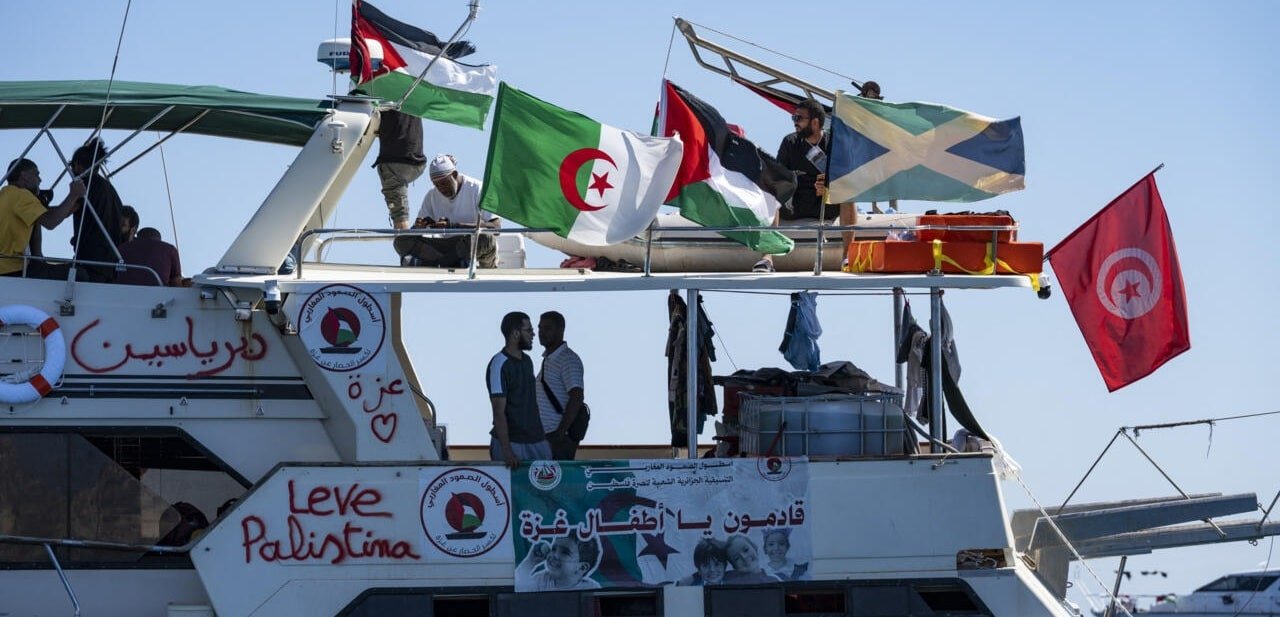
The Global Sumud Flotilla (GSF) a civilian maritime initiative launched in 2025 to challenge Israel’s naval blockade of Gaza and deliver humanitarian aid has entered a crucial, high stakes phase. With over 40 boats and around 500 activists from more than 44 nations, the flotilla carries not just relief supplies but also a message: “Break the Siege, End the Genocide.”
The Journey So Far & Key Developments
- The flotilla began its voyage in late August, with delegations departing from Barcelona, Genoa, and later Tunisia. On September 13, ships left from Tunisia’s port of Bizerte toward Gaza. Earlier, some vessels were struck by drones while docked, though no casualties were reported.
- In mid-September, as the flotilla entered what is deemed the “yellow zone” of international waters a buffer zone where conflict risk increases volunteers on board conducted training to maintain nonviolent responses in case of Israeli interception.
- Recent reports confirm that Israel’s navy has already intercepted several flotilla boats, boarded them, and detained activists. Activists say Israeli forces used aggressive maneuvers: circling boats, disabling communications systems, using water cannons, and jamming GPS signals.
- In one incident, the boat Family suffered a catastrophic engine failure off the coast of Crete and remains stranded, forcing participants to transfer to other vessels.
- Israel’s interception has already led to international condemnation. Countries including Italy and Greece have called for the safety and consular treatment of activists. Spain has also pledged diplomatic protection, rejecting Israeli threats against the flotilla and insisting on adherence to international law.
What’s Next? What More Can the 40+ Countries Do?
The flotilla’s situation raises fundamental questions about international solidarity, leverage, and moral responsibility. Here are paths that participating and supporting nations might take:
- Diplomatic Pressure & Legal Action
Countries whose nationals are onboard (or which support the mission) could bring the case before international forums such as the UN General Assembly, International Court of Justice, or the International Criminal Court, arguing that blocking civilian humanitarian aid is a violation of international humanitarian law. - Naval Escorts & Safe Passage Guarantees
Governments could provide naval or coast guard escorts in their territorial waters or launch ships to monitor and document actions by Israeli forces. Establishing “safe zones” or buffer zones backed by naval presence could help deter aggression. - Sanctions & Arms Embargo Measures
Countries can impose sanctions, travel bans, or trade restrictions against entities seen as complicit in enforcing the blockade or violating humanitarian norms, and suspend arms sales or military cooperation with Israel. - Public Advocacy & Global Mobilization
Coordinated media coverage, marches, campaigns, and diplomatic delegations could pressure governments to act. Muslim-majority nations can work through organizations such as the OIC and Arab League to demand stronger collective responses. - Humanitarian & Reconstruction Commitments
Nations can pledge funding, medical teams, and reconstruction support for Gaza after the crisis, and establish humanitarian corridors via land or air to reduce reliance solely on sea routes. - Accountability and Documentation
Deploy independent observers, journalists, and legal monitors to document abuses, detentions, and communications blackouts. Evidence can later be used in international legal forums.
Israel’s Actions & Global Silence: A Stark Reality
- While the flotilla mission captures global attention, Israel’s actions and many governments’ passivity reflect a deeper failure to uphold humanitarian norms.
- Israel claims the flotilla violates its security perimeter and enforces a naval blockade to prevent arms from reaching Hamas. Critics argue this amounts to collective punishment of civilians. The interception and detention of peaceful activists have been condemned as violations of maritime law and human rights.
- Activists describe tactics like radio hacking, drone harassment, and psychological intimidation. Despite the crisis and ongoing civilian suffering in Gaza, many Muslim majority countries have limited their responses to statements or symbolic gestures while continuing to pursue trade and diplomatic agreements with Israel.
- This inaction has drawn criticism from human rights groups and civil society organizations, who say moral leadership is being replaced by political convenience.
Final Thoughts & A Call to Action
- The Global Sumud Flotilla is not just a sea mission it’s a test of humanity’s conscience. Its fate will reveal how deeply nations commit to humanitarian principles beyond political interests.
- As the flotilla presses ahead into dangerous waters, we pray for the safety of every soul onboard. May Allah protect them and guide their mission. Their courage is a reminder that when governments falter, human conscience must prevail.
- It’s time for nations to match words with action. The world must speak not just in condemnations but in deeds to guarantee that aiding the innocent is never a crime.